Book 18: The Grief of Achilles and the Shield
Ἰλιάς · Book 18 · Classix Modern English Reading Edition
So they fought on like blazing fire, while swift-footed Antilochus came as a messenger to Achilles. He found him in front of the high-horned ships, turning over in his heart what had already come to pass. Groaning heavily, Achilles spoke to his own great heart: "Ah me, why are the long-haired Achaeans once again driven back upon the ships, routed in terror across the plain? May the gods not bring to pass the bitter griefs in my heart, just as my mother once made clear to me and told me: that while I was still alive, the best of the Myrmidons would leave the light of the sun beneath the hands of the Trojans. Surely Menoetius's brave son is dead—reckless man! Yet I ordered him, once he had beaten back the enemy fire, to come back to the ships and not fight Hector might against might."
Read Ancient Greek Source (Iliad.18.1–Iliad.18.14)
While he was weighing these things in his mind and heart, the son of noble Nestor came up close beside him, shedding hot tears, and spoke his painful message: "Alas, son of warlike Peleus, you must hear bitter news indeed—news that never should have been. Patroclus lies dead, and now they are fighting over his corpse, stripped bare, while Hector of the flashing helmet holds his armor."
Read Ancient Greek Source (Iliad.18.15–Iliad.18.21)
So he spoke, and a black cloud of grief closed over Achilles. With both hands he scooped up soot-dark dust and poured it down over his head, defiling his handsome face, and black ash settled all over his fragrant tunic. He himself stretched out in the dust at all his great length and lay there, tearing and marring his hair with his own hands. The captive women whom Achilles and Patroclus had taken as spoil, grieved to the heart, cried out aloud and ran outside around warlike Achilles; with their hands all of them beat their breasts, and the knees of each gave way beneath her. On the other side Antilochus wept, shedding tears and holding Achilles' hands while Achilles groaned from his great heart—for Antilochus feared that Achilles might slash his own throat with iron.
Read Ancient Greek Source (Iliad.18.22–Iliad.18.34)
Then Achilles gave a terrible cry, and his lady mother heard him as she sat in the depths of the sea beside her aged father, and she too cried out in lament. Around her gathered the goddesses, all the Nereids who were down in the depths of the sea. There were Glauce and Thalia and Cymodoce, Nesaea and Speio and Thoe and ox-eyed Halia, Cymothoe and Actaea and Limnoreia, and Melite and Iaera and Amphithoe and Agave, Doto and Proto and Pherusa and Dynamene, Dexamene and Amphinome and Callianeira, Doris and Panope and renowned Galatea, Nemertes and Apseudes and Callianassa; and there too were Clymene and Ianeira and Ianassa, Maera and Orithyia and Amatheia with her lovely braids, and the other Nereids who were in the depths of the sea. The bright silver cave was filled with them, and all together they beat their breasts, while Thetis led the lament:
Read Ancient Greek Source (Iliad.18.35–Iliad.18.51)
"Hear me, sister Nereids, so that all of you may listen and know well all the sorrows in my heart. Ah, wretched me, who bore the best of sons to my own sorrow! For I bore a son both faultless and strong, foremost of heroes. He shot up like a young sapling; I reared him like a tree on a rich orchard slope and sent him forth on the curved ships to Ilion to fight the Trojans; yet I shall never welcome him back again returning home to the house of Peleus. And while he lives for me and sees the light of the sun, he is in anguish, and even if I go to him I cannot help him at all. Still, I will go, to see my dear child and hear what grief has come upon him while he stays away from the fighting."
Read Ancient Greek Source (Iliad.18.52–Iliad.18.64)
So speaking, she left the cave, and the others went with her in tears, and around them the wave of the sea parted. When they came to fertile Troy, they stepped up onto the shore one after another, where the Myrmidons' ships were drawn up in close ranks around swift Achilles. As he groaned heavily, his lady mother stood beside him; with a sharp cry she cradled the head of her son, and grieving for him she spoke winged words: "Child, why are you weeping? What grief has come to your heart? Speak out, do not hide it. Indeed, those things have been fulfilled for you by Zeus, just as you prayed before when you lifted your hands, that all the sons of the Achaeans be pinned back against the sterns, needing you desperately, and suffer shameful ruin."
Read Ancient Greek Source (Iliad.18.65–Iliad.18.77)
Groaning heavily, swift-footed Achilles answered her: "My mother, the Olympian has indeed accomplished those things for me; but what joy is there in them for me now that my dear comrade is dead—Patroclus, whom I honored above all my comrades, equal to my own life? I have lost him, and Hector, who killed him, has stripped away that giant armor, a wonder to look upon, so beautiful, which the gods gave as splendid gifts to Peleus on the day they laid you in the bed of a mortal man. If only you had remained there among the immortal goddesses of the sea, and Peleus had brought home a mortal bride! But now immeasurable grief awaits your heart as well for the son you will lose, whom you will never welcome back again returning home—since my own spirit does not urge me to live on or remain among men, unless Hector is first struck down beneath my spear and loses his life, and pays the price for the slaughter of Patroclus, Menoetius's son."
Read Ancient Greek Source (Iliad.18.78–Iliad.18.93)
Then Thetis answered him, shedding tears: "Then you will be short-lived indeed, my child, by what you say; for straightway after Hector, your own doom waits ready."
Read Ancient Greek Source (Iliad.18.94–Iliad.18.96)
Groaning deeply, swift-footed Achilles answered her: "Then let me die at once, since I was not to defend my comrade when he was being killed. Far, far from his fatherland he perished, and he lacked me to save him from ruin. And now, since I shall not return to my dear native land, nor was I any light of deliverance to Patroclus or my other comrades, so many of whom have been brought down by brilliant Hector, but sit here beside the ships, a useless weight on the earth—though none of the bronze-armored Achaeans can match me in battle, while others are better in council—may strife perish from among both gods and men, and anger too, which drives even a sensible man to rage, and which, far sweeter than trickling honey, swells like smoke inside the chests of men: just so has Agamemnon, lord of men, angered me now. Still, let us leave all that in the past, however much it hurts, and master the heart in our chests, because we must.
Read Ancient Greek Source (Iliad.18.97–Iliad.18.113)
"Now I am going out to find the destroyer of the life I loved, Hector. As for my own death, I will accept it whenever Zeus and the other immortal gods choose to bring it about. Not even mighty Heracles escaped death, though he was dearest of all to Lord Zeus, son of Cronus: fate brought him down, and the bitter anger of Hera. So I too, if the same fate has been made for me, will lie still when I am dead. For now, let me win high glory, and make many a deep-robed Trojan and Dardanian woman, with both hands at her tender cheeks, wipe away the tears and sob without ceasing; let them learn how long I have stayed out of the war. Do not hold me back from battle, much as you love me; you will not persuade me."
Read Ancient Greek Source (Iliad.18.114–Iliad.18.126)
Then the goddess, silver-footed Thetis, answered him: "Yes, my child, in truth there is nothing wrong in this—warding off sheer destruction from your hard-pressed companions. But your fine armor is in Trojan hands, gleaming bronze; Hector of the flashing helmet wears it on his own shoulders and exults in it. Yet I say he will not glory in it for long, for death is close upon him. Even so, do not plunge into the grind of Ares yet, not until you see me return here with your own eyes. At dawn I will come back with the rising sun, bringing fine armor from Lord Hephaestus."
Read Ancient Greek Source (Iliad.18.127–Iliad.18.137)
So she spoke, and turned away from her son; turning to her sisters of the sea, she said to them: "Plunge back now into the broad fold of the sea, go see the Old Man of the Sea and our father's halls, and tell him everything. I am going to high Olympus, to Hephaestus the famed craftsman, to see if he is willing to give my son glorious, blazing armor." At her words, they plunged at once beneath the sea's wave, while the goddess, silver-footed Thetis, took her way to Olympus to bring glorious armor for her dear child.
Read Ancient Greek Source (Iliad.18.138–Iliad.18.147)
As her feet carried her toward Olympus, the Achaeans fled with an unearthly uproar before man-slaying Hector until they reached the ships and the Hellespont. Nor could the Achaeans in their fine leg armor pull Patroclus, the corpse of Achilles' companion, out from under the flying weapons; for once again the troops and horses overtook him, along with Priam's son Hector, like a flame in his fury. Three times glorious Hector seized him from behind by the feet, straining to drag him off, and shouted fiercely to the Trojans; and three times the two Ajaxes, clothed in furious strength, battered him back from the corpse. Yet Hector, unshaken in his strength, now lunged into the thick of the fray, and now again planted his feet with a great war cry, giving not a step of ground. Just as shepherds in the fields cannot drive a tawny lion away from a carcass when he is ravenous with hunger, so the two helmeted Ajaxes could not frighten Hector, son of Priam, away from the corpse.
Read Ancient Greek Source (Iliad.18.148–Iliad.18.164)
And now he would have dragged it away and won boundless glory, had not wind-footed, swift Iris come to the son of Peleus, running from Olympus as a messenger to tell him to arm, unknown to Zeus and the other gods—for Hera had sent her. Standing close by him, she spoke winged words: "Up, son of Peleus, most terrifying of all men! Rescue Patroclus, over whom a grim battle rages in front of the ships. Men are slaughtering one another, some fighting to defend the fallen corpse, while the Trojans charge on to drag him off to windy Ilion—and above all glorious Hector is desperate to haul him away; his heart urges him to sever the head from the tender neck and impale it on the stakes. Get up, lie there no longer! Let shame grip your heart at the thought of Patroclus becoming sport for the dogs of Troy. Yours is the disgrace if his corpse comes back defiled."
Read Ancient Greek Source (Iliad.18.165–Iliad.18.180)
Then swift-footed, brilliant Achilles answered her: "Goddess Iris, which of the gods sent you to me as a messenger?" Wind-footed, swift Iris replied: "Hera sent me, the glorious wife of Zeus; and the high-throned son of Cronus knows nothing of it, nor does any other of the immortals who dwell around snow-bright Olympus." Swift-footed Achilles answered her: "How can I go into the fighting? Those men have my armor, and my dear mother told me not to arm myself until I see her return with my own eyes; she promised to bring me fine armor from Hephaestus. I know of no other man whose glorious armor I could put on, unless it were the shield of Ajax, son of Telamon. But he himself, I am sure, is in the thick of the front ranks, killing with his spear over fallen Patroclus."
Read Ancient Greek Source (Iliad.18.181–Iliad.18.195)
Then wind-footed, swift Iris said to him: "We know full well that your glorious armor is in their hands. Even so, go to the ditch just as you are and show yourself to the Trojans, in hope that, terrified of you, the Trojans may hold back from the fighting, and the warlike sons of the Achaeans may catch their breath, hard-pressed as they are—for breathing space in war is brief."
Read Ancient Greek Source (Iliad.18.196–Iliad.18.201)
With those words swift-footed Iris departed, and Achilles, dear to Zeus, rose up. Athena flung her tasseled aegis around his mighty shoulders, and around his head the radiant goddess wreathed a cloud of gold, and from it she kindled a dazzling flame. Just as smoke rises to the bright upper air from a city far off on an island that enemies have besieged, where all day long men fight in the hateful war of Ares, fighting from their city walls; then, as the sun goes down, signal fires blaze one after another, and high up the glare shoots into the sky for their neighbors to see, in hope that they may come in their ships to save them from ruin—so the blaze from Achilles' head reached the upper sky.
Read Ancient Greek Source (Iliad.18.202–Iliad.18.214)
He strode from the wall and stood at the ditch, not mingling with the Achaeans, for he respected his mother's wise command. There he stood and shouted, and from afar Pallas Athena cried out as well, stirring up boundless panic among the Trojans. As clear and piercing as the voice of a trumpet ringing out when life-destroying enemies close in around a city, so clear and piercing rang the voice of Aeacus's grandson. When the Trojans heard the brazen voice of Aeacus's grandson, every heart was shaken, and the sleek-maned horses wheeled their chariots back, foreseeing disaster in their hearts. The charioteers were struck with terror when they saw the tireless fire burning terribly above the head of the great-hearted son of Peleus—the fire that the bright-eyed goddess Athena kept ablaze. Three times across the ditch brilliant Achilles shouted aloud, and three times the Trojans and their renowned allies were thrown into confusion. Right then and there twelve of their finest men perished amid their own chariots and spears.
Read Ancient Greek Source (Iliad.18.215–Iliad.18.231)
Meanwhile the Achaeans, gladly drawing Patroclus out from under the flying weapons, laid him on a bier, and his dear companions stood around him weeping; and swift-footed Achilles followed among them, shedding hot tears when he looked upon his faithful companion lying on the litter, mangled by sharp bronze—the man he had sent out with horses and chariot into the war, and never welcomed back again. Then ox-eyed Queen Hera sent the tireless Sun to return, unwilling, to the streams of Ocean. The sun went down, and the brilliant Achaeans rested from the fierce clash of battle and the war that levels all.
Read Ancient Greek Source (Iliad.18.232–Iliad.18.242)
On the other side, the Trojans, pulling back from the fierce combat, unyoked the swift horses from under their chariots and gathered in assembly before giving a thought to supper. They held the assembly standing on their feet, and no man dared to sit, for trembling held them all because Achilles had appeared again after staying so long away from the painful fighting. Wise Polydamas, son of Panthous, was the first to speak among them, for he alone looked both ahead and behind. He was Hector's companion, and they were born on the same night, yet one excelled far more in words, the other with the spear. With good intent toward them he spoke and addressed the assembly:
Read Ancient Greek Source (Iliad.18.243–Iliad.18.253)
"Weigh both sides carefully, my friends. For my part, I urge you to go back to the city now, and not wait for bright dawn out on the plain beside the ships; we are far from the wall. As long as this man raged against brilliant Agamemnon, the Achaeans were easier to fight, and even I was glad to camp overnight beside the swift ships, hoping we would capture the curved vessels. But now I am terribly afraid of the swift-footed son of Peleus. Fierce and overbearing as his spirit is, he will not be content to stay on the plain, where Trojans and Achaeans share the fury of Ares between them on middle ground, but he will fight to take our very city and our women. Come, let us go to the city—listen to me, for this is what will happen. For now, immortal night has stopped the swift-footed son of Peleus; but if he catches us still here when he charges out tomorrow in his armor, a man will know him all too well. Anyone who escapes will be glad to reach sacred Ilion, while dogs and vultures will devour many of the Trojans—may such news stay far from my ears! But if we heed my words, troubled though we are, through the night we will keep our strength together in the assembly place, while the towers and high gates, and the long, well-planed planks fitted to them and bolted fast, will guard the city. Early at dawn, armed in our battle gear, we will take our stand along the towers. It will be the worse for him, if he chooses to come from the ships and fight us around the wall. Back again to the ships he will go, once he has given his high-necked horses their fill of every kind of running, driving wildly beneath the city. His spirit will not let him storm inside, nor will he ever sack it; before that, swift dogs will devour him."
Read Ancient Greek Source (Iliad.18.254–Iliad.18.283)
Glaring at him from under his brows, Hector of the flashing helmet answered: "Polydamas, what you say is no longer welcome to me, telling us to go back and be penned inside the city. Have you not had enough of being cooped up behind the towers? In the old days, mortal men one and all used to call Priam's city rich in gold and rich in bronze; but now the fine treasures have vanished from our houses, and many possessions have been sold away to Phrygia and lovely Maeonia, since great Zeus grew angry. But now, when the son of crooked-counseling Cronus has granted me to win glory at the ships and pin the Achaeans against the sea, fool, do not air such thoughts before the people any longer. Not one of the Trojans will obey you, for I will not allow it. Come then, let us all do as I say. Take your supper now throughout the army, company by company, keep to your watches, and let every man stay awake. And any Trojan who is overly anxious about his possessions, let him gather them up and give them to the troops to consume in common; it is better for one of our own men to enjoy them than the Achaeans. Early at dawn, armed in our battle gear, let us stir up sharp Ares beside the hollow ships. And if in truth brilliant Achilles has risen beside the ships, it will be the worse for him, if he chooses to fight. I for one will not flee him out of the grim-sounding war, but right face to face I will stand against him, whether he wins great victory or I win it. Enyalius is impartial, and kills even the man who means to kill."
Read Ancient Greek Source (Iliad.18.284–Iliad.18.309)
So Hector spoke, and the Trojans roared their approval—fools, for Pallas Athena had taken away their wits. They cheered Hector, who gave disastrous counsel, and no one praised Polydamas, who had set forth a sound plan. Then they took their supper throughout the camp; but the Achaeans all night long groaned and wailed in mourning for Patroclus. Among them the son of Peleus led the vehement lament, laying his man-slaying hands on the chest of his companion, groaning heavily again and again, like a bearded lion whose cubs a deer-hunter has stolen away out of a dense forest; coming back too late, the lion grieves, and ranges through many glens, tracking the man's footprints in hope of finding him somewhere, for bitter rage seizes him. So Achilles, groaning deeply, spoke among the Myrmidons:
Read Ancient Greek Source (Iliad.18.310–Iliad.18.323)
"Ah, what an empty word I let fall on that day when I comforted the hero Menoetius in the halls! I told him I would bring his famous son back to Opoeis once he had sacked Ilion and won his share of the plunder. But Zeus does not fulfill all the plans of men; for we are both fated to redden the same earth right here in Troy, since I too shall never return home to be welcomed in the halls by the old charioteer Peleus or by my mother Thetis, but the earth will hold me here. Yet now, Patroclus, since I go beneath the earth after you, I will not give you burial until I bring back here the armor and the head of Hector, your great-hearted killer; and before your pyre I will slit the throats of twelve splendid sons of the Trojans, enraged over your killing. Until then, you will lie just as you are beside my curved ships, and around you Trojan and Dardanian women in deep-folded robes will weep night and day, shedding tears—women we two won by our own toil, by our strength and long spears, when we sacked the rich cities of mortal men."
Read Ancient Greek Source (Iliad.18.324–Iliad.18.342)
So speaking, brilliant Achilles ordered his companions to set a great tripod cauldron over the fire, so that as quickly as possible they might wash the clotted blood from Patroclus. They set the bath-heating tripod over the blazing fire, poured water into it, and took wood and kindled it underneath. The fire licked around the belly of the tripod, and the water grew hot. Once the water boiled in the gleaming bronze, they washed him then and anointed him richly with olive oil, and filled his wounds with ointment aged nine years. Laying him on a bier, they covered him in soft linen from head to foot, and over that with a white shroud. Then all night long around swift-footed Achilles the Myrmidons groaned and mourned for Patroclus.
Read Ancient Greek Source (Iliad.18.343–Iliad.18.355)
Meanwhile Zeus spoke to Hera, his sister and wife: "So you have done it at last, ox-eyed Queen Hera: you have roused swift-footed Achilles. Truly the long-haired Achaeans must have been born from you yourself." Then ox-eyed Queen Hera answered him: "Dread son of Cronus, what a thing to say! Even a mortal man will accomplish his purpose against another man, though he is only mortal and does not know such counsels as ours. How then was I—who claim to be the highest of goddesses, both by birth and because I am called your wife, while you rule among all the immortals—not bound in my anger against the Trojans to stitch ruin for them?" So they spoke such words to one another.
Read Ancient Greek Source (Iliad.18.356–Iliad.18.368)
Meanwhile silver-footed Thetis came to the house of Hephaestus, imperishable, starry, shining out among the immortals, built of bronze, which the club-footed god had made himself. She found him sweating as he wheeled about his bellows in eager haste; for he was forging twenty tripods in all to stand along the wall of his solidly built hall. He had set golden wheels beneath the base of each one, so that of their own accord they might enter the assembly of the gods and roll back home again, a wonder to behold. They were finished thus far, but the intricately wrought handles were not yet attached; he was fitting these now and hammering out the rivets. While he was laboring at these with his skilled mind, the goddess, silver-footed Thetis, came near to him.
Read Ancient Greek Source (Iliad.18.369–Iliad.18.381)
Charis of the shining veil stepped forward and saw her—lovely Charis, whom the famous lame god had wed. She clasped her hand, spoke to her, and addressed her by name: "Why, Thetis of the trailing robe, do you come to our house, honored and dear as you are? In the past you have not come often. Come inside, so that I may set hospitality before you." So speaking, the shining goddess led her further in. Then she seated her on a silver-studded chair, beautiful and artfully wrought, with a footstool beneath her feet, and called to Hephaestus, the famed craftsman, and said to him: "Hephaestus, come out here; Thetis has need of you for something."
Read Ancient Greek Source (Iliad.18.382–Iliad.18.392)
Then the famous lame god answered her: "Truly a dread and revered goddess is inside my house, she who saved me when pain overtook me after I fell far down by the will of my dog-eyed mother, who wanted to hide me away because I was lame. Then I would have suffered anguish in my heart, had not Eurynome and Thetis taken me into their embrace—Eurynome, daughter of backward-flowing Oceanus. With them for nine years I forged many intricate works of bronze: brooches, curved spirals, flower-cup pendants, and necklaces, inside a vaulted cave, while around us the stream of Oceanus flowed infinite, roaring with foam; and no one else knew of it, neither among the gods nor among mortal men, but only Thetis and Eurynome knew, the ones who saved me. Now she has come to our house; therefore I must by all means pay Thetis of the lovely braids the full price for saving my life. Go now and set fine gifts of hospitality before her, while I put away my bellows and all my tools."
Read Ancient Greek Source (Iliad.18.393–Iliad.18.409)
He spoke, and from the anvil block the panting giant rose, limping, while his slender legs moved busily beneath him. He set the bellows away from the fire, and gathered all the tools he had been working with into a silver chest. With a sponge he wiped his face all over and both his hands, his thick neck and his shaggy chest, put on a tunic, grasped a stout staff, and went out through the doorway limping; and handmaidens moved swiftly to support their lord—maidens wrought of gold, looking just like living young women. In their breasts there is intelligence, and in them too are voice and strength, and from the immortal gods they know skilled work. These busied themselves supporting their lord; and he, halting along near to where Thetis sat, took his seat on a shining chair, clasped her hand, spoke to her, and addressed her by name: "Why, Thetis of the trailing robe, do you come to our house, honored and dear as you are? In the past you have not come often. Speak what is on your mind; my heart urges me to fulfill it, if I can fulfill it, and if it is a thing that can be fulfilled."
Read Ancient Greek Source (Iliad.18.410–Iliad.18.427)
Then Thetis answered him, shedding tears: "Hephaestus, is there any among all the goddesses on Olympus who has endured in her heart such bitter sorrows as the griefs Zeus, son of Cronus, has given me above all others? Out of all the daughters of the sea he subjected me to a mortal man, Peleus, son of Aeacus, and I endured a mortal man's bed sorely against my will. Now Peleus lies worn out by grim old age in his halls, and there is more for me now: Zeus gave me a son to bear and raise, foremost of heroes. He shot up like a young sapling; I reared him like a tree on a rich orchard slope and sent him forth on the curved ships to Ilion to fight the Trojans; yet I shall never welcome him back again returning home to the house of Peleus. And while he lives for me and sees the light of the sun, he is in anguish, and even if I go to him I cannot help him at all. The girl the sons of the Achaeans chose for him as his prize of honor, Lord Agamemnon took back out of his hands. Grieving for her, he wasted his heart away, while the Trojans penned the Achaeans back against their sterns and would not let them come out at all. Then the elders of the Argives pleaded with him, and named many glorious gifts. Even then he himself refused to ward off ruin, yet he clothed Patroclus in his own armor and sent him into battle, giving him a great force of men to follow. All day they fought around the Scaean Gates, and on that very day they would have sacked the city, had not Apollo—after Menoetius's brave son had wreaked great havoc—killed him among the front fighters and given the glory to Hector. That is why I come now to your knees, in hope that you might be willing to give my short-lived son a shield and helmet, and fine greaves fitted with ankle-clasps, and a breastplate. For what he had, his faithful companion lost when overpowered by the Trojans, and now Achilles lies on the ground with his heart in anguish."
Read Ancient Greek Source (Iliad.18.428–Iliad.18.461)
Then the famous lame god answered her: "Take heart; do not let these things weigh upon your mind. I wish that from harsh-sounding death I could just as surely hide him far away when his dread fate comes upon him, as fine armor shall be his—such armor as any man among the multitude of men will marvel at, whoever sees it."
Read Ancient Greek Source (Iliad.18.462–Iliad.18.467)
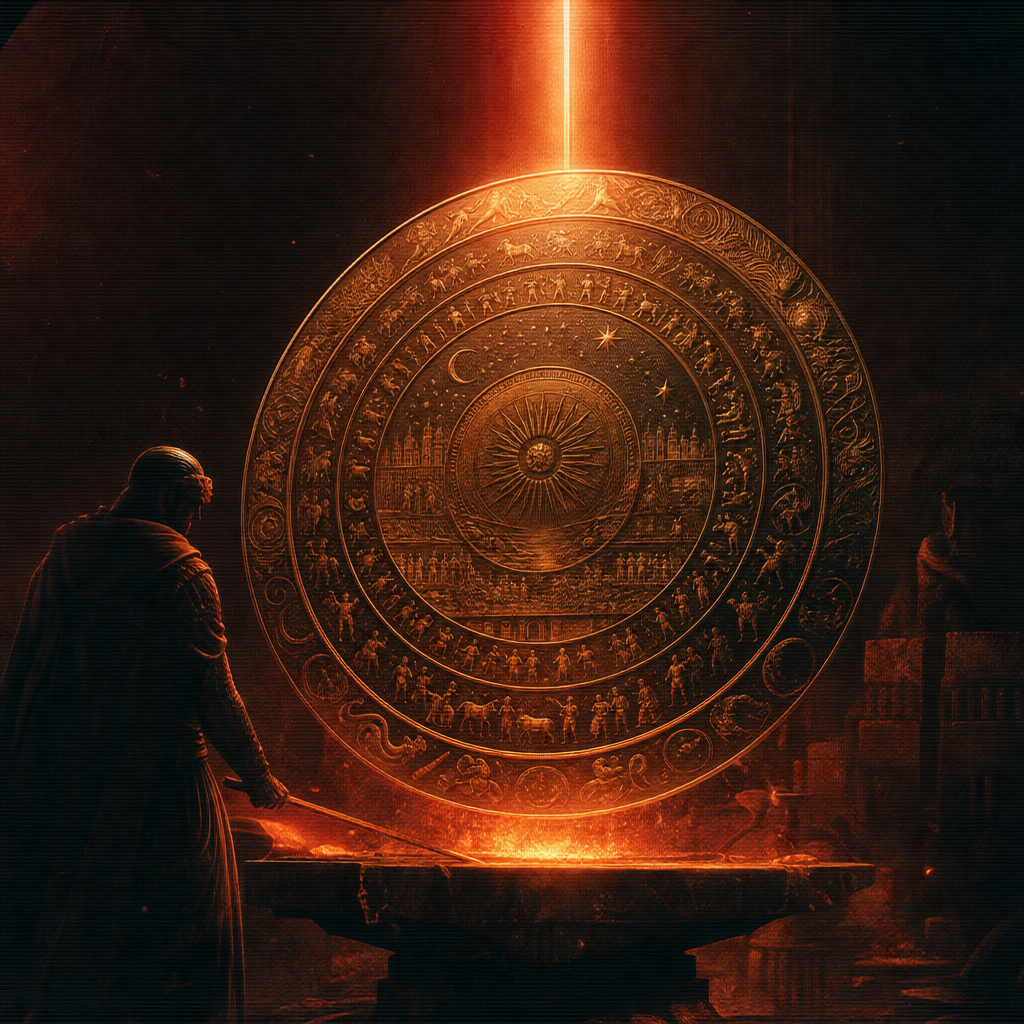
So speaking, he left her there and went to his bellows; he turned them toward the fire and commanded them to work. And the bellows, twenty in all, blew into the crucibles, sending out a well-blown blast of every strength, ready at times to aid him when he hurried, and at other times blowing just as Hephaestus wished and as the work progressed. He cast unyielding bronze into the fire, and tin, and precious gold and silver; and next he set the great anvil on its block, and took in one hand his massive hammer, and with the other grasped the tongs. First of all he forged a shield, huge and heavy, working it richly all over; around it he set a shining rim, threefold and gleaming, and fastened a silver strap to it. Five were the layers of the shield itself; and upon it he fashioned many intricate scenes with his skilled mind.
Read Ancient Greek Source (Iliad.18.468–Iliad.18.482)
On it he wrought the earth, and the sky, and the sea, the untiring sun and the moon at the full, and on it all the constellations that crown the heavens: the Pleiades and the Hyades and the mighty strength of Orion, and the Bear, which men also call by the name of the Wagon, that wheels in her place and keeps watch on Orion, and alone has no share in the baths of Ocean.
Read Ancient Greek Source (Iliad.18.483–Iliad.18.489)
On it too he made two fair cities of mortal men. In the one there were weddings and marriage feasts: beneath the blaze of torches they were leading brides from their chambers through the city, and loud rose the bridal song. Young men whirled in the dance, and among them pipes and lyres raised their music, while the women stood marveling, each at her own doorway. Meanwhile the people were gathered in the assembly place, where a quarrel had arisen: two men were disputing over the blood-price for a man who had been killed. One claimed to have paid everything, declaring it to the people, while the other denied having received anything; and both were eager to reach a settlement before an arbiter. The people shouted their support for both men, taking sides, while the heralds held back the crowd. The elders sat on polished stones in a sacred circle, holding in their hands the staffs of the clear-voiced heralds; with these they would spring to their feet and give judgment in turn. In the middle lay two talents of gold, to be given to whichever among them spoke the straightest judgment.
Read Ancient Greek Source (Iliad.18.490–Iliad.18.508)
Around the other city sat two armies of fighting men, gleaming in their armor, and they were divided between two plans: either to sack it utterly or to divide in half all the wealth that the lovely citadel held within. But the townsmen had not yet yielded, and were secretly arming for an ambush. On the wall their beloved wives and young children stood on guard, and with them the men whom old age held back, while the fighting men marched out, led by Ares and Pallas Athena. Both gods were wrought in gold and wore golden garments. Tall and splendid in their armor, they stood out clearly, while the human figures were smaller. When they came to the place where they meant to set their ambush, by a river where there was a watering place for all the herds, there they crouched down, wrapped in flashing bronze. Posted apart from the main force sat two scouts, watching for the moment they might see the sheep and curve-horned cattle. Soon the herds came into view, and two herdsmen followed with them, delighting in their reed pipes and suspecting nothing of the trap. The men in ambush saw them coming, rushed out upon them, and quickly cut off the herds of cattle and the fine flocks of white sheep on all sides, killing the shepherds beside them. When the besiegers, sitting before their assembly places, heard the loud uproar among the cattle, at once they mounted their chariots behind their high-stepping horses, set out in pursuit, and quickly arrived. They drew up their lines and fought a battle along the banks of the river, striking at one another with bronze-tipped spears. Strife and Turmoil mingled in the fray, and deadly Fate was there, gripping one man alive and freshly wounded, another unwounded, while she dragged another, dead, by the feet through the melee; around her shoulders she wore a cloak dark red with the blood of men. The warriors clashed and fought just like living mortals, and hauled away the bodies of one another's dead.
Read Ancient Greek Source (Iliad.18.509–Iliad.18.540)
On it he placed a soft fallow field, rich plowland, wide and thrice-plowed; and in it many plowmen wheeled their yoked teams and drove them back and forth. Whenever they turned upon reaching the boundary of the field, a man would step up and place a cup of honey-sweet wine into their hands; then they would turn back down the furrows, eager to reach the far edge of the deep fallow land. The earth darkened behind them and looked like freshly plowed ground, even though it was made of gold—forged as a surpassing wonder.
Read Ancient Greek Source (Iliad.18.541–Iliad.18.549)
On it he placed a king's estate, where hired laborers were reaping, holding sharp sickles in their hands. Some handfuls of grain fell thick and fast to the ground along the swath, while the sheaf-binders tied others with twisted bands of straw. Three sheaf-binders stood over the work; and behind them boys gathered the cut grain and carried it in their arms, handing it over without pause. Among them the king stood in silence by the swath, holding his staff, glad at heart. Apart from them, under an oak tree, heralds were preparing a feast, dressing a great ox they had slaughtered, while the women sprinkled plenty of white barley meal for the laborers' midday meal.
Read Ancient Greek Source (Iliad.18.550–Iliad.18.560)
On it he placed a vineyard heavily laden with grapes, beautiful and made of gold; the clusters along the vines were dark, and the rows stood propped throughout on silver stakes. Around it he ran a ditch of dark blue enamel, and around that a fence of tin; a single narrow path led into it, by which the carriers came and went when they harvested the vineyard. Young girls and youths with light hearts were carrying the honey-sweet fruit in woven baskets. In their midst a boy played sweet music on a clear-toned lyre, and sang the lovely Linos-song in accompaniment with his delicate voice; and they stamped the ground in time, following along with singing, shouting, and leaping feet.
Read Ancient Greek Source (Iliad.18.561–Iliad.18.572)
On it he made a herd of straight-horned cattle: the cows were fashioned of gold and of tin, and with a lowing they hurried out from the farmyard to pasture beside a rushing river, along the swaying reed-beds. Golden herdsmen walked in line beside the cattle, four of them, and nine swift-footed dogs followed behind them. Two terrible lions among the foremost cows had seized a loud-bellowing bull; and bellowing mightily he was dragged away, while the dogs and young men rushed after him. The two lions, having torn open the hide of the great bull, were gulping down the entrails and dark blood, while the herdsmen set on the swift dogs and urged them forward in vain. The dogs shrank back from biting the lions, but stood very close, barking and springing out of reach. On it too the famous lame god made a pasture in a lovely glen, a great pasture of white sheep, with farmsteads, roofed huts, and sheepfolds.
Read Ancient Greek Source (Iliad.18.573–Iliad.18.589)
On it the famous lame god intricately wrought a dancing floor, like the one that Daedalus once fashioned in wide Knossos for Ariadne of the lovely braids. There young men danced with girls whose bride-price was reckoned in cattle, holding one another's hands at the wrist. The girls wore robes of fine linen, while the young men wore finely spun tunics softly gleaming with olive oil; and the girls wore lovely garlands, while the young men carried daggers of gold hung from silver straps. At times they circled on practiced feet, very lightly, as when a seated potter fits his hands to his wheel and tests it to see if it will run; and at other times they ran in lines to meet one another. A great crowd stood around the lovely dance, taking delight in it; and among them a divine bard sang to his lyre, while two tumblers among them, leading the measure, whirled through the middle. On it he placed the great might of the river Oceanus along the outermost rim of the strongly built shield.
Read Ancient Greek Source (Iliad.18.590–Iliad.18.608)
Then, when he had forged the shield, huge and sturdy, he forged for him a breastplate brighter than the blaze of fire, and he forged for him a heavy helmet, fitted closely to the temples, beautiful and richly worked, and set a golden crest upon it, and he forged for him greaves of pliable tin. And when the famous lame god had labored to make all the armor, he lifted it and laid it down before the mother of Achilles. Like a falcon she plunged down from snow-capped Olympus, carrying the glittering armor from Hephaestus.