Book 17: The Struggle for the Body of Patroclus
Ἰλιάς · Book 17 · Classix Modern English Reading Edition
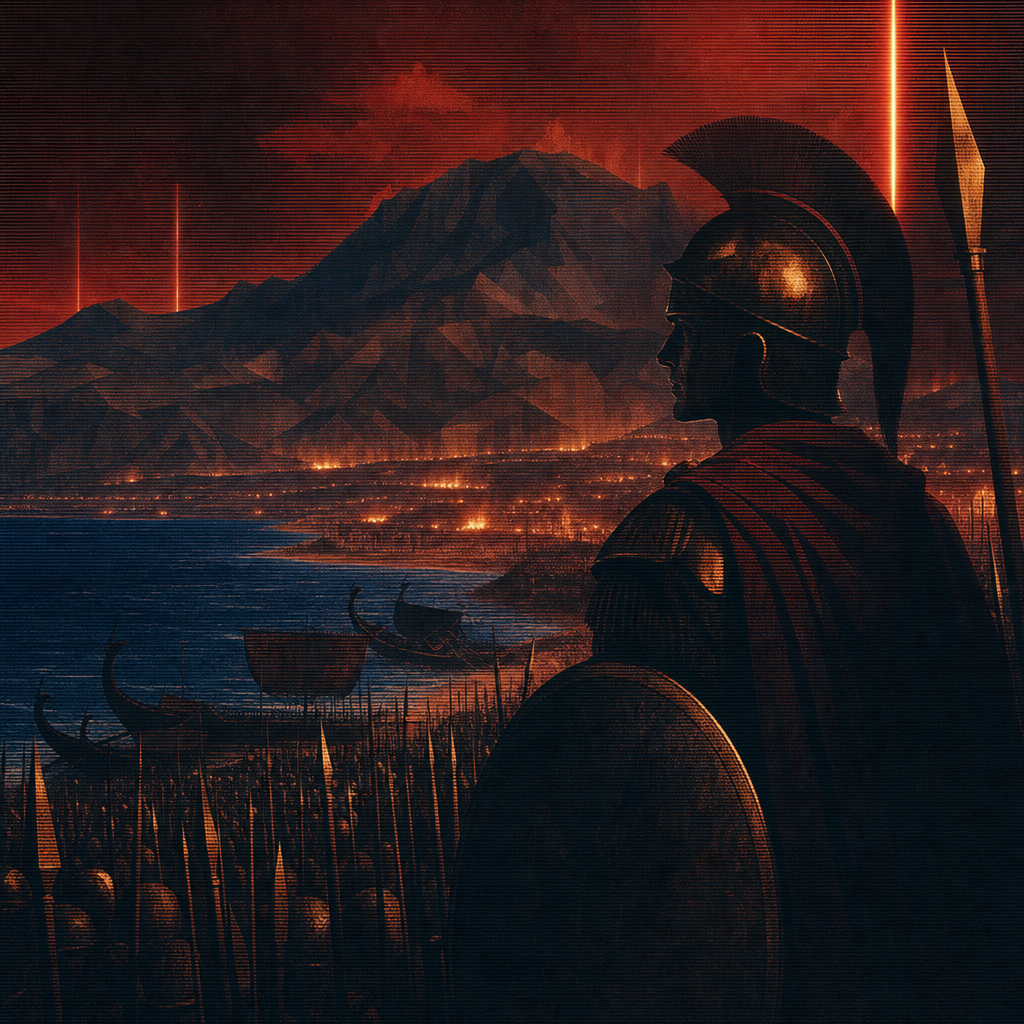
Nor did it escape Atreus' son, war-loving Menelaus, that Patroclus had been brought down by the Trojans in the slaughter. He strode through the front ranks armored in gleaming bronze, and stood astride the body like a mother cow over her firstborn calf, lowing plaintively, never having given birth before: so golden-haired Menelaus stood astride Patroclus. Before him he held his spear and his round, balanced shield, eager to kill any man who came out to face him.
Read Ancient Greek Source (Iliad.17.1–Iliad.17.8)
Nor did Panthous' son, skilled with the ash spear, overlook the fall of noble Patroclus. He came up and stood close by, and spoke to war-loving Menelaus: "Menelaus, son of Atreus, cherished by Zeus, leader of men, give ground! Leave the corpse, and let the bloodstained spoils be. No man among the Trojans and their renowned allies struck Patroclus with the spear before I did in the fierce battle. So let me win high glory among the Trojans, or I will strike you too and take your honey-sweet life."
Read Ancient Greek Source (Iliad.17.9–Iliad.17.17)
Deeply angered, golden-haired Menelaus answered him: "Father Zeus, it is not right to boast so arrogantly! Neither leopard nor lion nor destructive wild boar can match the proud spirit of Panthous' sons, skilled with the ash spear—not even the boar, whose mighty heart rages in its chest as it exults in its strength. Yet not even strong Hyperenor, tamer of horses, had any joy of his youth when he disparaged me and stood his ground, and said I was the most shameful fighter among the Danaans; I do not think he went home on his own two feet to bring joy to his dear wife and his honored parents. Just so I will break your strength too, if you stand and face me. No, I tell you to draw back and go into the crowd; do not stand against me before you suffer some harm. Once a thing is done, even a fool understands it."
Read Ancient Greek Source (Iliad.17.18–Iliad.17.32)
So he spoke, but did not persuade him, and the other answered: "Now indeed, Menelaus, cherished by Zeus, you will pay in full for my brother whom you killed and boast over as you speak! You made his wife a widow in the depths of her new bridal chamber, and laid accursed mourning and grief upon his parents. Surely I would bring those wretched two an end to their mourning if I carried back your head and your armor and placed them in the hands of Panthous and noble Phrontis. Enough—this struggle will not go untried much longer, nor go unfought, whether for valor or for flight!"
Read Ancient Greek Source (Iliad.17.33–Iliad.17.42)
With these words he stabbed the round, balanced shield, but the bronze did not break through; its point bent back in the stout shield. Then Atreus' son Menelaus lunged second with his bronze spear, praying to Father Zeus. As Euphorbus stepped back, Menelaus stabbed him right at the base of the throat and put his weight behind the blow, trusting his heavy hand. The point drove clean through his tender neck; he fell with a thud, and his armor clattered about him. Blood soaked his hair, lovely as the Graces', and his braided locks, bound tight with gold and silver. Just as a man tends a thriving shoot of olive in a lonely spot where water bubbles up in plenty—lovely and flourishing, stirred by the breaths of every wind, and bursting with white blossoms; then suddenly a wind comes with a fierce tempest, wrenches it from its trench, and stretches it out on the earth—so it was with Panthous' son, Euphorbus of the ash spear, when Atreus' son Menelaus killed him and began stripping his armor.
Read Ancient Greek Source (Iliad.17.43–Iliad.17.60)
As when a mountain-bred lion, trusting in his strength, seizes the finest cow from a grazing herd: first he grips her in his powerful jaws and breaks her neck, and then, tearing her apart, he gulps down the blood and all the entrails, while around him the dogs and herdsmen shout and clamor from a distance, unwilling to come face him, for pale terror grips them—so the heart in no Trojan's chest dared to come face glorious Menelaus.
Read Ancient Greek Source (Iliad.17.61–Iliad.17.69)
Then the son of Atreus would easily have carried off the famous armor of Panthous' son, had Phoebus Apollo not begrudged him and stirred Hector, a match for swift Ares, against him. Taking the likeness of a man, Mentes, leader of the Cicones, Apollo called out and spoke winged words to him: "Hector, here you run chasing what cannot be caught, the horses of the battle-minded grandson of Aeacus! They are hard for mortal men to master and drive, for any man other than Achilles, whom an immortal mother bore. Meanwhile warlike Menelaus, son of Atreus, standing astride Patroclus, has killed the best of the Trojans, Euphorbus, son of Panthous, and ended his furious valor."
Read Ancient Greek Source (Iliad.17.70–Iliad.17.81)
Speaking so, the god went back into the toil of men, and terrible grief shrouded Hector's dark heart. He scanned the ranks of men, and at once he saw the one stripping off the famous armor and the other lying on the ground, blood flowing from the wound where he had been struck. He strode through the front ranks armored in gleaming bronze, crying out sharply, like the unquenchable flame of Hephaestus. Nor did his sharp cry escape Atreus' son; deeply troubled, he spoke to his own great heart: "Ah me! If I leave behind the fine armor and Patroclus, who lies here for the sake of my honor, I fear some Danaan who sees it will reproach me. Yet if out of shame I fight Hector and the Trojans all alone, I fear they will surround me, many against one; Hector of the flashing helmet is leading all the Trojans here. But why does my own heart debate these things? Whenever a man wishes, against a god's will, to fight a warrior whom a god honors, great ruin soon rolls down upon him. Therefore no Danaan who sees it will reproach me for giving ground to Hector, since he fights with a god's help. Yet if I could somehow find Ajax, good at the war cry, the two of us could go back and set our minds to battle, even against a god, in hope of dragging the body away for Achilles, son of Peleus; of evils, that would be the best."
Read Ancient Greek Source (Iliad.17.82–Iliad.17.105)
While he turned these things over in his mind and heart, the Trojan ranks came on, with Hector leading them. Then Menelaus backed away and left the corpse behind, turning again and again like a bearded lion that dogs and men drive from a farmstead with spears and shouting; the brave heart in his chest chills within him, and unwillingly he leaves the yard—so golden-haired Menelaus went away from Patroclus.
Read Ancient Greek Source (Iliad.17.106–Iliad.17.113)
When he reached the throng of his companions, he turned and stood, scanning the field for great Ajax, son of Telamon. At once he spotted him on the far left of the whole battle, putting heart into his comrades and urging them on to fight, for Phoebus Apollo had cast an unearthly panic among them. Menelaus broke into a run, came right up beside Ajax, and spoke: "Ajax, my friend, come here! Let us hurry to defend dead Patroclus, in hope that we can at least bring his naked body back to Achilles; as for his armor, Hector of the flashing helmet already holds it." So he spoke, and stirred the heart of battle-minded Ajax. Ajax strode out through the front fighters, and golden-haired Menelaus went with him.
Read Ancient Greek Source (Iliad.17.114–Iliad.17.124)
Now Hector, once he had stripped Patroclus of his glorious armor, was dragging him off to cut the head from his shoulders with sharp bronze and haul the corpse away to give to the dogs of Troy. But Ajax came up close, carrying his shield like a tower. Hector gave ground, retreating into the crowd of his companions, and sprang up into his chariot; he handed the fine armor over to the Trojans to carry to the city, to be a great glory for him. Ajax covered the son of Menoetius with his broad shield and stood fast like a lion over its cubs, when hunters meet it in the forest as it leads its little ones; it exults in its strength, and draws down its whole brow to hood its eyes. So Ajax stood astride the hero Patroclus, while on the other side Atreus' son, war-loving Menelaus, stood fast, nursing great grief in his chest.
Read Ancient Greek Source (Iliad.17.125–Iliad.17.139)
Then Glaucus, son of Hippolochus, leader of the Lycian men, looked grimly at Hector and rebuked him with harsh words: "Hector, finest of men to look upon, in actual fighting you fall far short! Surely your high fame is for nothing, when you are a runaway. Think now how you will save the city and its citadel all by yourself, with only the people who were born in Ilium. For not one of the Lycians will go out to fight the Danaans in defense of the city, since after all there was no thanks for battling relentlessly against enemy men without pause. How would you ever save a lesser man in the press of battle, ruthless man, when you left Sarpedon, both your guest-friend and your comrade, to become prey and spoil for the Argives? While he lived, he was a great help to your city and to you yourself; yet now you did not have the courage to keep the dogs from him. So now, if any of the Lycian men will listen to me, we will go home, and sheer destruction will appear for Troy. For if the Trojans now had that fiercely daring, unflinching spirit that enters men who take on hard toil and conflict against their enemies for their homeland, we would quickly drag Patroclus inside Ilium. And if we dragged this man out of the fight and brought him dead to the great city of Lord Priam, the Argives would quickly give up Sarpedon's fine armor in exchange, and we could bring Sarpedon himself inside Ilium; for the man whose comrade has been slain is by far the best of the Argives beside the ships, and his comrades fight at close quarters. But you could not bring yourself to stand face to face with great-hearted Ajax, looking him in the eyes amid the enemy's battle cry, nor to fight him head-on, because he is a stronger man than you."
Read Ancient Greek Source (Iliad.17.140–Iliad.17.168)
Looking at him grimly, Hector of the flashing helmet answered: "Glaucus, why has a man like you spoken so arrogantly? Outrageous! I truly thought you surpassed in good sense all the others who dwell in deep-soiled Lycia; but now I altogether fault your judgment for what you have said, claiming that I did not stand my ground against huge Ajax. I do not shudder at battle or the thunder of horses; but the mind of aegis-bearing Zeus is always stronger. He easily puts even a brave man to flight and snatches away his victory, and at other times he himself spurs the man on to fight. Come here then, my friend, stand beside me and watch my work: see whether I will be a coward all day long, as you say, or whether I will stop any Danaan, however eager in his valor, from fighting in defense of dead Patroclus."
Read Ancient Greek Source (Iliad.17.169–Iliad.17.182)
So speaking, he called out to the Trojans with a loud shout: "Trojans, Lycians, and Dardanians who fight at close quarters, be men, my friends, and remember your furious valor, while I put on the fine armor of peerless Achilles that I stripped from mighty Patroclus when I killed him." With those words Hector of the flashing helmet strode away out of the blazing battle. Running on swift feet, he very quickly overtook his companions, not yet far off, as they carried the glorious armor of Peleus' son toward the city. Standing apart from the tearful battle, he exchanged his gear: his own armor he gave to the war-loving Trojans to carry to sacred Ilium, while he put on the immortal armor of Achilles, son of Peleus, which the heavenly gods had given to his dear father. Peleus in turn had handed it on to his son when he grew old—yet the son did not grow old in his father's armor.
Read Ancient Greek Source (Iliad.17.183–Iliad.17.197)
When cloud-gathering Zeus saw him from afar arming himself in the gear of the godlike son of Peleus, he shook his head and spoke to his own heart: "Ah, poor wretch, death is not in your thoughts at all, though already it comes near you; and you put on the immortal armor of the greatest of men, before whom others too tremble. You killed his companion, both gentle and strong, and contrary to due order you stripped the armor from his head and shoulders. Yet for now I will put great might in your hands, in compensation for this: that you will never return home from the battle for Andromache to receive from you the glorious armor of Peleus' son." So he spoke, and the son of Cronus nodded with his dark brows. He made the armor fit close to Hector's body, and Ares, the dread war god, entered him, filling his limbs within with valor and strength. Then Hector strode among his renowned allies with a great shout, and to all of them he appeared blazing in the armor of the great-hearted son of Peleus.
Read Ancient Greek Source (Iliad.17.198–Iliad.17.214)
Going up to each man in turn, he urged them on with words—Mesthles and Glaucus, Medon and Thersilochus, Asteropaeus, Deisenor, and Hippothous, Phorcys, Chromius, and Ennomus the reader of bird-omens. Urging these men on, he spoke winged words to them: "Hear me, countless tribes of neighboring allies! It was not because I sought or needed a mere crowd of men that I gathered each of you here from your cities, but so that you might wholeheartedly defend the Trojans' wives and little children for me against the war-loving Achaeans. With this in mind, I wear down my own people for gifts and food while I build up the heart of each one of you. So now let every man turn straight ahead and either die or save his life—for that is the intimacy of war. And whoever drags Patroclus, dead though he is, back to the horse-taming Trojans, and makes Ajax give way, I will give him half the spoils as his share and keep half for myself, and his glory will be as great as my own." So he spoke, and they bore down with all their weight and charged straight at the Danaans, holding their spears high; and their hearts strongly hoped to drag the corpse out from under Ajax, son of Telamon—fools! Over that body he was to strip the life from many men.
Read Ancient Greek Source (Iliad.17.215–Iliad.17.236)
Then Ajax spoke to Menelaus, good at the war cry: "Dear friend, Menelaus, cherished by Zeus, I no longer expect that even the two of us will return alive from this battle. I do not fear so much for the dead body of Patroclus, who will soon glut the dogs and birds of the Trojans, as much as I fear for my own head, lest it come to harm, and for yours, since Hector wraps everything around in a cloud of war, and for us sheer destruction looms in plain sight. Come, call the best men of the Danaans, in case anyone can hear."
Read Ancient Greek Source (Iliad.17.237–Iliad.17.245)
So he spoke, and Menelaus, good at the war cry, did not disobey, but shouted piercingly, calling out to the Danaans: "Friends, leaders and rulers of the Argives, who beside the sons of Atreus, Agamemnon and Menelaus, drink wine provided by the people and each give commands to your armies, while honor and glory attend you from Zeus: it is hard for me to scan the field for each individual commander, for such a fierce strife of battle is blazing; let every man come forward on his own, and feel outrage in his heart that Patroclus should become a plaything for the dogs of Troy!"
Read Ancient Greek Source (Iliad.17.246–Iliad.17.255)
So he spoke, and swift Ajax, son of Oileus, heard him clearly. He was the first to come running toward him through the carnage, and after him came Idomeneus and Idomeneus' comrade-in-arms Meriones, a match for the man-slaying war god Enyalius. As for the rest, who could recall in his own mind all the names of those who came up behind and roused the fighting for the Achaeans? The Trojans struck forward in a mass, with Hector leading them. Just as a great wave roars against the current at the mouth of a rain-fed river, and all around the jutting headlands boom as the sea spews its surf ashore, with such a roar the Trojans came on. But the Achaeans stood firm around the son of Menoetius, sharing a single spirit, fenced in by their bronze-plated shields. Around their gleaming helmets the son of Cronus poured a thick mist, for he had never hated the son of Menoetius before, while he lived and was the comrade-in-arms of the grandson of Aeacus; he loathed that he should become prey for the enemy dogs of Troy, and so he stirred his comrades to defend him.
Read Ancient Greek Source (Iliad.17.256–Iliad.17.273)
First the Trojans shoved back the bright-eyed Achaeans; leaving the corpse, the Achaeans shrank back in fear, yet the high-hearted Trojans killed none of them with their spears, eager as they were, but began dragging the body away. Even so, the Achaeans were to be parted from him for only a moment, for Ajax very quickly wheeled them around—Ajax, who in build and in the work of war surpassed all the other Danaans after the peerless son of Peleus. He charged straight through the front ranks with the strength of a wild boar that in the mountains easily scatters the hounds and vigorous young hunters when he wheels at bay through the glens; just so glorious Ajax, son of noble Telamon, plunged in and easily scattered the battalions of the Trojans who had closed around Patroclus and were set above all on dragging him to their own city and winning glory.
Read Ancient Greek Source (Iliad.17.274–Iliad.17.287)
Now Hippothous, the glorious son of Pelasgian Lethus, was dragging him by the foot through the fierce battle, having tied a leather strap around the tendons at the ankle to win favor with Hector and the Trojans; but disaster quickly came upon him, which none of his comrades could ward off for all their eagerness. The son of Telamon lunged through the crowd and struck him at close quarters through his bronze-cheeked helmet. The horsehair-crested helmet split open around the spearpoint under the blow of the great spear and his heavy hand, and bloody brain spurted from the wound along the socket of the spearhead. His strength gave way on the spot; from his hands he let the foot of great-hearted Patroclus drop to the ground to lie there, and right beside him he fell face down across the corpse, far from fertile Larisa. He never repaid his dear parents for rearing him, for his life was cut short when he was brought down by the spear of great-hearted Ajax.
Read Ancient Greek Source (Iliad.17.288–Iliad.17.303)
Then Hector threw his shining spear at Ajax. Ajax saw it coming straight at him and dodged the bronze spear by a hair, and Hector hit Schedius, son of great-hearted Iphitus, by far the best of the Phocians, who had his home in famous Panopeus and ruled over many men. He struck him squarely beneath the collarbone, and the tip of the bronze point drove clean through and jutted out by the base of his shoulder; he fell with a thud, and his armor clattered about him. Next Ajax struck battle-minded Phorcys, son of Phaenops, squarely in the belly as Phorcys stood astride Hippothous; he broke the hollow plate of the corselet, and the bronze tore his bowels out. He fell in the dust and clutched the earth with his palm. The front-line fighters and glorious Hector gave ground, while the Argives raised a great shout, dragged off the bodies of Phorcys and Hippothous, and unstrapped the armor from their shoulders.
Read Ancient Greek Source (Iliad.17.304–Iliad.17.318)
Then the Trojans would have been driven once more by the war-loving Achaeans back up into Ilium, overcome by their own cowardice, and the Argives would have won glory even beyond the decree of Zeus by their own might and strength. But Apollo himself urged Aeneas on, taking the form of Periphas the herald, son of Epytus, who had grown old serving as herald in the house of Aeneas' aged father, his mind full of loyal counsel. Likening himself to this man, Apollo, son of Zeus, spoke to him: "Aeneas, how could you ever defend steep Ilium even against a god's will—as I have seen other men do, trusting in their own might, strength, and manhood, and in their own numbers, with a fearless people—when Zeus wills victory for us far more than for the Danaans, yet you yourselves panic uncontrollably and do not fight?"
Read Ancient Greek Source (Iliad.17.319–Iliad.17.332)
So he spoke, and Aeneas recognized far-shooting Apollo when he looked him straight in the face. Shouting aloud, he called to Hector: "Hector, and you other leaders of the Trojans and the allies, this is a disgrace now, for us to be driven by the war-loving Achaeans back up into Ilium, overcome by our own cowardice! Even now one of the gods has stood close beside me and declared that Zeus, the highest counselor, is our ally in the fight. So let us charge straight at the Danaans, and not let them bring dead Patroclus back to their ships at their ease." So he spoke, and leaping out far ahead of the front fighters he took his stand; and the Trojans wheeled around and stood facing the Achaeans.
Read Ancient Greek Source (Iliad.17.333–Iliad.17.343)
There Aeneas lunged with his spear and wounded Leiocritus, the son of Arisbas and brave companion of Lycomedes. War-loving Lycomedes pitied him as he fell; he strode right up, took his stand, and hurled his shining spear, striking Apisaon, son of Hippasus, shepherd of the people, in the liver beneath the midriff, and at once loosed his knees beneath him. Apisaon had come from rich-soiled Paeonia, and after Asteropaeus he was their best fighter in battle. Warlike Asteropaeus pitied him as he fell, and he too charged eagerly forward to fight the Danaans; yet he could no longer break through, for on every side they were fenced with shields as they stood around Patroclus and held their spears out in front. For Ajax ranged among them all, urgently giving orders: he commanded that no man fall back behind the corpse and no man charge out in front ahead of the other Achaeans, but that all stand firm right around him and fight at close quarters. So huge Ajax commanded, and the earth was drenched with dark blood, while side by side they fell dead together—Trojans and their proud allies, and Danaans too; for not even the Danaans fought without bloodshed, though far fewer of them perished, because they always remembered to ward off sheer death from one another in the press of battle.
Read Ancient Greek Source (Iliad.17.344–Iliad.17.365)
So they fought like blazing fire. You would have thought the sun and moon had vanished, so thick was the mist shrouding the bravest men as they stood around the fallen son of Menoetius. Meanwhile the other Trojans and the Achaeans in fine leg armor fought unhindered beneath the clear sky, with the sharp brilliance of the sun spread wide, and not a cloud showed over all the plain or the mountains; they fought with pauses to rest, dodging one another's groan-bringing shafts from far apart. But those in the center suffered agony from the mist and the battle, worn down by the pitiless bronze, all who were the bravest. Yet two glorious men, Thrasymedes and Antilochus, had not yet heard that peerless Patroclus was dead, for they still thought he was alive and fighting the Trojans in the front of the tumult. Watching out against the death and rout of their companions, those two were fighting apart, since Nestor had ordered it so when he urged them into battle from the black ships.
Read Ancient Greek Source (Iliad.17.366–Iliad.17.383)
All day long the bitter struggle raged around those in the center. As the two sides fought over the brave companion of the swift-footed grandson of Aeacus, sweat from their unending toil soaked each man’s knees, shins, feet, hands, and eyes. As when a man gives the hide of a great bull, soaked in fat, to his people to stretch, and they take it, station themselves apart in a circle, and haul on it, and at once the moisture leaves it and the grease sinks in under the pull of many hands until the whole hide is stretched taut through and through—so the two sides hauled the corpse this way and that in a narrow space, their hearts strongly hoping, the Trojans to drag him to Ilium, and the Achaeans to the hollow ships. Around him a fierce turmoil rose up; neither Ares who rouses armies nor Athena, seeing that fight, could have found fault with it, not even if anger had seized them, such was the grim labor of men and horses that Zeus stretched tight over Patroclus on that day. Yet godlike Achilles still knew nothing of Patroclus' death, for they were fighting far away from the swift ships beneath the wall of the Trojans. Therefore he never expected in his heart that Patroclus was dead, but thought he would press right up to the gates alive and then return, since he did not expect at all that Patroclus would sack the city without him, nor even with him; for often he had learned this from his mother, hearing it from her apart when she reported to him the purpose of great Zeus. Yet this time his mother had not told him how great an evil had come to pass—that the companion dearest to him by far had perished.
Read Ancient Greek Source (Iliad.17.384–Iliad.17.411)
Meanwhile around the corpse, holding their sharp-pointed spears, they pressed in relentlessly and slaughtered one another. Thus one of the bronze-clad Achaeans would say: "Friends, there is no glory for us in going back to the hollow ships—no, let the black earth gape open for us all right here! That would at once be far better for us, if we are to abandon this man to the horse-taming Trojans to drag to their city and win the glory." And thus in turn one of the great-hearted Trojans would cry out: "Friends, even if it is fate for all of us together to be cut down beside this man, let no one give ground from the fighting!" So a man would speak on either side, and rouse the spirit of each fighter. So they fought on, and the iron din reached the bronze sky through the barren upper air.
Read Ancient Greek Source (Iliad.17.412–Iliad.17.425)
But the horses of the grandson of Aeacus, standing apart from the battle, had been weeping ever since they first learned that their charioteer had fallen in the dust at the hands of man-slaying Hector. Automedon, the brave son of Diores, lashed them again and again with the swift whip, and spoke to them again and again with gentle words and with threats; yet the pair would neither go back to the ships by the broad Hellespont nor into the fighting among the Achaeans. Just as a stone pillar stands fast in its place when it is set upon the burial mound of a dead man or woman, so they stood unmoving, holding the splendid chariot still, bowing their heads to the ground. Hot tears ran from their eyelids to the earth as they mourned in longing for their charioteer, and their thick manes were soiled as they spilled from the collar-pads on either side of the yoke.
Read Ancient Greek Source (Iliad.17.426–Iliad.17.440)
Seeing the two of them mourning, the son of Cronus pitied them, and shaking his head he spoke to his own heart: "Poor wretches, why did we give the two of you to Lord Peleus, a mortal man, when you are ageless and immortal? Was it so that you would suffer grief among wretched men? For truly there is nothing more miserable than a man, of all the creatures that breathe and move upon the earth. Yet Hector, son of Priam, shall never ride behind the two of you in your richly worked chariot; I will not allow it. Is it not enough that he holds the armor and boasts of it in vain? Instead, I will put strength into your knees and into your hearts, so that you may also bring Automedon safely out of the fighting to the hollow ships; for I will still grant the Trojans glory to keep killing until they reach the well-benched ships, and the sun goes down and sacred darkness comes on." So speaking, he breathed noble strength into the horses. Shaking the dust from their manes onto the ground, the two of them swiftly bore the fast chariot among Trojans and Achaeans.
Read Ancient Greek Source (Iliad.17.441–Iliad.17.458)
Mounted behind them, Automedon fought on, though grieving for his companion, swooping with the horses like a vulture among geese; for easily he would dart away from the din of the Trojans, and easily he would charge back in, pressing hard through the dense crowd. Yet he could not bring men down when he rushed in pursuit, for there was no way, while alone in the sacred chariot, for him to attack with the spear and rein in the swift horses at once. At last a comrade saw him with his own eyes—Alcimedon, son of Laerces the son of Haemon. He came and stood behind the chariot and spoke to Automedon: "Automedon, which of the gods put this useless plan into your chest, and took away your good sense? Look how you fight the Trojans in the front of the press all alone! Your companion has been killed, and Hector himself exults, wearing the armor of Aeacus' grandson on his shoulders." Then Automedon, son of Diores, answered him: "Alcimedon, what other Achaean can match you in mastering and guiding the spirit of immortal horses, except Patroclus, a counselor equal to the gods, while he lived? Now death and fate have overtaken him. But take the whip and the glossy reins yourself, and I will step down from the chariot to fight."
Read Ancient Greek Source (Iliad.17.459–Iliad.17.480)
So he spoke, and Alcimedon, springing onto the swift war-chariot, quickly seized the whip and the reins in his hands, while Automedon leaped down. Glorious Hector noticed this, and at once called out to Aeneas, who was nearby: "Aeneas, counselor of the bronze-clad Trojans, I have spotted these two horses of the swift-footed grandson of Aeacus appearing in the battle with weak charioteers. I might hope to capture the pair, if in your heart you are willing, since if the two of us charge them, they would not dare stand against us and fight in the fury of war."
Read Ancient Greek Source (Iliad.17.481–Iliad.17.490)
So he spoke, and the noble son of Anchises did not refuse. The two went straight forward, their shoulders covered by shields of tough, dry oxhide, with thick bronze hammered over them. Along with them went Chromius and godlike Aretus, both together, and their hearts strongly hoped to kill the two men themselves and drive off the high-necked horses—fools, for they were not going to return without blood from their encounter with Automedon. He prayed to Father Zeus, and his dark heart was filled with courage and strength. At once he spoke to Alcimedon, his loyal companion: "Alcimedon, do not hold the horses far back from me, but keep them breathing right on my back; for I do not think Hector, son of Priam, will check his fury until he either mounts behind Achilles' fine-maned horses after killing us both and routs the ranks of the Argives, or else is himself brought down among the front fighters." So speaking, he called out to the two Ajaxes and Menelaus: "You two Ajaxes, leaders of the Argives, and Menelaus, entrust the dead body to those who are the bravest to stand around him and fend off the ranks of men, and come ward off the pitiless day of death from the two of us while we still live; for right here Hector and Aeneas, who are the best of the Trojans, press hard with all their weight in the tearful battle. Yet truly these things lie on the knees of the gods; I too will hurl my spear, and all the rest will be for Zeus to decide."
Read Ancient Greek Source (Iliad.17.491–Iliad.17.515)
He spoke, and poising his long-shadowed spear he hurled it, striking Aretus on his round, balanced shield. The shield did not stop the spear, but the bronze drove straight through and plunged through his belt into his lower belly. Just as when a vigorous man holding a sharp axe strikes behind the horns of a field-dwelling ox and severs the whole tendon through, and the beast leaps forward and collapses, so Aretus leaped forward and fell flat on his back; and the sharp spear, quivering in his entrails, loosed his limbs.
Read Ancient Greek Source (Iliad.17.516–Iliad.17.524)
Then Hector threw his shining spear at Automedon, but Automedon saw it coming straight at him and dodged the bronze spear; for he ducked forward, and the long spear stuck in the ground behind him, the butt-end of its shaft quivering until mighty Ares spent its force. Then they would have rushed at one another with swords at close quarters, had the two Ajaxes not parted them in their fury as they came through the crowd at their comrade's call. Shrinking back in fear before them, Hector, Aeneas, and godlike Chromius gave ground again and left Aretus lying there with his heart torn open. Automedon, a match for swift Ares, stripped off Aretus' armor and boasted aloud: "Truly now I have eased my heart a little of its grief for the dead son of Menoetius, even though the man I killed is a lesser one." Speaking so, he took up the bloodstained spoils and laid them in the chariot, and mounted it himself, his feet and hands covered in blood, like a lion that has devoured a bull.
Read Ancient Greek Source (Iliad.17.525–Iliad.17.542)
Once more the fierce battle, grim and tearful, was stretched tight over Patroclus, and Athena came down from heaven and stirred up the strife, for far-seeing Zeus had sent her forth to rouse the Danaans, since his mind had shifted. Just as Zeus stretches a dark-gleaming rainbow from heaven for mortals, to be a sign either of war or of a chilling storm that stops men from their work on the earth and afflicts the flocks, so she wrapped herself in a dark-gleaming cloud, plunged into the host of the Achaeans, and roused each man. First she spoke to urge on Atreus' son, mighty Menelaus, since he was close beside her, taking the form and tireless voice of Phoenix: "For you indeed, Menelaus, it will be a humiliation and a disgrace if swift dogs tear the loyal companion of noble Achilles beneath the wall of the Trojans. Hold fast with all your strength, and urge on the whole army!" Menelaus, good at the war cry, answered her: "Phoenix, old father, born long ago, if only Athena would grant me strength and turn aside the rush of spears! Then I would gladly stand beside Patroclus and defend him, for his death has cut me to the heart. But Hector has the terrible fury of fire and never stops slaughtering with the bronze, for Zeus grants him glory."
Read Ancient Greek Source (Iliad.17.543–Iliad.17.566)
So he spoke, and the bright-eyed goddess Athena rejoiced that he had prayed to her first of all the gods. She put strength into his shoulders and knees, and into his chest she put the boldness of a fly, which, though brushed away again and again from a man's skin, persists in biting, for human blood is sweet to it. With such boldness she filled his dark heart, and he strode back over Patroclus and hurled his shining spear. Now among the Trojans there was a man named Podes, son of Eetion, both rich and brave; Hector honored him above all the people, since he was his dear companion and feast-fellow. Golden-haired Menelaus struck him on the belt as he darted in flight, and drove the bronze clean through; he fell with a thud, and Atreus' son Menelaus dragged the corpse out from among the Trojans into the throng of his companions.
Read Ancient Greek Source (Iliad.17.567–Iliad.17.581)
Then Apollo came up close and urged Hector on, in the likeness of Phaenops, son of Asius, who lived in Abydos and was dearest to him of all his guest-friends. Likening himself to this man, far-working Apollo spoke to him: "Hector, what other Achaean will ever fear you again, when you shrink back like this before Menelaus, who in the past was a soft spearman? Now all by himself he has lifted a corpse and carried it off from the Trojans, after killing your loyal companion, a brave man among the front fighters—Podes, son of Eetion." So he spoke, and a black cloud of grief enveloped Hector, and he strode through the front ranks armored in gleaming bronze.
Read Ancient Greek Source (Iliad.17.582–Iliad.17.592)
Then the son of Cronus took up his tasseled, glittering aegis and wrapped Mount Ida in clouds; he flashed his lightning, thundered mightily, and shook the aegis, granting victory to the Trojans and putting the Achaeans to flight. First to begin the flight was Peneleos the Boeotian. For as he kept facing forward, he was struck a grazing blow on the top of his shoulder by a spear; the point of Polydamas' spear scratched right to the bone, for Polydamas had come up close and cast it. Next Hector wounded Leitus, son of great-hearted Alectryon, at close quarters on the wrist, and stopped him from fighting. He shrank back, glancing around, since he no longer hoped in his heart to hold a spear in his hand and fight the Trojans.
Read Ancient Greek Source (Iliad.17.593–Iliad.17.604)
As Hector rushed after Leitus, Idomeneus struck him on the breastplate beside the nipple; but the long spear snapped at the socket, and the Trojans shouted aloud. Hector then cast his spear at Idomeneus, son of Deucalion, as he stood in his chariot. He missed him by a hair, but struck Coeranus, the companion and charioteer of Meriones, who had followed him from well-built Lyctus—for Idomeneus had first come on foot when he left the curved ships, and would have handed great victory to the Trojans if Coeranus had not quickly driven up his swift horses; to him Coeranus came as a light of deliverance and warded off the pitiless day of death, but he himself lost his life at the hands of man-slaying Hector—Hector struck him beneath the jaw and ear; the spear-point knocked out his teeth at the roots and sliced his tongue right through the middle. He toppled from the chariot and let the reins spill to the ground. Meriones bent down, gathered them up from the plain in his own hands, and spoke to Idomeneus: "Lay on the whip now, until you reach the swift ships! You can see for yourself that the Achaeans no longer have the upper hand." So he spoke, and Idomeneus lashed the fine-maned horses toward the hollow ships, for fear had now fallen upon his heart.
Read Ancient Greek Source (Iliad.17.605–Iliad.17.625)
Nor did it escape great-hearted Ajax and Menelaus that Zeus was shifting the tide of victory to the Trojans. Great Ajax, son of Telamon, was the first to speak: "Outrageous! By now even an utter fool could see that Father Zeus himself is helping the Trojans. Every one of their missiles hits its mark, whoever throws it, whether a coward or a brave man—Zeus guides them all alike—while for all of us our spears fall uselessly to the ground. Come then, let us devise the best plan we can by ourselves, both how to drag the corpse away and how to return alive ourselves and bring joy to our dear comrades, who must be grieving as they look this way, thinking that we will no longer hold back the fury and invincible hands of man-slaying Hector, but will fall back upon the black ships. If only there were some comrade to bring word as quickly as possible to the son of Peleus, since I think he has not even heard the grim news that his dear companion has perished. Yet I cannot see any such man among the Achaeans, for men and horses alike are shrouded in mist. Father Zeus, deliver the sons of the Achaeans from the mist, make the sky clear, and grant that we may see with our eyes! So long as it is in the light, destroy us even, since that is your pleasure."
Read Ancient Greek Source (Iliad.17.626–Iliad.17.647)
So he spoke, and the Father pitied him as he shed tears. At once he scattered the mist and drove away the fog; the sun shone out, and the whole battle came into view. Then Ajax spoke to Menelaus, good at the war cry: "Look around now, Menelaus, cherished by Zeus, to see if you can spot Antilochus, the son of great-hearted Nestor, still alive, and urge him to go quickly to battle-minded Achilles and tell him that the companion dearest to him by far has perished."
Read Ancient Greek Source (Iliad.17.648–Iliad.17.655)
So he spoke, and Menelaus, good at the war cry, did not disobey. He set off like a lion leaving a farmyard when it has grown weary of harrying the dogs and men who keep watch all night long and will not let it carry off the fattest of the cattle; craving meat, it charges straight in, but accomplishes nothing, for javelins fly thick and fast against it from bold hands, along with blazing torches that it shrinks from despite its fury, until at dawn it goes away with a heavy heart. Just so Menelaus, good at the war cry, went away from Patroclus most unwillingly, for he was terribly afraid that the Achaeans, driven by grim panic, would leave Patroclus behind as prey for the enemy. Earnestly he enjoined Meriones and the two Ajaxes: "You two Ajaxes, leaders of the Argives, and Meriones, let each of us now remember the gentleness of poor Patroclus; for while he lived he knew how to be kind to all, though now death and fate have overtaken him."
Read Ancient Greek Source (Iliad.17.656–Iliad.17.672)
With these words golden-haired Menelaus went away, glancing in every direction like an eagle, which men say has the sharpest sight of all the winged birds under heaven, and which, even when high aloft, does not fail to spot a swift-footed hare crouching beneath a leafy bush, but swoops down upon it, seizes it quickly, and takes its life. Just so, Menelaus, cherished by Zeus, your bright eyes turned in every direction through the throng of your many companions, to see if you might spot Nestor's son still alive. At once he saw him on the far left of the whole battle, putting heart into his comrades and urging them on to fight. Standing close beside him, golden-haired Menelaus said: "Antilochus, cherished by Zeus, come here and learn the grim news—would that it had never happened! Even by looking for yourself, I think you already know that a god is rolling disaster down upon the Danaans, and that victory belongs to the Trojans. The best of the Achaeans, Patroclus, has been slain, and great longing for him has fallen upon the Danaans. Run quickly to the ships of the Achaeans and tell Achilles, in hope that he may at once bring the naked corpse safely to his ship; as for his armor, Hector of the flashing helmet holds it."
Read Ancient Greek Source (Iliad.17.673–Iliad.17.693)
So he spoke, and Antilochus was horror-struck as he heard the word. For a long time speechlessness held him; his eyes filled with tears, and his strong voice was choked. Yet even so he did not neglect Menelaus' command, but set off at a run, handing his armor to his noble companion Laodocus, who was wheeling his solid-hoofed horses nearby. His feet carried him, weeping, out of the battle to bring the evil news to Achilles, son of Peleus.
Read Ancient Greek Source (Iliad.17.694–Iliad.17.701)
Nor did your heart wish, Menelaus, cherished by Zeus, to stay and defend the hard-pressed comrades from whom Antilochus had departed, though the Pylians sorely missed him. Instead, he sent godlike Thrasymedes to support them, while he himself strode back to the hero Patroclus. Running up, he took his stand beside the two Ajaxes and spoke at once: "I have sent that man off to the swift ships to go to swift-footed Achilles. Yet I do not think Achilles will come now, furious though he will be with godlike Hector, for there is no way he could fight the Trojans unarmed. So let us devise the best plan we can by ourselves, both how to drag the corpse away and how we ourselves may escape death and fate amid the battle cries of the Trojans." Great Ajax, son of Telamon, answered him: "Everything you have said is fitting, glorious Menelaus. Quickly now, you and Meriones stoop under the corpse, lift it, and carry it out of the toil of battle, while behind you the two of us will fight the Trojans and godlike Hector—sharing one name and one spirit, we who in the past as well have stood side by side and endured the sharp fury of Ares."
Read Ancient Greek Source (Iliad.17.702–Iliad.17.721)
So he spoke, and with a mighty heave they lifted the corpse high off the ground in their arms. Behind them the Trojan army shouted aloud when they saw the Achaeans lifting the dead man, and they charged forward like hounds that rush ahead of young hunters at a wounded wild boar: for a while they run on, eager to tear it to pieces, but when it wheels among them, trusting in its strength, they fall back and scatter in terror this way and that. Just so the Trojans for a while kept following in a pack, stabbing with swords and double-pointed spears; but whenever the two Ajaxes wheeled around and stood to face them, the Trojans turned pale, and no man dared dash forward to fight over the corpse. Thus Menelaus and Meriones strained with all their might to carry the body out of the battle toward the hollow ships. Against them the fighting stretched fierce as a fire that, springing up suddenly, rushes upon a city of men and sets it ablaze, and houses crumble in the great glare while the force of the wind roars through it; so the unceasing din of horses and spearmen pressed upon them as they went.
Read Ancient Greek Source (Iliad.17.722–Iliad.17.741)
And like mules that clothe themselves in stubborn strength and drag from a mountain down a rugged, rocky track either a house-beam or a great ship-timber, and the spirit within them is worn down by exhaustion and sweat together as they strain forward—so the two strained to carry the corpse. Behind them the two Ajaxes held back the enemy, just as a wooded ridge that stretches all the way across a plain holds back the water, checking even the violent torrents of mighty rivers and at once turning all their streams aside to wander across the plain, nor can their rushing strength break through it. So the two Ajaxes constantly held back the onslaught of the Trojans, who still pressed after them, and two men above all among them—Aeneas, son of Anchises, and glorious Hector. And as a cloud of starlings or jackdaws flies off with a shrill, continuous cry when they see a falcon coming that brings death to small birds, so before Aeneas and Hector the young men of the Achaeans fled with a shrill, continuous cry, and forgot their fighting spirit. Many fine pieces of armor fell in and around the trench as the Danaans fled, and there was no respite from the war.