Book 1: Athena Visits Telemachus in Ithaca
Ὀδύσσεια · Book 1 · Classix Modern English Reading Edition
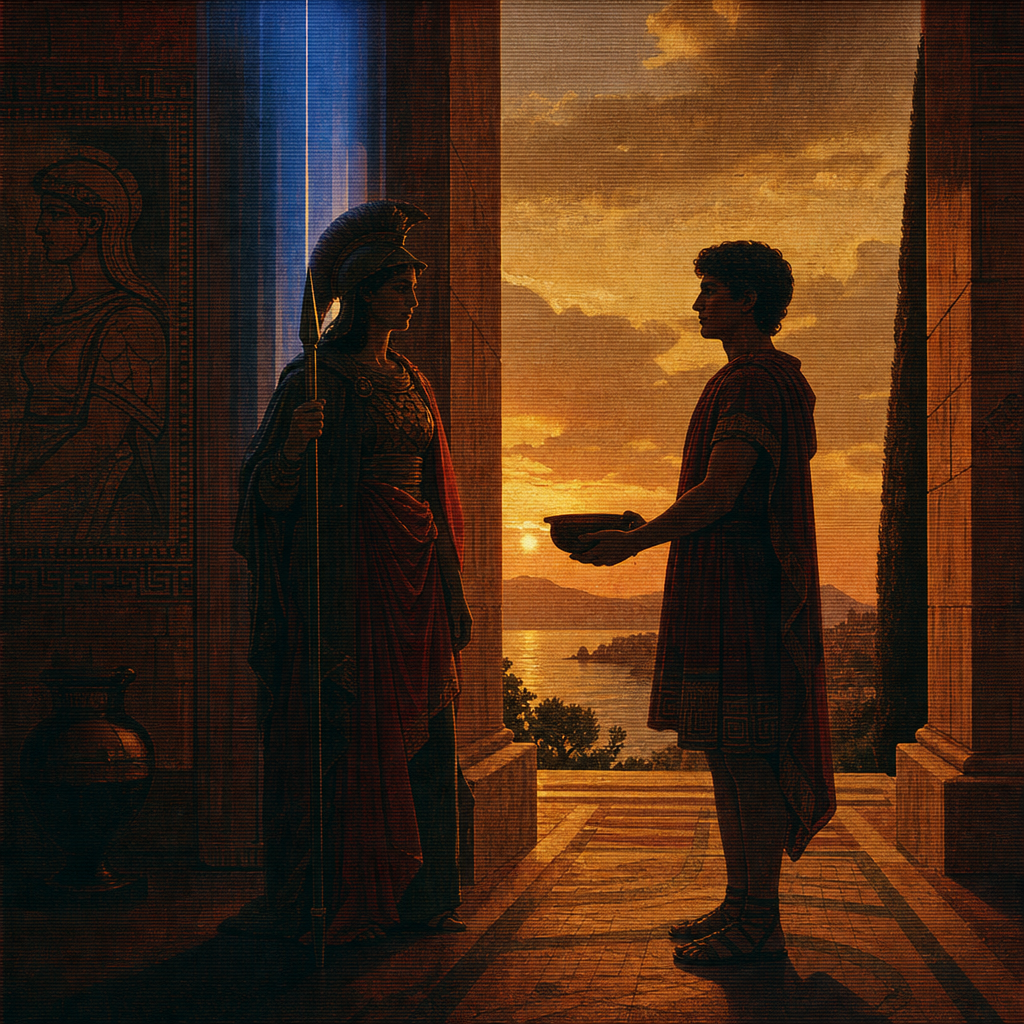
Tell me, Muse, of the man of many turns, who was driven far and wide after he sacked the sacred citadel of Troy. He saw the cities of many men and learned their minds, and on the sea he suffered many griefs in his heart, striving to save his own life and bring his companions home. Yet even so he could not save his companions, eager though he was, for they perished through their own reckless folly—fools, who devoured the cattle of Hyperion the Sun, and the Sun took from them the day of their return. Begin wherever you choose in the story, goddess, daughter of Zeus, and tell it to us too.
Read Ancient Greek Source (Odyssey.1.1–Odyssey.1.10)
By then all the others, all who had escaped sheer destruction, were at home, having escaped both war and the sea. Odysseus still longed for home and his wife. He alone was held back by the queenly nymph Calypso, radiant among goddesses, in her hollow caves; she craved him for her husband. Yet when, as the years revolved, that year came in which the gods spun the thread for him to return home to Ithaca, not even then had he escaped his struggles, even among his own loved ones. All the gods pitied him except Poseidon, who raged relentlessly against godlike Odysseus before he reached his own land.
Read Ancient Greek Source (Odyssey.1.11–Odyssey.1.21)
But Poseidon had gone to visit the far-off Ethiopians—the Ethiopians, divided in two at the farthest edge of mankind, some where Hyperion sets and some where he rises—to accept a great sacrifice of bulls and rams. There he sat taking pleasure in the feast, while the other gods were gathered together in the halls of Olympian Zeus. Among them the father of men and gods began to speak, for in his heart he remembered noble Aegisthus, whom Agamemnon’s far-famed son Orestes had killed. Thinking of him, Zeus spoke out among the immortals:
Read Ancient Greek Source (Odyssey.1.22–Odyssey.1.31)
“Look now, how mortals blame the gods! They say their evils come from us, when they themselves, by their own reckless folly, suffer sorrows beyond their fate—just as Aegisthus now, beyond his fate, took the wedded wife of the son of Atreus in marriage and killed the man on his return, though he knew it meant sheer ruin. For we ourselves had warned him beforehand, sending keen-eyed Hermes, the slayer of Argus, that he must neither kill the man nor woo his wife, since vengeance for the son of Atreus would come from Orestes once he grew to manhood and longed for his own land. So Hermes spoke, with good counsel, yet he could not sway the mind of Aegisthus; and now Aegisthus has paid for it all at once.”
Read Ancient Greek Source (Odyssey.1.32–Odyssey.1.43)
Then the goddess, bright-eyed Athena, answered him: “Father of us all, son of Cronus, highest of rulers, that man surely lies dead in the ruin he deserved. So may anyone else perish who does such things! Yet my heart is torn for wise Odysseus, that ill-fated man, who far from his loved ones has long suffered torment on a wave-washed island, where the navel of the sea lies. It is a wooded island, and a goddess makes her home there, the daughter of deadly-minded Atlas, who knows the depths of the whole sea and himself holds the tall pillars that keep earth and heaven apart. His daughter holds that grieving, wretched man back, forever charming him with soft and beguiling words so that he will forget Ithaca; yet Odysseus, longing to see even the smoke leaping up from his own land, yearns to die. Still your own heart is not moved, Olympian. Did Odysseus not please you by offering sacrifices beside the Argive ships in broad Troy? Why then are you so angry with him, Zeus?”
Read Ancient Greek Source (Odyssey.1.44–Odyssey.1.62)
Cloud-gathering Zeus answered her and said: “My child, what a word has escaped the barrier of your teeth! How could I ever forget godlike Odysseus, who excels all mortals in mind, and beyond all others gave sacrifices to the immortal gods who hold wide heaven? But earth-embracing Poseidon is forever, relentlessly enraged on account of the Cyclops, whom Odysseus blinded in his eye—godlike Polyphemus, whose strength is greatest among all the Cyclopes. The nymph Thoosa, daughter of Phorcys, ruler of the barren salt sea, bore him after she lay with Poseidon in hollow caves. From that day on, Poseidon the earth-shaker has not killed Odysseus, but drives him wandering from his fatherland. But come, let all of us here together work out his homecoming, so that he may return. Poseidon will let go of his anger, for he will never be able to strive alone against the will of all the immortal gods.”
Read Ancient Greek Source (Odyssey.1.63–Odyssey.1.79)
Then the goddess, bright-eyed Athena, answered him: “Father of us all, son of Cronus, highest of rulers, if indeed this is now pleasing to the blessed gods, that resourceful Odysseus should return to his own home, then let us send Hermes the guide, the slayer of Argus, to the island of Ogygia, so that at once he may declare to the fair-haired nymph our unerring resolve: the homecoming of steadfast Odysseus, that he is to return. Meanwhile I will go to Ithaca, to urge his son on all the more and put courage in his heart, so that he will call the long-haired Achaeans to assembly and speak out to all the suitors, who forever slaughter his thronging sheep and shambling, curved-horned cattle. And I will send him to Sparta and to sandy Pylos to ask after his dear father’s homecoming, in case he hears some word, and so that he may win good renown among mankind.”
Read Ancient Greek Source (Odyssey.1.80–Odyssey.1.95)
So she spoke, and beneath her feet she bound her fine sandals, immortal and golden, which carried her over the wet sea and over the boundless earth with the blasts of the wind. She seized her mighty spear, tipped with sharp bronze—heavy, huge, and sturdy—with which she, daughter of the mighty father, breaks the ranks of warrior men against whom she is angered. She darted down from the peaks of Olympus and stood in the land of Ithaca at the outer gate of Odysseus, on the threshold of the courtyard. In her grip she held the bronze spear, taking the likeness of a stranger, Mentes, leader of the Taphians.
Read Ancient Greek Source (Odyssey.1.96–Odyssey.1.105)
There she found the haughty suitors. Right then they were amusing themselves with game-stones in front of the doors, sitting on the hides of cattle they themselves had killed. Heralds and brisk attendants served them: some mixed wine and water in the mixing bowls, others washed the tables with porous sponges and set them out, while still others divided abundant meat. Godlike Telemachus was by far the first to see her, for he was sitting among the suitors, troubled at heart, picturing in his mind his noble father—if only he might come from somewhere, scatter the suitors throughout the halls, win back his own honor, and be master in his own house. Dwelling on these thoughts as he sat among the suitors, he caught sight of Athena.
Read Ancient Greek Source (Odyssey.1.106–Odyssey.1.118)
He went straight to the outer gate, indignant in his heart that a stranger should stand so long at the doors. Stepping up close, he clasped her right hand, took the bronze spear, and addressed her with winged words: “Welcome, stranger! You will be treated as a friend among us; and afterward, once you have shared our meal, you can tell us what you need.” So speaking, he led the way, and Pallas Athena followed him.
Read Ancient Greek Source (Odyssey.1.119–Odyssey.1.125)
When they were inside the high-roofed hall, he carried the spear and set it against a tall pillar inside a polished spear-rack, where many other spears of steadfast Odysseus stood. He led her to a fine, richly worked high chair, spread a linen cloth over it, and seated her there, with a footstool beneath her feet. Beside his guest, Telemachus set an inlaid chair for himself, apart from the others, the suitors, so that the stranger would not be troubled by their uproar and lose all pleasure in the meal from sitting among arrogant men, and so that Telemachus could ask about his own absent father. A maidservant brought water for their hands and poured it from a fine golden pitcher over a silver basin for them to wash, and drew a polished table to their side. The respected housekeeper brought bread and set it before them, adding many dishes from her store and giving generously of what was at hand. A carver lifted platters of meat of every kind and set them down, and placed golden cups beside them, while a herald came by often to pour their wine.
Read Ancient Greek Source (Odyssey.1.126–Odyssey.1.143)
Then the haughty suitors came in. At once they took their seats in rows on the low chairs and high seats. Heralds poured water over their hands, enslaved women piled bread in baskets beside them, and young men filled the mixing bowls to the brim with drink. They reached out their hands to the good food spread ready before them. When the suitors had satisfied their desire for drink and food, their thoughts turned to other pleasures, to song and dance, for those are the crowning grace of a feast. A herald placed a beautiful lyre in the hands of Phemius, who sang among the suitors under compulsion; and stroking the strings, he struck up a fine song.
Read Ancient Greek Source (Odyssey.1.144–Odyssey.1.155)
Meanwhile Telemachus spoke to bright-eyed Athena, leaning his head close so the others would not hear: “Dear guest, will you take offense at what I am about to say? These men care only for such things, the lyre and the song—and easily enough, since they devour another man’s livelihood with impunity, the substance of a man whose white bones are likely rotting in the rain where they lie on dry land, or tumbling in the waves of the sea. If they ever saw him returned to Ithaca, every one of them would pray for faster feet rather than greater wealth in gold and fine clothes. But as it is, he has died a grim death, and there is no comfort left for us, even if someone among men on earth claims he will come back; the day of his homecoming is gone. But come, tell me this and tell it truly: who are you among men, and where do you come from? Where are your city and your parents? On what kind of ship did you arrive, and how did the sailors bring you to Ithaca? Who did they claim to be? For I hardly think you came here on foot. And tell me this truly as well, so that I may know for certain: are you visiting here for the first time, or are you my father’s guest-friend? For many other men used to come to our house, since he too moved much among mankind.”
Read Ancient Greek Source (Odyssey.1.156–Odyssey.1.177)
Then the goddess, bright-eyed Athena, answered him: “Then I will tell you all this quite truly. I declare that I am Mentes, wise Anchialus’s son, and I rule over the oar-loving Taphians. Just now I put in here with my ship and my companions, sailing across the wine-dark sea to men of foreign speech, bound for Temese after bronze, and I carry gleaming iron. My ship lies moored off the open country, away from the city, in the harbor of Rheithron, beneath wooded Neion. We claim to be guest-friends of one another from our fathers’ days, from long ago, as you can learn if you go and ask the old man, the hero Laertes, who they say no longer comes into the city, but stays far out in the country, suffering grief with an old serving woman who sets out food and drink for him whenever weariness takes hold of his limbs as he creeps along the rising ground of his wine-growing vineyard. Now I have come here because people said he was back in the land—your father—yet the gods are still hindering his journey. For godlike Odysseus has not yet died upon the earth, but is still alive somewhere, held back on the broad sea upon a wave-washed island, and harsh men hold him fast, savages who must be keeping him there against his will.
Read Ancient Greek Source (Odyssey.1.178–Odyssey.1.199)
“Yet now I will prophesy to you, just as the immortals place it in my heart and as I think it will come to pass, though I am no prophet and no expert in the omens of birds. He will not stay away much longer from his dear native land, not even if iron bonds hold him fast; he will contrive a way to return, for he is a man of many resources. But come, tell me this and tell it truly, whether indeed you, grown so tall, are the son of Odysseus himself. In your head and your fine eyes you look astonishingly like that man, for we used to spend much time together before he embarked for Troy, where the others too, the best of the Argives, sailed in their hollow ships. Since that day I have not seen Odysseus, nor has he seen me.”
Read Ancient Greek Source (Odyssey.1.200–Odyssey.1.212)
Then thoughtful Telemachus answered her: “Then, guest, I will tell you all this quite truly. My mother says that I am his, though I myself do not know; for no one ever knows his own parentage for himself. How I wish I were the son of some fortunate man whom old age overtook among his own possessions! Instead, people say I was born from the man who proved the most ill-fated of mortal men, since you ask me this.”
Read Ancient Greek Source (Odyssey.1.213–Odyssey.1.220)
Then the goddess, bright-eyed Athena, answered him: “Surely the gods have not left your family line to go nameless hereafter, not when Penelope has borne a son such as you. But come, tell me this and tell it truly: what feast is this, and what is this crowd? What need do you have of it? Is it a banquet or a wedding feast? For this is clearly no meal where each man brings his share, so insolently and arrogantly do they seem to me to be feasting through the hall. Any sensible man who came among them would be outraged to see so many shameful acts.”
Read Ancient Greek Source (Odyssey.1.221–Odyssey.1.229)
Then thoughtful Telemachus answered her: “Guest, since you ask and question me about these things, once this house was bound to be wealthy and above reproach, for as long as that man was still here in his own land. Now the gods have willed otherwise, devising trouble, and they have made him vanish without a trace beyond all other men. I would not grieve so bitterly even for his death, if he had been brought down among his comrades in the land of the Trojans, or in the arms of his friends after he had wound up the war. Then all the Achaeans would have raised a burial mound for him, and he would have won great renown hereafter for his son as well. But now the snatching winds have swept him away without glory; he is gone, unseen, unheard of, and has left me pain and lamentation. Nor do I weep and groan for him alone, since the gods have fashioned other bitter sorrows for me. For all the leading men who hold power in the islands—in Dulichium, and Same, and wooded Zacynthus—and all who rule across rocky Ithaca, every one of them is courting my mother and wearing down our house. She neither refuses the hateful marriage nor is she able to carry it through to completion; meanwhile they eat and waste away my household, and soon they will tear me apart as well.”
Read Ancient Greek Source (Odyssey.1.230–Odyssey.1.251)
Stung with indignation, Pallas Athena spoke to him: “What an outrage! Truly, with Odysseus gone so long, you sorely need him here to lay his hands on these shameless suitors! If only he would come now and stand at the outer doorway of the hall, holding a helmet and a shield and two spears, just such a man as he was when I first saw him in our house, drinking and taking his pleasure, on his way back from Ephyra, from the home of Ilus son of Mermerus—for Odysseus had gone even there aboard a swift ship in search of a man-killing poison, so that he might have it to smear on his bronze-tipped arrows; yet Ilus would not give it to him, because he stood in awe of the gods who live forever, but my father gave it to him, for he loved him fiercely—if Odysseus were such a man when he met these suitors face to face, every one of them would find a swift death and a bitter wedding. Still, these things lie on the knees of the gods, whether he will return and take vengeance in his own halls, or whether he will not. But I urge you to consider how you may drive the suitors out of the hall.
Read Ancient Greek Source (Odyssey.1.252–Odyssey.1.270)
“Come now, listen closely and take heed of my words. Tomorrow, summon the Achaean warriors to an assembly, declare your word to them all, and let the gods be witnesses to it. Order the suitors to scatter, each to his own home; and as for your mother, if her heart is eager to marry, let her go back to the hall of her father, a man of great power; her kinsmen will arrange the wedding and prepare the bridal gifts, in rich abundance, all that should go with a beloved daughter. And for you yourself I have shrewd advice, if you will take it: fit out a ship with twenty oarsmen, the best vessel you have, and set out to ask for news of your long-absent father, in case some mortal can tell you, or you hear some rumor from Zeus, which above all carries report among mortals. First go to Pylos and question noble Nestor, and from there go on to Sparta, to fair-haired Menelaus, for he was the last of the bronze-clad Achaeans to reach home. If you hear that your father is alive and on his way home, then, hard-pressed though you are, you could hold out for one more year. But if you hear that he is dead and no longer among the living, then return to your dear native land, heap up a burial mound for him, and over it pay the funeral honors, in full measure, all that is due, and give your mother to a husband.
Read Ancient Greek Source (Odyssey.1.271–Odyssey.1.292)
“Then, once you have finished and carried out all these things, consider carefully in your mind and in your heart how you may kill the suitors inside your own halls, whether by trickery or in open fight. You must no longer cling to childish ways, for you are past that age now. Have you not heard what fame noble Orestes won among all humankind when he killed his father’s murderer, crafty Aegisthus, who had slain his famous father? You too, my friend—for I see how tall and handsome you are—be valiant, so that even men yet unborn will speak well of you. Now I will go back down to my swift ship and to my companions, who must be growing restless waiting for me. See to all this yourself, and take my words to heart.”
Read Ancient Greek Source (Odyssey.1.293–Odyssey.1.305)
Thoughtful Telemachus answered her in turn: “Stranger, truly you speak these words out of kindness, like a father to his son, and I will never forget them. But come, stay a little longer, eager though you are for your journey, so that after you have bathed and refreshed your heart, you may go to your ship with a gift in hand, glad in spirit—something precious and very fine, which will be a keepsake for you from me, the kind of gift dear hosts give to their guests.”
Read Ancient Greek Source (Odyssey.1.306–Odyssey.1.313)
Then the goddess, bright-eyed Athena, answered him: “Do not hold me back any longer now, when I am eager for the road. Whatever gift your heart prompts you to give me, give it to me on my way back, to carry home with me—and choose a very fine one; it will bring you a worthy return.” With those words bright-eyed Athena departed, flying upward like a bird. In his heart she planted strength and courage, and made him remember his father even more than before. Recognizing this in his mind, he was struck with wonder at heart, for he sensed that she was a god. At once Telemachus, that godlike man, went to join the suitors.
Read Ancient Greek Source (Odyssey.1.314–Odyssey.1.324)
For them the famous singer was singing, and in silence they sat listening; he sang of the Achaeans’ homecoming—that bitter return from Troy which Pallas Athena had laid upon them. From her upper chamber, the daughter of Icarius, wise Penelope, heard his inspired song and took it to heart. Down the high staircase of her house she came, not alone, for two attendant women went with her. When that noble woman reached the suitors, she stood beside the pillar of the strongly built roof, holding her glistening veil before her cheeks, while a trusted attendant stood on either side of her. Bursting into tears, she spoke to the divine singer: “Phemius, you know many other songs to charm mortals, deeds of men and of gods, the things that singers celebrate. Sit beside them and sing one of those, and let them drink their wine in silence; but stop singing this bitter song, which always wears down the heart in my chest, since unforgettable grief has struck me most of all. For I long for one so dear, remembering him always—a man whose fame is wide through Hellas and the heart of Argos.”
Read Ancient Greek Source (Odyssey.1.325–Odyssey.1.344)
Thoughtful Telemachus answered her in turn: “Mother, why do you begrudge the loyal singer giving delight wherever his mind moves him? It is not the singers who are to blame; rather, Zeus is to blame, who deals out to bread-eating mortals, to each one, whatever he wills. There is no blame in his singing the bitter doom of the Danaans, for people praise that song most of all which rings newest in the ears of those who hear it. So let your heart and spirit bear up and listen. Odysseus was not the only one who lost the day of his homecoming at Troy; many other men perished there too. Go back to your quarters now and tend to your own work, the loom and the distaff, and tell your maids to set about their tasks. Speech will be the business of men, all men, and above all mine; for mine is the authority in this house.” Struck with wonder, she went back to her quarters, for she took her son’s sensible words to heart. Going upstairs to her chamber with her waiting-women, she wept there for Odysseus, her dear husband, until bright-eyed Athena cast sweet sleep upon her eyelids.
Read Ancient Greek Source (Odyssey.1.345–Odyssey.1.364)
Meanwhile the suitors broke into an uproar through the shadowy halls, and every man of them prayed to lie beside her in bed. Then clear-headed Telemachus began to speak to them: “Suitors of my mother, in all your overbearing insolence, for now let us enjoy our feast, and let there be no shouting, since it is a fine thing to listen to a singer such as this man, with a voice like the gods. At dawn let us go to the assembly place and take our seats, all of us, so I may give you my blunt command: leave these halls! Go prepare other feasts, eating up your own goods, taking turns from house to house. But if it seems better and more profitable to you that one man’s livelihood should be wasted with impunity, then strip it bare. I will call upon the everlasting gods, in hope that Zeus may someday grant payback for what you do; then you would perish inside these halls unavenged.” So he spoke, and they all bit their lips, marveling at Telemachus for speaking so boldly.
Read Ancient Greek Source (Odyssey.1.365–Odyssey.1.382)
Then Antinous, son of Eupeithes, answered him: “Telemachus, surely the gods themselves are teaching you to talk so high and mighty and speak so boldly. May the son of Cronus never make you king in sea-girt Ithaca, though it is your birthright from your father.”
Read Ancient Greek Source (Odyssey.1.383–Odyssey.1.387)
Clear-headed Telemachus answered him in turn: “Antinous, will you take offense at what I am about to say? I would gladly accept even that, if Zeus were to give it. Or do you claim this is the worst thing that can happen to a man? It is no bad thing at all to be a king: his house quickly grows wealthy, and he himself holds greater honor. Still, there are many other kings of the Achaeans here in sea-girt Ithaca, both young and old, and one of them may hold this place, since godlike Odysseus is dead. But I myself will be master of our own house and of the slaves whom godlike Odysseus captured for me.”
Read Ancient Greek Source (Odyssey.1.388–Odyssey.1.398)
Then Eurymachus, son of Polybus, answered him in turn: “Telemachus, that matter rests on the knees of the gods—who shall be king of the Achaeans in sea-girt Ithaca. But may you keep your possessions yourself and be master in your own house. May the man never come who would use force against your will to strip away your possessions, so long as Ithaca is still inhabited. But I want to ask you, my good friend, about that stranger: where does the man come from, what land does he claim as his own, and where are his family and his native soil? Does he bring some news of your father on his way home, or did he come here pursuing some business of his own? How suddenly he sprang up and left, and did not stay for us to know him! By his face, he looked like no base man.”
Read Ancient Greek Source (Odyssey.1.399–Odyssey.1.411)
Clear-headed Telemachus answered him in turn: “Eurymachus, my father’s homecoming is surely lost. I put no trust in any news anymore, wherever it may come from, nor do I care for any prophecy that my mother may ask from a seer she has summoned into the hall. That stranger is a family guest-friend of mine from Taphos; he is Mentes, and claims to be the son of wise Anchialus, and he rules over the oar-loving Taphians.” So Telemachus spoke, though in his heart he knew the immortal goddess. The suitors turned to dancing and lovely song, taking their pleasure, and waited for evening to come on. And as they took their pleasure, dark evening came upon them; then each man went to his own house to lie down and sleep.
Read Ancient Greek Source (Odyssey.1.412–Odyssey.1.424)
Turning many things over in his mind, Telemachus went to bed in his high bedroom, built in the fine courtyard in a place with a clear view all around. With him, carrying blazing torches, went devoted Eurycleia, daughter of Ops the son of Peisenor. Laertes had once bought her with his own wealth when she was still in her first youth, giving the price of twenty oxen; he honored her in his halls as he did his own loyal wife, though he never lay with her in bed, so as to avoid his wife’s anger. She carried the blazing torches with Telemachus now, for she loved him more than any other of the enslaved women did, and had nursed him when he was little. He opened the doors of the solidly built bedroom, sat down on the bed, pulled off his soft tunic, and laid it in the careful old woman’s hands. She folded and smoothed the tunic, hung it on a peg beside the jointed bedstead, and went out of the bedroom, pulling the door shut by its silver handle and drawing the bolt home with the strap. There, all night long, wrapped in the softest fleece of a sheep, he weighed in his mind the journey that Athena had shown him.