Book 19: The Reconciliation of Achilles and Agamemnon
Ἰλιάς · Book 19 · Classix Modern English Reading Edition
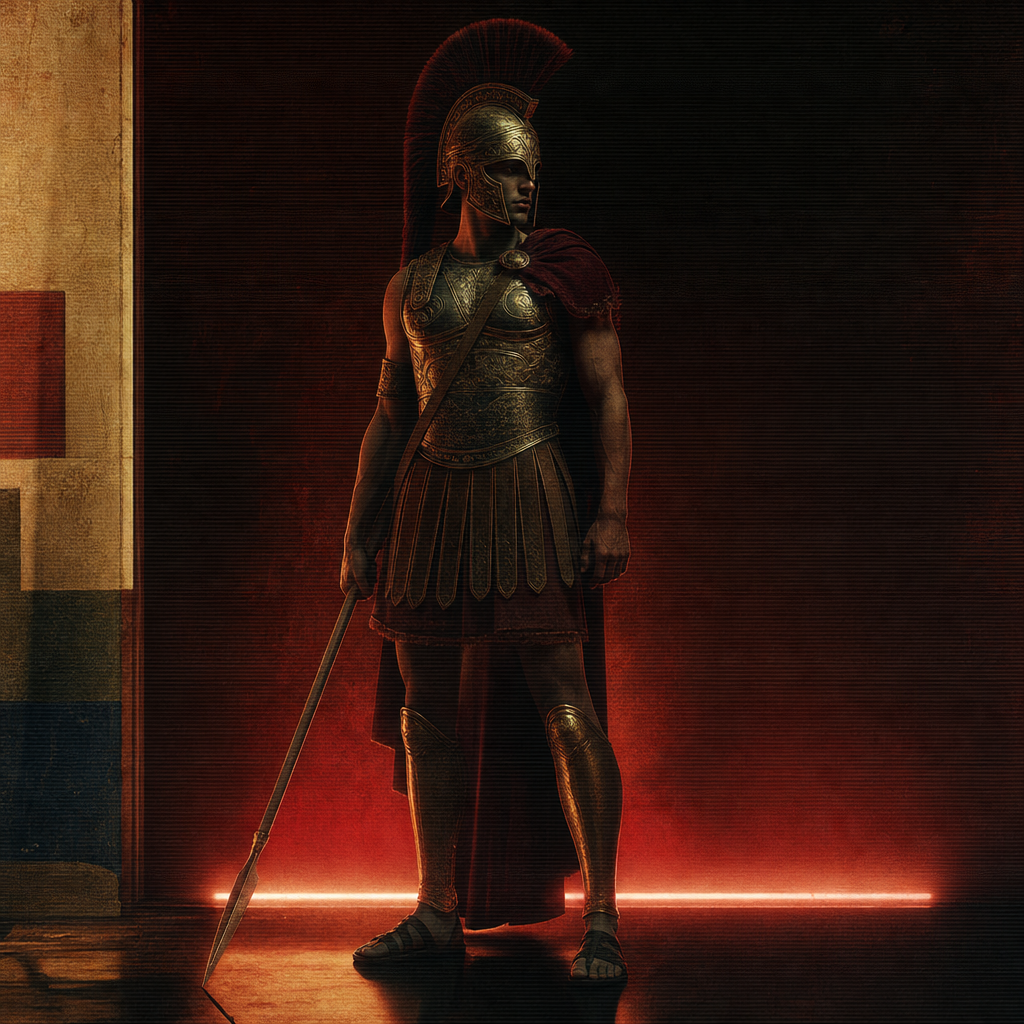
Dawn in her saffron robe rose from the currents of Ocean to bring light to immortals and to mortal men, while Thetis came to the ships carrying the gifts from the god. She found her dear son lying with his arms flung around Patroclus, weeping shrill and loud, as his many companions mourned in tears around him. The shining goddess stood among them, clasped his hand in hers, spoke to him, and called him by name:
Read Ancient Greek Source (Iliad.19.1–Iliad.19.7)
"My child, grieving though we are, we must let this man lie where he is, since once and for all he has been brought down by the will of the gods. Now accept from Hephaestus this glorious armor, surpassingly fine, such as no man has ever worn upon his shoulders."
Read Ancient Greek Source (Iliad.19.8–Iliad.19.11)
So the goddess spoke, and she set the armor down in front of Achilles, and all the intricate pieces rang out aloud. Trembling seized all the Myrmidons; not one of them dared to look straight at it, and they shrank back in fear. But the moment Achilles saw it, rage sank deeper into him, and his eyes shone out terribly from beneath his lids like a flare of fire. He rejoiced as he held the shining gifts of the god in his hands; and when he had delighted his heart by gazing at the intricate work, at once he spoke winged words to his mother:
Read Ancient Greek Source (Iliad.19.12–Iliad.19.20)
"My mother, the god has given me armor worthy of immortal craftsmanship, such as no mortal man could fashion. Now I will arm myself; yet I am terribly afraid that in the meantime flies may slip into the wounds that bronze tore in the brave son of Menoetius and breed maggots inside them, disfiguring his corpse—for the life has been driven out of him—and all his flesh may rot."
Read Ancient Greek Source (Iliad.19.21–Iliad.19.27)
Then the silver-footed goddess Thetis answered him: "Child, do not let these things weigh on your mind. I will see to warding off from him the fierce swarms of flies that devour men killed in battle. Even if he lies here for the full circle of a year, his flesh will always remain sound, or even better than before. But call the Achaean heroes to the assembly, renounce your wrath against Agamemnon, shepherd of the people, and arm yourself quickly for war, and put on your fighting strength."
Read Ancient Greek Source (Iliad.19.28–Iliad.19.36)
So she spoke, and she breathed bold, unshakeable spirit into him; then on Patroclus she shed ambrosia and red nectar, dripping it through his nostrils so that his flesh would stay sound.
Read Ancient Greek Source (Iliad.19.37–Iliad.19.39)
Meanwhile godlike Achilles strode along the shore of the sea, shouting a terrible cry, and roused the Achaean heroes. And even those who before had always stayed among the gathered ships—the steersmen who handled the rudders of the vessels and the stewards by the ships who portioned out the food—even they came then to the assembly, because Achilles had appeared at last after staying so long away from painful battle. Two attendants of Ares, Tydeus's son, steadfast in war, and godlike Odysseus, came limping along, leaning on their spears, for they still had painful wounds; they came forward and sat down in the front row of the assembly. Last of all came Agamemnon, lord of men, nursing a wound; for in the fierce clash of battle Coon, Antenor's son, had stabbed him too with a bronze-tipped spear.
Read Ancient Greek Source (Iliad.19.40–Iliad.19.53)
When all the Achaeans were gathered together, swift-footed Achilles stood up and spoke among them: "Son of Atreus, was this really any better for the two of us—for you and for me—when with grief in our hearts we raged in a soul-devouring quarrel over a girl? I wish Artemis had killed her at the ships with an arrow on the day I took her after laying waste to Lyrnessus! Then not so many Achaeans would have bitten the vast earth under the hands of our enemies while I held fast to my wrath. For Hector and the Trojans it was a gain; but the Achaeans, I think, will long remember this quarrel of yours and mine. Still, grieving though we are, let us leave what is past to be past, subduing the heart within our chests by necessity. Now I put an end to my anger; it is not for me to rage on relentlessly forever. Come then, quickly urge the long-haired Achaeans into battle, so that I may go out against the Trojans and test them once more, to see if they wish to spend the night by the ships. Among them, I think, any man will gladly bend his knee to rest who escapes out of the fierce fighting before my spear."
Read Ancient Greek Source (Iliad.19.54–Iliad.19.73)
So he spoke, and the Achaeans in fine leg armor rejoiced that the great-hearted son of Peleus had renounced his wrath. Then Agamemnon, lord of men, spoke among them too, right from his seat where he was, without standing in their midst: "Friends, Danaan heroes, attendants of Ares, when a man stands to speak it is right to listen, and not fitting to interrupt; that is hard even on a skilled speaker. And in a great uproar of men, how can anyone hear or speak? Even a clear-voiced speaker is thwarted. I will address myself to the son of Peleus, but the rest of you Argives pay heed, and let each of you take in my words well. Often the Achaeans have spoken to me of this matter and reproached me for it; yet I am not to blame, but Zeus and Fate and the Fury who walks in darkness, who cast fierce delusion into my mind in the assembly on the day when I myself took away Achilles' prize of honor. But what could I do? A god brings all things to pass. Ate, Zeus's eldest daughter, is an accursed power of delusion who blinds everyone. Her feet are delicate, for she does not draw near the ground, but steps instead across the heads of men, bringing harm to humankind; and she has ensnared one man or another.
Read Ancient Greek Source (Iliad.19.74–Iliad.19.94)
"For once even Zeus was blinded—he who they say is the greatest of men and of gods; yet even him Hera, female though she was, deceived with her scheming on the day when Alcmene was about to give birth to mighty Heracles in well-crowned Thebes. Boasting aloud, he spoke among all the gods: 'Hear me, all you gods and all you goddesses, so that I may speak what the heart in my chest commands me. Today Eileithyia, goddess of childbirth pains, will bring a man into the light—one of the race of men who come from my own blood—and he will rule over all those who dwell around him.' With a plot in her heart, Queen Hera spoke to him: 'You will play the liar, and not fulfill your word after all. Come then, Olympian, swear me a binding oath that whoever of the men who come from the lineage of your blood falls on this day between a woman's feet shall truly rule over all those who dwell around him.' So she spoke, and Zeus did not perceive her cunning trick at all, but swore a great oath, and in doing so was terribly blinded. Hera darted away and left the peak of Olympus, and swiftly reached Achaean Argos, where she knew she would find the noble wife of Sthenelus, son of Perseus. She was carrying her dear son, and the seventh month had begun; Hera brought him out into the light even before his full term of months, while she stopped Alcmene's labor and held back the childbirth goddesses. Then she went herself to bring the news and spoke to Zeus, son of Cronus: 'Father Zeus, lord of the bright lightning, I will put a word in your mind. A noble man is already born who will rule over the Argives: Eurystheus, the son of Perseus's son Sthenelus, of your own lineage; it is not unfitting for him to rule the Argives.' So she spoke, and sharp grief struck him deep in his heart. At once, enraged in his heart, he seized Ate by her head of shining braids and swore a mighty oath that never again to Olympus and the starry sky would Ate return, she who blinds all. With those words he whirled her around in his hand and hurled her from the starry sky, and quickly she reached the works of men. Because of her he always groaned whenever he saw his dear son enduring degrading labor in the trials set by Eurystheus.
Read Ancient Greek Source (Iliad.19.95–Iliad.19.133)
"So I too, when great Hector of the flashing helmet was slaughtering the Argives by the sterns of the ships, could not forget Ate, by whom I was blinded at the first. But since I was blinded and Zeus stole away my wits, I want to make amends now and give boundless compensation. Rouse yourself for war, and urge on the rest of the army. Here I stand ready to deliver all the gifts, everything that godlike Odysseus went and promised you yesterday in your shelter. If you are willing, wait a little, eager though you are for Ares' battle, and my attendants will take the gifts from beside my ship and bring them to you, so that you may see that what I give will satisfy your heart."
Read Ancient Greek Source (Iliad.19.134–Iliad.19.144)
Swift-footed Achilles answered him: "Most glorious son of Atreus, Agamemnon, lord of men, as for the gifts, hand them over if you wish, as is fitting, or keep them with you. Right now let us turn our minds to battle at once; we must not stand here spinning out words or wasting time, for a great work still remains undone. Once again let a man see Achilles among the front fighters, shattering the Trojan ranks with his bronze spear; let each of you keep that in mind and fight his man."
Read Ancient Greek Source (Iliad.19.145–Iliad.19.153)
Resourceful Odysseus answered him: "Brave as you are, godlike Achilles, do not drive the sons of the Achaeans toward Ilion unfed to fight the Trojans. The battle will last no brief time once the massed ranks of men first clash and a god breathes fury into both sides. Instead, order the Achaeans by the swift ships to take food and wine, for in that lies spirit and fighting strength. No man can fight face to face without food all day long until the setting of the sun. Even if in his heart he burns to fight on, his limbs grow heavy without his knowing, thirst and hunger overtake him, and his knees fail him as he moves. But the man who has had his fill of wine and food and then fights all day long against the enemy keeps a bold heart within his chest, and his limbs do not grow weary before all draw back from the war.
Read Ancient Greek Source (Iliad.19.154–Iliad.19.170)
"Come then, dismiss the army and order them to make their meal ready. As for the gifts, let Agamemnon, lord of men, bring them into the middle of the assembly, so that all the Achaeans may see them with their own eyes and your own heart may be warmed. And let him stand up among the Argives and swear an oath to you that he never climbed into Briseis's bed or lay with her, as is the custom, my lord, of men and women; and let the spirit in your own chest be appeased as well. After that, let him make amends to you in his shelter with a rich feast, so that you will lack nothing of your due. And you, son of Atreus, in the future be more just toward others as well; for there is no fault in a king making amends to a man when the king was the first to act harshly."
Read Ancient Greek Source (Iliad.19.171–Iliad.19.183)
Then Agamemnon, lord of men, spoke to him in turn: "I am glad, son of Laertes, to hear these words of yours, for you have gone through everything and set it out in due measure. I am willing to swear this oath, as my own heart urges me, and I will not swear falsely before the gods. Let Achilles remain right here for now, eager though he is for Ares' battle, and let all the rest of you stay gathered here until the gifts arrive from my shelter and we cut the sacrifice for our solemn oaths. To you yourself I give this charge and command: choose young men, the noblest of all the Achaeans, to bring from beside my ship all the gifts that we promised yesterday to give Achilles, and to lead the women here. And let Talthybius quickly make ready a boar for me in the wide camp of the Achaeans to sacrifice to Zeus and Helios."
Read Ancient Greek Source (Iliad.19.184–Iliad.19.197)
Swift-footed Achilles answered him: "Most glorious son of Atreus, Agamemnon, lord of men, you ought to busy yourselves with these things at some other time, when there comes some lull in the fighting and no such fury is raging in my chest. Right now the men cut down by Hector, son of Priam, when Zeus gave him glory, lie mangled on the ground, while the two of you urge men to their meal! For my part, I would order the sons of the Achaeans into battle right now, fasting and unfed, and at sunset have them make ready a great supper, once we have avenged our disgrace. Before that, neither drink nor food could pass down my throat with my companion dead, who lies in my shelter mangled by the sharp bronze, turned toward the doorway, while around him our companions weep and mourn. So my heart cares nothing for those things, only for slaughter and blood and the agonized groaning of men."
Read Ancient Greek Source (Iliad.19.198–Iliad.19.214)
Resourceful Odysseus answered him: "Achilles, son of Peleus, greatest by far of the Achaeans, you are stronger than I am and mightier by no small measure with the spear, yet in judgment I might surpass you by far, since I was born earlier and know more. So let your heart be patient and listen to my words. Men quickly have their fill of battle, where the bronze strews the thickest straw upon the ground, yet the harvest is smallest when Zeus tips the scales, he who governs war as steward over men. The Achaeans cannot mourn a dead man by going hungry; for far too many fall thick and fast every single day—when could anyone catch his breath from toil? No, we must bury whoever dies, weeping for the day and keeping our hearts unyielding; and all who are left alive from hateful war must remember drink and food, so that clothed in unyielding bronze upon our flesh we may fight our foes all the more, relentlessly and without cease. Let no man among the troops hold back waiting for another summons; for this summons will mean ruin for anyone left behind at the ships of the Argives. Instead, let us charge in one body and rouse sharp Ares against the horse-taming Trojans."
Read Ancient Greek Source (Iliad.19.215–Iliad.19.237)
He spoke, and took with him the sons of glorious Nestor, along with Meges son of Phyleus, Thoas, Meriones, Lycomedes son of Creon, and Melanippus, and they went to the shelter of Agamemnon, son of Atreus. At once, no sooner was the word spoken than the work was done: from the shelter they carried seven tripods that Agamemnon had promised Achilles, twenty gleaming cauldrons, and twelve horses; and quickly they led out seven women skilled in faultless work, and as the eighth, fair-cheeked Briseis. Odysseus weighed out ten full talents of gold and led the way, while the young men of the Achaeans carried the gifts with him.
Read Ancient Greek Source (Iliad.19.238–Iliad.19.248)
They set them down in the middle of the assembly, and Agamemnon rose to his feet; and Talthybius, with a voice like a god's, stood beside the shepherd of the people, holding a boar in his hands. The son of Atreus drew with his hands the knife that always hung beside the great scabbard of his sword, cut the first bristles from the boar, and lifting his hands to Zeus prayed, while all the Argives sat in silence where they were, listening to their king as was fitting. Looking up into the wide sky, he prayed and spoke: "Let Zeus be witness first, highest and greatest of the gods, and Earth and the Sun and the Furies, who beneath the earth punish men, whoever swears a false oath: I have never laid a hand on the girl Briseis, either for my bed or for any other purpose, but she remained untouched in my shelter. If anything in this oath is false, may the gods give me many sorrows—all that they give to one who sins against them by a false oath."
Read Ancient Greek Source (Iliad.19.249–Iliad.19.265)
He spoke, and slit the boar's throat with the pitiless bronze, and Talthybius whirled and flung the carcass into the great gulf of the gray sea as food for the fish. Then Achilles rose and spoke among the war-loving Argives: "Father Zeus, great indeed are the delusions you send upon men! Never otherwise would the son of Atreus have stirred the spirit within my chest so utterly, nor led the girl away against my will, headstrong though he was; no, somehow Zeus wished that death should come to many Achaeans. Now go to your meal, so that we may bring on the clash of Ares." So he spoke, and quickly broke up the assembly.
Read Ancient Greek Source (Iliad.19.266–Iliad.19.276)
The men scattered, each to his own ship, while the great-hearted Myrmidons took charge of the gifts and went carrying them to the ship of godlike Achilles. They placed them in his shelter and seated the women, while his noble attendants drove the horses into the herd.
Read Ancient Greek Source (Iliad.19.277–Iliad.19.281)
Then Briseis, like golden Aphrodite, when she saw Patroclus mangled by the sharp bronze, flung herself upon him and wailed aloud, and with her hands tore at her breasts, her tender neck, and her lovely face. Weeping, the woman like a goddess spoke: "Patroclus, dearest of all to my wretched heart, I left you alive when I went from this shelter, and now on my return I find you dead, leader of men; so for me one sorrow always follows another. The husband to whom my father and honored mother gave me I saw mangled by the sharp bronze before our city, along with my three brothers, born of the same mother, all dear to me, who all met their day of destruction. Yet when swift Achilles killed my husband and sacked the city of godlike Mynes, you would never let me weep, but promised to make me godlike Achilles' wedded wife, and bring me in the ships to Phthia, and hold my wedding feast among the Myrmidons. So I weep without end for you, always gentle, now dead." So she spoke, weeping, and the women mourned with her, with Patroclus as the occasion, each grieving for her own sorrows.
Read Ancient Greek Source (Iliad.19.282–Iliad.19.302)
Around Achilles himself the elders of the Achaeans gathered, begging him to eat; but he refused with a groan: "I beg you, if any of my dear companions will listen to me, do not urge me yet to satisfy my heart with food or drink, for terrible grief has come upon me. Until the sun goes down I will wait and endure it all the same." With these words he sent the other kings away, but the two sons of Atreus stayed, along with godlike Odysseus, Nestor, Idomeneus, and the old charioteer Phoenix, trying earnestly to comfort him in his heavy grief; yet his heart found no comfort before he entered the jaws of bloody war.
Read Ancient Greek Source (Iliad.19.303–Iliad.19.313)
Remembering, he drew a deep, heavy sigh and spoke: "Once you too, ill-fated one, dearest of my companions, would set out a savory meal for me yourself in this shelter, quickly and deftly, whenever the Achaeans were in haste to bring tearful Ares against the horse-taming Trojans. Now you lie here mangled, and my heart goes without drink or food, though plenty is here inside, out of longing for you. For I could suffer no worse blow than this, not even if I heard of the death of my father—who now in Phthia must be shedding soft tears for want of such a son, while in a foreign land I fight the Trojans for the sake of horrible Helen—or of the dear son who is being raised for me on Scyros, if indeed godlike Neoptolemus is still alive. Before now, the heart in my chest had hoped that I alone would perish far from horse-pasturing Argos, right here in Troy, and that you would return to Phthia, so that in a swift black ship you could bring my boy out from Scyros and show him everything—my possessions, my slaves, and my great high-roofed hall. For by now I think Peleus must either be dead altogether, or else, barely still alive, he grieves in hateful old age, always waiting for the bitter news of me, for the day he hears that I have died." So he spoke, weeping, and the elders groaned with him, each remembering what he had left behind in his own halls.
Read Ancient Greek Source (Iliad.19.314–Iliad.19.339)
The son of Cronus saw them mourning and felt pity for them, and at once he spoke winged words to Athena: "My child, you have completely abandoned a noble man. Does Achilles no longer matter to your heart at all? There before the high-horned ships he sits mourning his dear companion, while the others have gone to their meal, and he stays fasting and unfed. Go now, and shed nectar and lovely ambrosia into his chest, so that hunger does not overtake him." So he spoke, urging on Athena, who was already eager. Like a long-winged, shrill-voiced hawk, she plunged down from heaven through the bright air. Meanwhile the Achaeans were arming at once throughout the camp; and she shed nectar and lovely ambrosia into Achilles' chest, so that joyless hunger would not reach his knees. Then she returned to the strong house of her mighty father, while the men poured out away from the fast ships.
Read Ancient Greek Source (Iliad.19.340–Iliad.19.356)
As thick snowflakes fly down from Zeus, icy cold beneath the blast of the North Wind born in the clear sky, so thick were the brightly gleaming helmets carried out from the ships, along with bossed shields, corselets with strong curved plates, and ash-wood spears. The brilliance reached the sky, and all the earth around laughed beneath the flash of bronze, while a heavy din rose under the feet of the men; and in their midst godlike Achilles armed himself. His teeth ground together aloud, and his two eyes blazed like a flare of fire, while unbearable grief sank into his heart; and raging against the Trojans, he put on the gifts of the god that Hephaestus had labored to make for him.
Read Ancient Greek Source (Iliad.19.357–Iliad.19.368)
First he placed the fine leg armor around his shins, fitted with silver ankle-clasps; second, he fastened the corselet around his chest. Around his shoulders he slung the silver-studded bronze sword, and next he took up the great, sturdy shield, and its gleam shone far out like the moon. Just as to sailors out at sea the light appears from a blazing fire that burns high up in the mountains at a lonely shepherd's fold, while storm winds carry them against their will over the fish-filled sea, far from their loved ones, so the gleam from Achilles' fair, finely worked shield went up into the bright air. Lifting the heavy helmet, he set it upon his head; and the horsehair-crested helmet shone like a star, while around it waved the golden plumes that Hephaestus had set thick along the ridge. Then godlike Achilles tested himself in the armor to see if it fitted him and his splendid limbs moved freely inside it; and it became like wings to him, lifting up the shepherd of the people. Out from its case he drew his father's spear, heavy, huge, and sturdy. No other of the Achaeans could brandish it, and Achilles alone knew how to wield it: the Pelian ash spear, which Chiron had brought from the peak of Pelion and given to Achilles' dear father, to bring death to heroes.
Read Ancient Greek Source (Iliad.19.369–Iliad.19.391)
Meanwhile Automedon and Alcimus busied themselves with the horses and yoked them; they fastened the fine breast-straps around them, put the bits between their jaws, and stretched the reins back to the tight-jointed chariot. Then Automedon took the bright, well-fitted whip in his hand and sprang up behind the horses; and behind him stepped Achilles in full armor, blazing in his gear like shining Hyperion, the sun. Terribly he shouted to his father's horses: "Xanthus and Balius, far-famed children of Podarge, take better care this time to bring your rider safely back to the host of the Danaans when we have had our fill of war, and do not leave him dead on the field, as you left Patroclus."
Read Ancient Greek Source (Iliad.19.392–Iliad.19.403)
Then from beneath the yoke spoke the nimble-footed horse Xanthus, and at once he bowed his head, so that all his mane streamed down from the yoke-pad beside the yoke and touched the ground; and the white-armed goddess Hera gave him a voice: "Yes, for this time still we will bring you safely back, mighty Achilles; yet the day of your destruction is near. Nor are we to blame, but a great god and mighty Fate. For it was not through any slowness or sluggishness of ours that the Trojans stripped the armor from Patroclus's shoulders; no, the finest of the gods, whom lovely-haired Leto bore, killed him among the front fighters and gave the glory to Hector. The two of us could run even with the blast of the West Wind, which men say is the swiftest of all; yet for you yourself it is fated to be overpowered by force, by a god and a mortal man." When he had spoken so, the Furies stopped his voice.
Read Ancient Greek Source (Iliad.19.404–Iliad.19.418)
Deeply troubled, swift-footed Achilles answered him: "Xanthus, why do you prophesy my death? You have no need to. I know well enough myself that it is my fate to perish here, far from my dear father and mother; yet even so, I will not stop until I have given the Trojans their fill of war." He spoke, and with a shout among the front ranks he drove on his solid-hoofed horses.