Book 21: The Contest of the Great Bow
Ὀδύσσεια · Book 21 · Classix Modern English Reading Edition
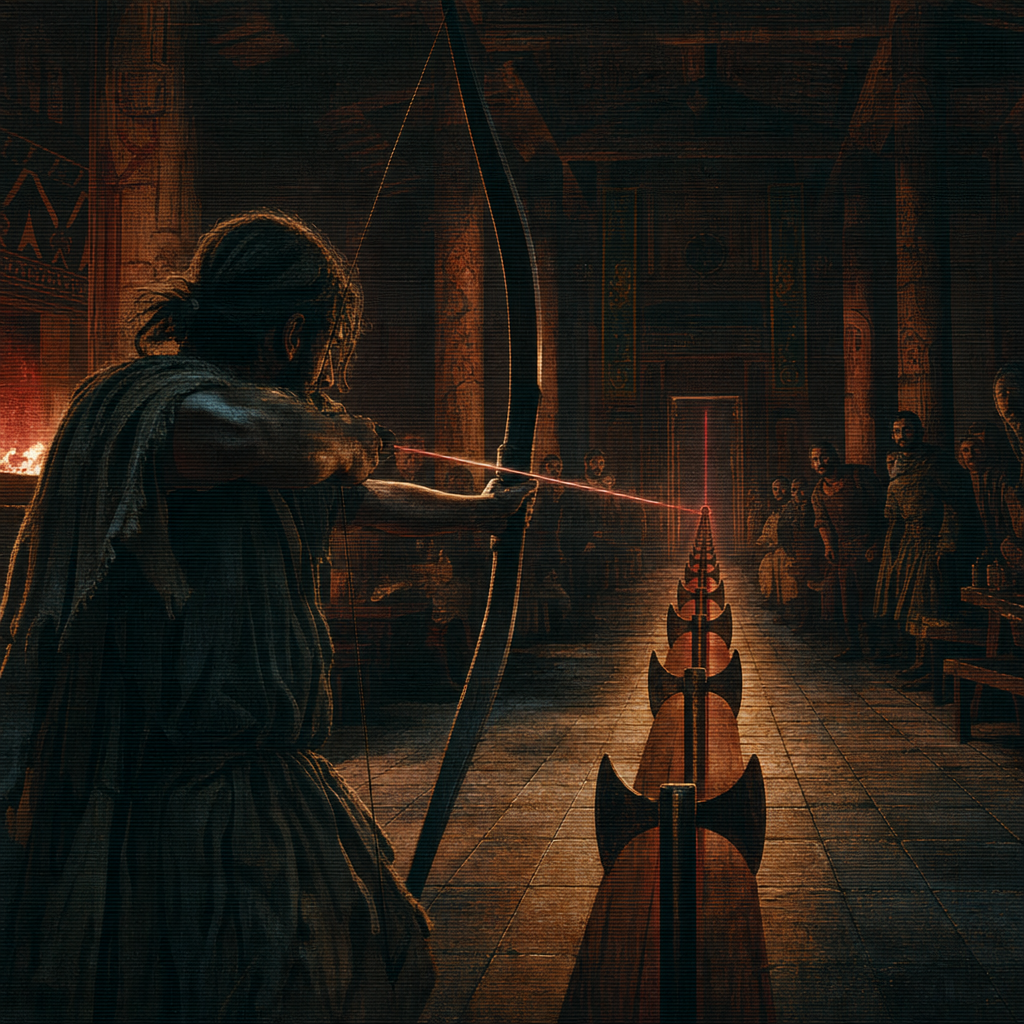
Then gray-eyed Athena put it into the mind of Icarius’ daughter, thoughtful Penelope, to set the bow and gray iron before the suitors in Odysseus’ hall, a contest and the beginning of their murder. She climbed the high stair of her house and took in her strong hand a finely curved bronze key with an ivory handle. With her women attendants she went to the innermost storeroom, where her lord’s treasures lay: bronze and gold and iron worked with toil. There lay the back-bending bow and the quiver that held its arrows, many arrows that would bring groans. Iphitus, Eurytus’ son, a man like the immortals, had given them to Odysseus as a guest-friend when they met in Lacedaemon.
Read Ancient Greek Source (Odyssey.21.1–Odyssey.21.14)
The two had encountered one another in Messene, in the house of wise Ortilochus. Odysseus had come over a debt the whole people owed him: Messenian men had carried off three hundred sheep from Ithaca, with their shepherds, in many-benched ships. Odysseus had traveled that long road on an embassy for their sake, young as he was, sent by his father and the other elders. Iphitus, for his part, was searching for twelve mares he had lost, with hardworking mule foals beneath them. Those mares would later bring him death and doom, when he reached the stout-hearted son of Zeus, Heracles, the man who knew mighty deeds. Heracles killed him in his own house, though he was his guest—the brutal man, with no respect for the gods’ vengeance or the table he had set before him. He killed Iphitus and kept the strong-hoofed mares in his hall.
Read Ancient Greek Source (Odyssey.21.15–Odyssey.21.30)
While searching for them, Iphitus met Odysseus and gave him the bow that great Eurytus had carried before him and left to his son when he died in his lofty house. Odysseus gave Iphitus a sharp sword and a strong spear, the beginning of a close bond of hospitality. But they never knew one another at the table: before that could happen, Zeus’ son killed Iphitus, Eurytus’ son, a man like the immortals, who had given Odysseus the bow. Godlike Odysseus never took it when he went to war in his black ships. It lay there in the hall as a keepsake of his dear guest-friend, though he carried it in his own country.
Read Ancient Greek Source (Odyssey.21.31–Odyssey.21.41)
When the radiant woman reached the storeroom, she stepped onto the oak threshold that a craftsman had once skillfully smoothed and straightened to a line, fitting doorposts into it and setting shining doors on them. Quickly she loosened the strap from the door ring, put in the key and aimed straight to shoot back the bolts. The doors bellowed like a bull grazing in a meadow—so loudly did the fine doors roar at the stroke of the key—and quickly opened before her. She stepped onto a raised platform where chests stood, filled with fragrant clothes. Reaching up, she took the bow from its peg, with the shining case that covered it. She sat down there, laid it on her knees, drew her lord’s bow out, and wept aloud. When she had had her fill of tearful grief, she went to the hall among the splendid suitors, carrying the back-bending bow and the quiver, with its many groan-bringing arrows. Her attendants carried a chest beside her, containing much iron and bronze, her lord’s equipment for the contest.
Read Ancient Greek Source (Odyssey.21.42–Odyssey.21.62)
When that radiant woman reached the suitors, she stood beside a pillar of the strongly built roof, holding her shining veil before her cheeks, a faithful attendant at either side. At once she addressed the suitors. “Listen, proud suitors, who have taken over this house for endless eating and drinking while its master has been away so long. You could find no other excuse for your talk than your desire to marry me and make me your wife. Come then, suitors, here is your contest. I will set out the great bow of godlike Odysseus. Whichever man most easily strings it in his hands and shoots through all twelve axes, I will follow, leaving this house where I came as a bride, so beautiful, so full of wealth. I think I will remember it even in my dreams.”
Read Ancient Greek Source (Odyssey.21.63–Odyssey.21.79)
She told Eumaeus, the noble swineherd, to set the bow and gray iron before the suitors. Weeping, Eumaeus took them and laid them down. Elsewhere the cattle keeper wept too when he saw his lord’s bow. Antinous rebuked them. “Foolish countrymen, whose thoughts last a day! You miserable pair, why shed tears and stir the woman’s heart, when her spirit already lies in pain because she has lost her dear husband? Sit and feast in silence, or go outside to weep and leave the bow here for the suitors, a decisive contest. I don’t think this polished bow will be easy to string. Among all these men there is no one like Odysseus. I saw him myself and remember him, though I was still a little child.” So he said, but in his breast his heart hoped to string the cord and shoot through the iron. In truth he would be the first to taste an arrow from the hands of blameless Odysseus, whom he was now dishonoring as he sat in the hall, stirring all his companions against him.
Read Ancient Greek Source (Odyssey.21.80–Odyssey.21.100)
Telemachus spoke in his strength. “Well now! Zeus, Cronus’ son, must have made me a fool. My dear mother, wise though she is, says she will follow another man and leave this house, yet here I am laughing and delighting in my senseless heart. Come then, suitors, here is your contest for a woman whose like cannot be found in all Achaean land, in holy Pylos, Argos or Mycenae, here in Ithaca or on the dark mainland. You know that yourselves. Why do I need to praise my mother? Don’t put us off with excuses or keep avoiding the bow’s stringing. Let us see. I too would try the bow. If I can string it and shoot through the iron, my honored mother will not leave this house with another man to my grief, with me left behind already able to take up my father’s fine contest weapons.”
Read Ancient Greek Source (Odyssey.21.101–Odyssey.21.117)
He sprang upright, took the scarlet cloak from his shoulders, and laid his sharp sword aside. First he set up the axes. He dug one long trench for them all, straightened them to a line and packed earth around them. Everyone who saw was amazed at how neatly he set them, though he had never seen it done before. Then he went to the threshold and tried the bow. Three times he made it tremble, straining to draw it; three times he relaxed his effort, still hoping in his heart to string the cord and shoot through the iron. On the fourth attempt he would indeed have strung it by force, but Odysseus shook his head and stopped him, eager though he was. Telemachus spoke again in his strength. “Well, will I prove weak and helpless after all? Or am I too young still, not yet sure of my hands when I must fend off a man who attacks me first? Come, you who have more strength than I do, try the bow, and let us finish the contest.” He set the bow down on the ground, leaning it against the smooth, fitted boards, and rested the swift arrow beside its handsome curved tip. Then he sat again on the chair from which he had risen.
Read Ancient Greek Source (Odyssey.21.118–Odyssey.21.139)
Antinous, Eupeithes’ son, addressed them. “Get up in order, friends, all going to the right, beginning at the place where the wine is poured.” His proposal pleased them. Leodes, Oenops’ son, rose first. He was their diviner of sacrifices and always sat in the farthest corner beside the fine mixing bowl. He alone hated their reckless deeds and resented all the suitors’ conduct. Now he was the first to take up the bow and swift arrow. He went to the threshold and tried the bow, but could not string it. His soft, uncalloused hands tired first as he pulled. He spoke to the suitors. “Friends, I cannot string it. Let someone else take it. This bow will rob many of the best men of heart and life. It is far better to die than to live and fail in the thing for which we always gather here, waiting day after day. Even now a man hopes and longs in his heart to marry Penelope, Odysseus’ wife. But when he has tried the bow and seen, let him court some other Achaean woman in fine robes, seeking her with marriage gifts. Then let Penelope marry whoever gives the most and comes as her destined man.”
Read Ancient Greek Source (Odyssey.21.140–Odyssey.21.162)
He put the bow aside, leaning it against the smooth, fitted boards, and rested the swift arrow beside its handsome curved tip. Then he sat again on the chair from which he had risen. Antinous rebuked him. “Leodes, what words have escaped the fence of your teeth? Terrible, grievous words—I resent hearing them! This bow will rob the best men of heart and life just because you cannot string it? Your honored mother did not bear you to draw a bow and arrows. But other splendid suitors will soon string it.” Then he ordered Melanthius the goatherd, “Quick, Melanthius, light a fire in the hall, set a large stool beside it with a fleece on top, and bring a great round of the fat stored inside. Then we young men can warm the bow, rub it with grease and try it, and finish the contest.” Melanthius at once kindled the tireless fire, brought a stool and put a fleece on it, and fetched a great round of fat from inside. Warming the bow with it, the young men tried, but could not string it. They fell far short of the strength required. Antinous and godlike Eurymachus still held back, the leaders of the suitors, by far the best in prowess.
Read Ancient Greek Source (Odyssey.21.163–Odyssey.21.187)
The cattle keeper and the swineherd of godlike Odysseus went out of the house together. Godlike Odysseus himself followed them. When they were outside the doors and courtyard, he addressed them gently. “Herdsman, and you, swineherd, shall I say something, or keep it to myself? My heart urges me to speak. What kind of defenders would you be for Odysseus if he came from somewhere, very suddenly, brought here by a god? Would you support the suitors or Odysseus? Tell me what your hearts and spirits command.” The cattle keeper answered him. “Father Zeus, if only you would fulfill this wish! Let that man come, let some god bring him! You would see what strength I have, and what my hands can do.” Eumaeus likewise prayed to all the gods that Odysseus of the many plans would return to his own house.
Read Ancient Greek Source (Odyssey.21.188–Odyssey.21.204)
When he had truly learned their minds, he answered them again. “Here I am, the man himself. After much toil and suffering I have come to my native land in the twentieth year. I know that I find you two alone among the slaves longing for me. I have heard none of the others pray that I might come home again. I’ll tell you the truth, just as it will happen. If a god brings the proud suitors down beneath my hands, I will find wives for both of you and give you possessions and houses built near mine. Then I will count you as Telemachus’ companions and brothers. Come, I’ll show you another unmistakable sign, so you can know me well and be sure in your hearts: the scar where a boar struck me with its white tusk when I went to Parnassus with Autolycus’ sons.”
Read Ancient Greek Source (Odyssey.21.205–Odyssey.21.220)
He moved his rags aside from the great scar. When they had seen and examined it closely, they threw their arms around wise Odysseus and wept, kissing his head and shoulders in their welcome. Odysseus likewise kissed their heads and hands. The sunlight would have gone down on their weeping if Odysseus himself had not stopped them. “Stop your tears and lamenting. Someone might come out of the hall, see us and tell them inside. Go in one after another, not all together: I first, then you. Let this be our arrangement. All the proud suitors will refuse to let anyone give me the bow and quiver. But you, noble Eumaeus, carry the bow through the hall and put it into my hands. Tell the women to close the hall’s closely fitted doors. If any of them hears groaning or the crash of men inside our enclosure, she must not come out, but stay there silently at her work. And you, noble Philoetius, I order to lock the courtyard gates and quickly fasten a binding on them.”
Read Ancient Greek Source (Odyssey.21.221–Odyssey.21.241)
He went into the well-appointed house and sat on the stool from which he had risen. The two slaves of godlike Odysseus came inside as well. Eurymachus was already handling the bow, warming it here and there in the glow of the fire. Even so he could not string it, and his proud heart groaned deeply. In vexation he spoke. “What grief for me, for myself and all of us! It isn’t so much the marriage I mourn, distressed though I am. There are many other Achaean women, here in sea-girt Ithaca and in other cities. But if we fall so far short of godlike Odysseus in strength that we cannot string his bow, the disgrace will be heard of even by people yet to come.”
Read Ancient Greek Source (Odyssey.21.242–Odyssey.21.255)
Antinous, Eupeithes’ son, answered him. “Eurymachus, it won’t be so. You know it yourself. Today the holy feast of the god is being kept throughout the land. Who would be stringing bows? Set it down and be at ease. We may leave all the axes standing: I don’t think anyone will come into the hall of Odysseus, Laertes’ son, and take them away. Come, let the cupbearer make a first serving into the cups, so we can pour libations and put down the curved bow. In the morning tell Melanthius the goatherd to bring goats, the finest by far in all his flocks. Then we can offer thighbones to Apollo, famed for his bow, and try the bow and finish the contest.”
Read Ancient Greek Source (Odyssey.21.256–Odyssey.21.268)
His proposal pleased them. Heralds poured water over their hands; young men filled the mixing bowls to the brim and served everyone, beginning with a first portion in the cups. When they had poured libations and drunk as much as they wished, Odysseus, master of schemes, spoke with a trick in mind. “Listen, suitors of our renowned queen, while I say what the heart in my breast commands. I appeal above all to Eurymachus and godlike Antinous, since he has rightly said that we should leave the bow alone now and entrust it to the gods. In the morning a god will give victory to whomever he wishes. But come, give me the polished bow, so I too can test my hands and strength among you: do I still have the power my supple limbs once had, or have wandering and neglect destroyed it?”
Read Ancient Greek Source (Odyssey.21.269–Odyssey.21.284)
They were all furious, afraid he might string the polished bow. Antinous rebuked him. “Wretched stranger, you haven’t a scrap of sense. Aren’t you glad to feast quietly among us proud men, with no lack of food, and hear our talk and speeches? No other stranger or beggar hears what we say. Honey-sweet wine is biting you, as it harms anyone who gulps it down instead of drinking properly. Wine led even the famed Centaur Eurytion astray in the hall of great-hearted Peirithous, when he came among the Lapiths. His wits deranged by wine, he raged and did evil things through Peirithous’ house. The heroes were seized with grief. They sprang up and dragged him through the entrance and outside, slicing off his ears and nose with merciless bronze. He went away, his mind clouded, carrying his ruin in a senseless heart. From that time strife arose between Centaurs and men, and drunken Eurytion first found trouble for himself. So I foretell great suffering for you too if you string the bow. You will find no kindness from anyone in our land. At once we’ll send you in a black ship to King Echetus, the ruin of all men. You won’t be saved from there. Drink quietly and don’t contend with younger men.”
Read Ancient Greek Source (Odyssey.21.285–Odyssey.21.310)
Thoughtful Penelope answered him. “Antinous, it is neither right nor just to cheat any guest of Telemachus who comes to this house. Do you expect that, if the stranger strings Odysseus’ great bow, trusting in his hands and his own strength, he will take me home and make me his wife? He himself surely has no such hope in his heart. None of you should sit feasting here in distress for that reason. It would be quite improper.” Eurymachus, Polybus’ son, answered her. “Daughter of Icarius, thoughtful Penelope, we don’t think this man will take you away. That would be improper. We are ashamed of what men and women will say. Some Achaean, another man worse than we are, may say, ‘Far inferior men court a blameless man’s wife: they cannot even string his polished bow. But some other fellow, a beggar who has wandered here, easily strung the bow and shot through the iron.’ That is what they’ll say, and it would be a disgrace to us.”
Read Ancient Greek Source (Odyssey.21.311–Odyssey.21.329)
Thoughtful Penelope answered him. “Eurymachus, men who dishonor and devour the household of a noble man cannot have a good name among the people. Why make this into a disgrace? This stranger is tall and strongly built, and claims to be the son of a good father. Come, give him the polished bow, so we can see. I tell you this, and I will do it: if he strings it and Apollo gives him glory, I’ll dress him in a cloak and tunic, fine clothes, and give him a sharp spear to fend off dogs and men, and a double-edged sword. I’ll give him sandals for his feet and send him wherever his heart and spirit tell him.”
Read Ancient Greek Source (Odyssey.21.330–Odyssey.21.342)
Sensible Telemachus answered her. “Mother, no Achaean has a greater right than I to give the bow to whomever I choose, or refuse it: none of the men who rule rugged Ithaca, nor any on the islands toward horse-pasturing Elis. No one among them will force me against my will if I wish to give this bow to the stranger to take away for good. Go to your rooms and see to your own work, the loom and spindle, and tell the attendants to get on with theirs. The bow will be the concern of the men, of all of them, but most of all of me: the power in this house is mine.” Astonished, she went back to her rooms, taking her son’s sensible words to heart. She went upstairs with her women attendants and wept for Odysseus, her dear husband, until gray-eyed Athena cast sweet sleep over her eyelids.
Read Ancient Greek Source (Odyssey.21.343–Odyssey.21.358)
The noble swineherd took up the curved bow and carried it. All the suitors shouted through the hall. One of the arrogant young men would say, “Where are you taking the curved bow, you worthless swineherd, you vagabond? Soon the swift dogs you raised will eat you out among your pigs, alone, far from men, if Apollo and the other immortal gods favor us.” He put it down where he stood, afraid because so many shouted in the hall. From the other side Telemachus called out a threat. “Old father, bring the bow on! You won’t do well by obeying everyone. Take care I don’t chase you back to the fields with stones, young though I am. I’m stronger than you. If only I were as far above all these suitors here in strength of hand and body! Then I would soon send some of them on a hateful journey out of our house, since they devise wickedness.” All the suitors laughed pleasantly at him, and relaxed their fierce anger toward Telemachus. The swineherd carried the bow through the hall, stood beside wise Odysseus and placed it in his hands.
Read Ancient Greek Source (Odyssey.21.359–Odyssey.21.379)
He called out to the nurse Eurycleia. “Thoughtful Eurycleia, Telemachus tells you to close the hall’s closely fitted doors. If any woman hears groaning or the crash of men inside our enclosure, she must not come out, but stay there silently at her work.” She took his words to heart and shut the doors of the well-appointed rooms. In silence Philoetius leaped outside and closed the gates of the well-enclosed courtyard. A papyrus cable from a curved ship lay beneath the portico. He bound the gates with it, went back inside and sat on the stool from which he had risen, watching Odysseus. Odysseus was turning the bow over in his hands, testing it all around to see whether worms had eaten the horn while its master was away. One man would look at his neighbor and say, “He must be an admirer of bows, or a sly dealer in them. Perhaps he has bows like this at home, or plans to make one. Look how he turns it this way and that, the tramp, so skilled in mischief.” Another arrogant young man would say, “May he get just as much good as he has any chance of stringing that bow!”
Read Ancient Greek Source (Odyssey.21.380–Odyssey.21.403)
So the suitors spoke. But when Odysseus, master of schemes, had handled the great bow and looked at it from every side, he strung it as easily as a man skilled in the lyre and song stretches a string around a new peg, fastening the well-twisted sheep gut at either end. So effortlessly Odysseus strung the great bow. He took the string in his right hand and tested it; it sang beautifully beneath his touch, with a swallow’s voice. Great grief came upon the suitors; every man’s color changed. Zeus thundered loudly, showing his signs, and steadfast, godlike Odysseus rejoiced that the son of crooked-minded Cronus had sent him an omen. He took up a swift arrow that lay bare beside him on the table. The others lay inside the hollow quiver, and the Achaeans would soon taste them.
Read Ancient Greek Source (Odyssey.21.404–Odyssey.21.418)
He laid it along the bow, drew the string and the arrow’s notched end, and from where he sat on the stool sent the arrow straight at his aim. Beginning at the first handle socket, he missed none of the axes: the bronze-weighted arrow went right through and out beyond. He addressed Telemachus. “Telemachus, the stranger sitting in your hall has brought no disgrace on you. I did not miss the mark or toil long at stringing the bow. My strength is still sound, despite what the suitors say to insult and scorn me. Now it is time to prepare supper for the Achaeans while it is still light, and then find other pleasures in song and the lyre: they are the ornaments of a feast.” He gave a signal with his brows. Telemachus, godlike Odysseus’ dear son, slung on his sharp sword, closed his hand around his spear, and stood close beside his father’s chair, armed in gleaming bronze.