Book 20: Signs and Omens on the Eve of the Contest
Ὀδύσσεια · Book 20 · Classix Modern English Reading Edition
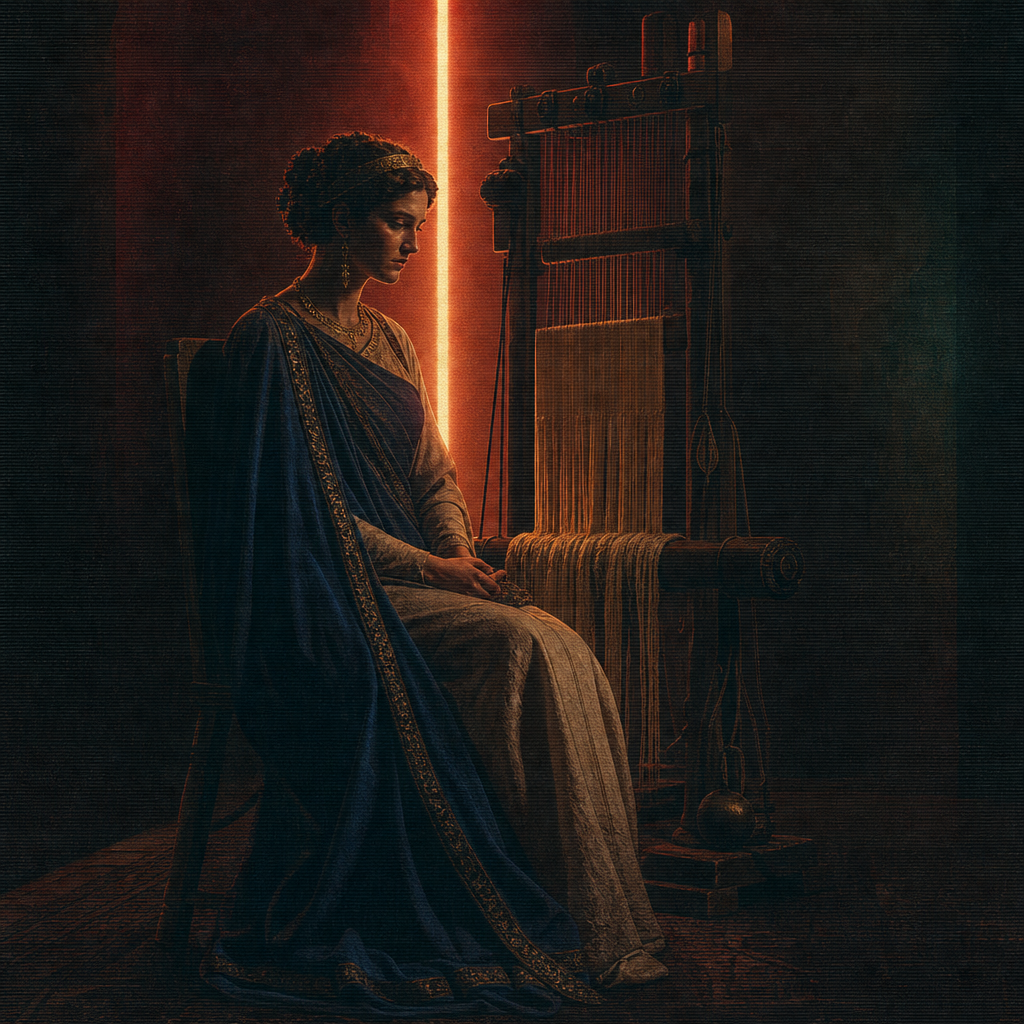
Godlike Odysseus made his bed in the entrance hall. He spread an untanned oxhide on the ground and over it many fleeces from sheep the Achaeans had slaughtered. Eurynome laid a cloak over him when he lay down. There Odysseus lay awake, planning trouble for the suitors in his heart. The women who had been sleeping with the suitors came out of the hall, laughing and making merry with one another. His spirit stirred in his chest. He pondered deeply whether to rush after them and bring death to each, or let them join the overbearing suitors one last time, their final time. His heart barked within him. As a dog standing over her tender puppies barks at a stranger and longs to fight, so his heart barked within him in anger at their evil deeds.
Read Ancient Greek Source (Odyssey.20.1–Odyssey.20.16)
He struck his chest and rebuked his heart. “Endure, heart! You have endured something more doglike still, on the day the irresistible Cyclops devoured my strong companions. You held firm until cunning brought you out of the cave when you expected to die.” So he spoke, chiding his dear heart in his chest, and his heart remained obedient, steadfastly enduring. But he himself rolled from side to side. As a man turns a stomach full of fat and blood this way and that over a great blazing fire, eager to have it quickly cooked, so he rolled this way and that, wondering how he could lay hands on the shameless suitors, one man against many.
Read Ancient Greek Source (Odyssey.20.17–Odyssey.20.30)
Athena came close to him, descending from heaven in the form of a woman. She stood above his head and spoke. “Why are you awake again, most unfortunate of all men? Here is your house, your wife is here in it, and your son, such a son as any man would wish to have.” Odysseus, master of schemes, answered her. “Yes, goddess, everything you say is right. But this is what my heart keeps turning over: how can I lay hands on the shameless suitors, alone as I am, while they are always gathered together inside? And I have a greater worry still. Even if I kill them by your favor and Zeus’, where could I escape afterward? I ask you to consider that.”
Read Ancient Greek Source (Odyssey.20.31–Odyssey.20.43)
Gray-eyed Athena answered him. “Stubborn man! People trust even a weaker companion, a mortal who knows far fewer ways. I am a goddess, and I guard you constantly in all your troubles. I will tell you plainly: even if fifty bands of mortal men surrounded us, eager to kill us in battle, you could still drive off their cattle and fat sheep. Now let sleep take you too. It is misery to stay awake keeping watch all night. Soon you will come out from under your troubles.” She poured sleep over his eyelids, and the divine goddess went back to Olympus.
Read Ancient Greek Source (Odyssey.20.44–Odyssey.20.55)
As sleep seized him, loosening his limbs and releasing the cares in his heart, his faithful wife awoke. Sitting up in her soft bed, she wept. When her heart had had its fill of weeping, that radiant woman first prayed to Artemis. “Artemis, lady goddess, daughter of Zeus, if only you would shoot an arrow into my breast and take my life this instant! Or let a storm snatch me up and carry me away down the misty paths, to cast me at the mouths of backward-flowing Ocean. So the storms once carried off the daughters of Pandareus. The gods had destroyed their parents, and they were left orphaned in the house. Divine Aphrodite tended them with cheese, sweet honey and pleasant wine. Hera gave them beauty and good sense beyond all women; holy Artemis gave them stature, and Athena taught them to make splendid works.
Read Ancient Greek Source (Odyssey.20.56–Odyssey.20.72)
“But when divine Aphrodite went to high Olympus to ask for the girls’ fulfillment in a flourishing marriage—she went to Zeus who delights in thunder, for he knows everything, the good fortune and misfortune of mortal people—meanwhile the Harpies snatched the girls away and gave them to the hateful Furies to serve. So may the gods who dwell on Olympus make me vanish, or Artemis of the lovely braids strike me, so I can go beneath the hateful earth with Odysseus before my eyes, and never gladden the heart of a lesser man. Suffering can be borne when someone weeps by day, with grief deep in the heart, but sleep holds them by night. Once sleep covers the eyelids, it makes us forget everything, good and bad. But a god has sent me evil dreams as well. This very night someone lay beside me, looking just like him, as he was when he left with the army. My heart rejoiced: I thought it was no dream, but waking truth.”
Read Ancient Greek Source (Odyssey.20.73–Odyssey.20.90)
As she spoke, Dawn came on her golden throne. Godlike Odysseus heard her weeping voice. He wondered, and in his heart imagined that she already knew him and was standing by his head. He gathered the cloak and fleeces on which he had slept, laid them on a chair in the hall, and carried the oxhide outside. Raising his hands, he prayed to Zeus. “Father Zeus, if it was by your will that you gods brought me over dry land and water to my own country, after troubling me so cruelly, let someone among the people waking inside speak a word of omen for me, and let another sign from Zeus appear outside.” So he prayed, and Zeus the deviser heard him. At once he thundered from bright Olympus, high above from the clouds. Godlike Odysseus rejoiced.
Read Ancient Greek Source (Odyssey.20.91–Odyssey.20.104)
A woman grinding grain spoke a word from the nearby building where the shepherd of his people kept his mills. Twelve women labored at them, making barley meal and wheat flour, the marrow of men. The others slept, their wheat ground, but one had not yet stopped: she was the weakest of them all. She halted her mill and spoke, a sign for her master. “Father Zeus, ruler of gods and men, how loudly you have thundered from the starry sky, though there isn’t a cloud anywhere! You must be showing someone a sign. Grant me too, wretched as I am, the prayer I make. May the suitors take their pleasant feast in Odysseus’ hall today for the last time, the very last. They have weakened my knees with this heart-breaking labor, making their meal. May this be their final dinner!” Godlike Odysseus rejoiced at the omen of her words and at Zeus’ thunder. He believed he would punish the guilty men.
Read Ancient Greek Source (Odyssey.20.105–Odyssey.20.121)
The other enslaved women gathered in Odysseus’ fine house and kindled the tireless fire upon the hearth. Telemachus rose from bed, a man like a god. He put on his clothes, slung his sharp sword from his shoulder, tied fine sandals beneath his shining feet, and took a strong spear tipped with sharp bronze. He went to stand on the threshold and spoke to Eurycleia. “Dear nurse, did you honor the stranger in the house with food and a bed, or is he lying there just as he was, uncared for? That is my mother’s way, wise though she is. At random she honors a worse man and sends the better away dishonored.” Thoughtful Eurycleia answered him. “Child, don’t blame her now when she is blameless. He sat and drank as much wine as he wanted, but said he was no longer hungry when she asked about food. When he began to think of sleep and bed, she ordered the women to spread bedding for him. But like a man utterly wretched and ill-fated, he would not sleep in a bed with coverlets. He lay in the entrance hall on an untanned oxhide and sheep fleeces, and we put a cloak over him.” Telemachus went through the hall with his spear, two swift dogs following him, and made his way to the gathering place among the Achaeans in fine leg armor.
Read Ancient Greek Source (Odyssey.20.122–Odyssey.20.146)
Then that noble woman Eurycleia, daughter of Ops, Peisenor’s son, called to the enslaved women. “Quickly! Some of you get busy and sweep the hall, sprinkle it with water, and spread purple rugs over the well-made chairs. Others sponge all the tables clean and wash the mixing bowls and the two-handled cups. The rest of you go for water at the spring, and hurry back. The suitors won’t stay away from the hall long. They will come very early, since this is a feast day for everyone.” They listened and obeyed her. Twenty went to the dark-watered spring, while the others worked skillfully about the house.
Read Ancient Greek Source (Odyssey.20.147–Odyssey.20.159)
The Achaeans’ menservants came in and split wood carefully and well. The women returned from the spring. Then the swineherd came, driving three fat pigs, the best of all his stock. He let them feed within the fine enclosure and spoke gently to Odysseus. “Stranger, do the Achaeans show you any more regard now, or do they dishonor you in the hall just as before?” Odysseus, master of schemes, answered him. “Eumaeus, if only the gods would punish the shameful way these insolent men act, devising wickedness in another man’s house, without a trace of respect.”
Read Ancient Greek Source (Odyssey.20.160–Odyssey.20.171)
As they spoke together, Melanthius the goatherd came near, bringing goats, the finest in all his flocks, for the suitors’ dinner. Two herdsmen followed him. He tied the animals beneath the echoing portico and spoke mockingly to Odysseus. “Stranger, are you still going to plague the men here in the house with your begging? Won’t you get outside? I don’t think we will part now without a taste of one another’s fists, since you beg in such a disorderly way. The Achaeans have other feasts.” Odysseus, master of schemes, said nothing in reply. In silence he shook his head, brooding deep on trouble for the man.
Read Ancient Greek Source (Odyssey.20.172–Odyssey.20.184)
A third man came, Philoetius, a leader among men, bringing a barren cow and fat goats for the suitors. Ferrymen had brought them across, the men who carry any other traveler who comes to them. He tied the animals securely beneath the echoing portico, then stood near the swineherd and asked him, “Who is this stranger who has just come to our house, swineherd? What people does he claim as his own? Where are his family and native fields? Poor man, his body looks like a king’s. But the gods afflict men who wander far, when they spin sorrow even for kings.” He stood beside Odysseus, greeted him with his right hand and spoke these flying words: “Health to you, stranger, old father. May prosperity be yours hereafter, though many troubles hold you now. Father Zeus, no other god is more destructive than you! You yourself bring men into being, yet show them no pity when you plunge them into misery and bitter pain.
Read Ancient Greek Source (Odyssey.20.185–Odyssey.20.203)
“I broke into a sweat when I saw you; now my eyes fill with tears as I remember Odysseus. I think he too must be wandering among men in rags like yours, if he is still alive and sees the sunlight. But if he is already dead and in the house of Hades, then alas for blameless Odysseus! He put me in charge of his cattle among the Cephallenians when I was still a little boy. Now they breed beyond counting. No other man’s broad-browed cattle could have multiplied like this. Yet other men order me to bring the animals for them to eat. They pay no heed to the son in the house and have no fear of the gods’ vengeance. Already they are eager to divide the possessions of their long-absent lord. This thought keeps turning in my heart: it would be wrong, while his son is alive, to take the cattle and go among strangers in another country. Yet it is worse to stay here suffering, watching over cattle that have passed to others. I would have fled long ago and gone to another of the mighty kings, since this is no longer bearable. But I still think of that unhappy man, hoping he may come from somewhere and scatter the suitors through his house.”
Read Ancient Greek Source (Odyssey.20.204–Odyssey.20.225)
Odysseus, master of schemes, answered him. “Herdsman, you seem neither a bad man nor a fool. I can see for myself that understanding has reached your mind. So I’ll tell you, and swear a great oath with it. Let Zeus be my first witness among the gods, and this table of hospitality and the hearth of blameless Odysseus to which I have come: while you are still here, Odysseus will come home. With your own eyes you will see, if you wish, the killing of the suitors who lord it here.” The man who tended the cattle answered, “Stranger, if only Cronus’ son would bring your words to pass! You would see what strength I have, and what my hands can do.” Eumaeus likewise prayed to all the gods that Odysseus of the many plans might return to his own house.
Read Ancient Greek Source (Odyssey.20.226–Odyssey.20.239)
While they were speaking together, the suitors were arranging death and doom for Telemachus. But a bird came to them on the left, a high-flying eagle holding a timid dove. Amphinomus addressed them. “Friends, this plan of ours won’t succeed, this murder of Telemachus. Let’s think of our feast instead.” His proposal pleased them. They came to godlike Odysseus’ house and laid their cloaks on couches and chairs. They slaughtered great sheep and fat goats, fattened pigs and a cow from the herd. They roasted and distributed the inner meats and mixed wine in bowls. The swineherd handed out cups; Philoetius, leader of men, distributed bread in fine baskets, and Melanthius poured the wine. They reached for the good things set ready before them.
Read Ancient Greek Source (Odyssey.20.240–Odyssey.20.256)
Telemachus, turning over his plans, seated Odysseus inside the well-built hall beside the stone threshold. He put down a shabby stool and a small table for him, set portions of the inner meats beside him, poured wine in a golden cup and said, “Sit here now and drink your wine among the men. I myself will keep every suitor’s insults and hands away from you. This house is not a public place: it belongs to Odysseus, and he acquired it for me. And you, suitors, restrain your urge to abuse him or strike, so no quarrel and strife breaks out.” They all bit their lips, astonished that Telemachus spoke so boldly. Antinous, Eupeithes’ son, addressed them. “Achaeans, hard as it is, let us accept what Telemachus says. He speaks with quite a threat against us. Zeus, Cronus’ son, would not allow it; otherwise we would have silenced him in this hall by now, clear-voiced speaker though he is.” So Antinous said, but Telemachus paid no heed to his words.
Read Ancient Greek Source (Odyssey.20.257–Odyssey.20.275)
Heralds led the sacred hundred-beast offering through the town for the gods, and the long-haired Achaeans gathered beneath the shady grove of Apollo who strikes from afar. In the house, when the men had roasted the outer meat and drawn it off the spits, they divided the portions and enjoyed a splendid feast. The servers set an equal portion beside Odysseus, the same as they themselves received: so Telemachus, godlike Odysseus’ dear son, had ordered.
Read Ancient Greek Source (Odyssey.20.276–Odyssey.20.283)
Athena would not let the proud suitors hold back entirely from their bitter insults, so that grief would sink still deeper into the heart of Odysseus, Laertes’ son. Among the suitors was a man who knew lawless ways, named Ctesippus, whose home was on Same. Trusting in his wondrous wealth, he courted the wife of long-absent Odysseus. Now he addressed the overbearing suitors. “Listen, proud suitors, while I tell you something. The stranger has long had an equal portion, as is proper. It is neither right nor just to cheat any guest of Telemachus who comes to this house. Come, I too will give him a guest-gift, so he can offer a reward to the bath attendant or some other slave in godlike Odysseus’ house.” With that he took an ox’s foot from a basket in his thick hand and threw it. Odysseus tilted his head a little and dodged it, giving a very grim smile within. The foot struck the well-built wall.
Read Ancient Greek Source (Odyssey.20.284–Odyssey.20.302)
Telemachus rebuked Ctesippus. “Ctesippus, it was much better for you that you failed to hit the stranger. He dodged the missile himself. Otherwise I would have struck you through the middle with my sharp spear, and your father would have busied himself here with your funeral instead of your wedding. Let no one display such outrages in my house. I already understand and know what is good and what is worse. Before, I was still a child. Even so, we have endured seeing all this: sheep slaughtered, wine drunk and bread consumed. It is hard for one man to hold back many. But stop doing me harm in your hostility. If you are eager to kill me myself with bronze, I would even choose it. It would be much better to die than to keep seeing these shameful acts: guests mistreated, and men dragging the enslaved women brutally through the fine house.”
Read Ancient Greek Source (Odyssey.20.303–Odyssey.20.319)
They all fell silent. At last Agelaus, Damastor’s son, spoke. “Friends, no one should get angry and lash out with hostile words at something fairly said. Don’t mistreat the stranger or any other of the slaves in godlike Odysseus’ house. But I would offer Telemachus and his mother some gentle advice, if it pleased the hearts of both. While you still hoped within your breasts that Odysseus of the many plans would return to this house, no one could blame you for waiting and keeping the suitors here: that was the better course if Odysseus returned and came back to his home. But now it is clear he will never return. Come, sit beside your mother and tell her to marry the best man, the one who gives the most. Then you can enjoy all your father’s possessions, eating and drinking, while she looks after another man’s house.”
Read Ancient Greek Source (Odyssey.20.320–Odyssey.20.337)
Sensible Telemachus answered him. “No, Agelaus! By Zeus and the sufferings of my father, who somewhere far from Ithaca has either died or wanders still, I am not delaying my mother’s marriage. I tell her to marry whomever she wishes and offer countless gifts besides. But I shrink from driving her unwilling from the hall with a command that forces her. May no god ever bring that about.”
Read Ancient Greek Source (Odyssey.20.338–Odyssey.20.344)
So Telemachus spoke. Pallas Athena stirred unquenchable laughter among the suitors and drove their minds astray. Now they laughed with jaws that seemed no longer their own. They ate meat spattered with blood, their eyes filled with tears, and their spirits foresaw lamentation. Godlike Theoclymenus spoke among them. “You wretches! What evil is this you suffer? Night wraps your heads and faces, and your knees below. Wailing blazes up, your cheeks are wet with tears, and the walls and fine crossbeams are sprayed with blood. The entrance is full of ghosts, the courtyard full, rushing toward Erebus beneath the gloom. The sun has vanished from the sky, and an evil mist spreads over everything.”
Read Ancient Greek Source (Odyssey.20.345–Odyssey.20.357)
They all laughed pleasantly at him. Eurymachus, Polybus’ son, began to speak. “This stranger who has just come from elsewhere has lost his wits. Young men, send him out of the house at once to the gathering place, since he thinks it is night in here.” Godlike Theoclymenus answered him. “Eurymachus, I haven’t asked you to give me guides. I have eyes, ears and both my feet, and a mind in my chest that is quite sound. I’ll use them to go outside, since I see disaster coming upon you. None of you suitors can escape or avoid it, you who insult men and devise wickedness in godlike Odysseus’ house.” With that he left the well-appointed house and went to Peiraeus, who welcomed him warmly.
Read Ancient Greek Source (Odyssey.20.358–Odyssey.20.372)
All the suitors looked at one another and taunted Telemachus, laughing at his guests. One of the arrogant young men would say, “Telemachus, no one has worse luck with guests than you! Look at this scrounging tramp you have, hungry for food and wine, with no skill for work and no strength, just a burden on the earth. Then another gets up to tell fortunes! But if you’d listen to me, it would be far more profitable: let’s put these guests aboard a many-benched ship and send them to the Sicels. They’d fetch you a decent price there.” So the suitors spoke, but he paid no heed. He watched his father silently, always waiting for the moment he would lay hands on the shameless suitors.
Read Ancient Greek Source (Odyssey.20.373–Odyssey.20.386)
Thoughtful Penelope, Icarius’ daughter, had placed her beautiful chair opposite them and heard what each man said in the hall. Laughing, they had prepared a sweet and satisfying dinner, for they had slaughtered a great many animals. But no supper could be more unwelcome than the one a goddess and a strong man would soon set before them: they had been the first to devise shameful deeds.