Book 1: Athena Visits Telemachus in Ithaca
Ὀδύσσεια · Book 1 · Classix 2026 Lyric-Poetic Edition
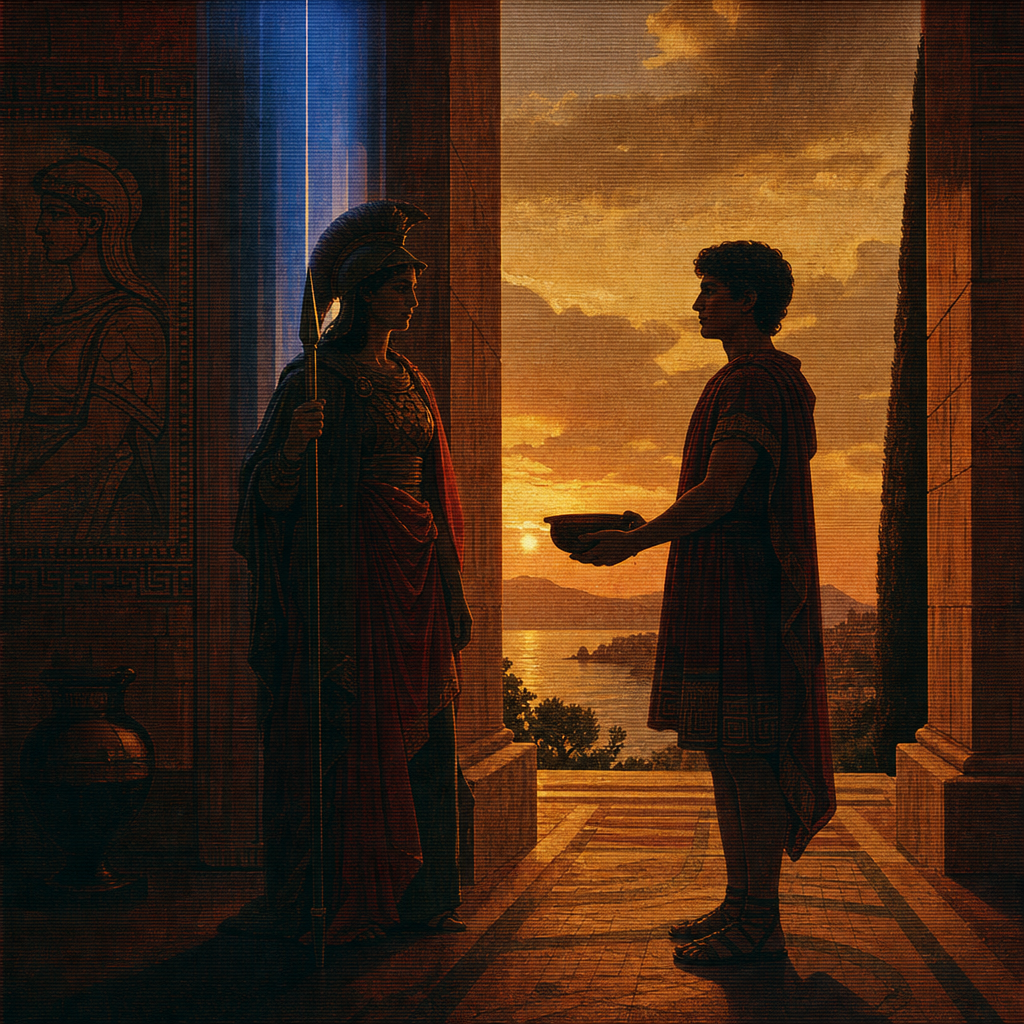
Tell me, Muse, about the man who knew every way through, driven so far off course after he tore sacred Troy to the ground. He saw the cities of strangers, learned the shape of their minds. Out on the open water, he took every blow in his chest, fighting to keep his own breath, fighting to bring his people home. He gave everything he had. He still couldn’t save them. They walked into the dark on their own— blind fools, they slaughtered and ate the cattle of Hyperion the Sun, and the Sun crossed out the day they would have walked through their own front doors. Daughter of Zeus—start wherever you want. Tell it to us too.
Read Ancient Greek Source (Odyssey.1.1–Odyssey.1.10)
Everyone else who had slipped death’s steep drop had made it home: the war behind them, the sea behind them. He alone was still held back, hungry for his country, hungry for his wife. Calypso, the nymph who ruled that island, a radiant goddess, kept him in her deep-cut caves. She wanted him beside her as her husband. The years came round until the year arrived the gods had threaded into his fate: his passage back to Ithaca. Even there, even with his own people around him, he would still have battles left to bear. All the gods pitied him. Poseidon alone kept his anger clenched against magnificent Odysseus, right up to the day he reached his native ground.
Read Ancient Greek Source (Odyssey.1.11–Odyssey.1.21)
Poseidon had traveled to the distant Ethiopians, people at the outer edge of the human world, divided between two horizons: where Hyperion sinks, and where he climbs into the sky. He went to accept a hundred-head sacrifice of bulls and rams, and sat enjoying their feast. The other gods had gathered in the palace of Zeus on Olympus. The father of gods and human beings opened the discussion. He had been thinking of noble Aegisthus, the man Agamemnon’s son Orestes had killed— Orestes, whose name had carried far. With that death on his mind, Zeus spoke to the gods who never die:
Read Ancient Greek Source (Odyssey.1.22–Odyssey.1.31)
“Incredible. The way these mortals put the blame on us. Every evil comes from the gods, they say, then break their own lives open through their crimes and suffer more than fate had set aside. Look at Aegisthus. He crossed that line himself: took the wedded wife of Atreus’ son, then murdered him when he returned. He knew the sheer drop waiting at his feet. We had warned him. We had sent the warning ourselves. We dispatched Hermes, the sharp-eyed killer of Argus: ‘Do not murder him. Do not pursue his wife. Orestes will make you pay for Atreus’ son when he comes of age and starts aching for his own country.’ Hermes meant to save him. He made it clear. Aegisthus would not let the warning in. Now the whole debt has come down on him. He paid it all at once.”
Read Ancient Greek Source (Odyssey.1.32–Odyssey.1.43)
Athena answered, her eyes bright: “Our father, son of Cronus, highest of all rulers, yes, that man lies dead by a death he earned. May anyone who does the same come to the same end. But my heart breaks for Odysseus— so sharp-minded, so cursed with bad luck, wearing away all these years, so far from everyone who loves him, out on an island ringed by the tide at the dead center of the sea. It’s thick with timber, and a goddess keeps her house there: the daughter of Atlas, whose mind knows every dark design, who knows the bottom of every ocean and holds up the tall pillars on his own shoulders to keep the earth and sky from crashing together. His daughter holds that broken man there in tears. Every day she works on him—soft voice, velvet words— trying to erase Ithaca from his head. And Odysseus just wants to see one thread of smoke rising up from his own land, and then he’s ready to die. Does none of this touch your heart, Olympian? Didn’t his offerings please you, the sacrifices he made beside the Greek ships on Troy’s broad plain? Zeus, what has made you hate him so?”
Read Ancient Greek Source (Odyssey.1.44–Odyssey.1.62)
Zeus, who draws the clouds together, replied: “My child, what a thing to let past your teeth. How could I ever forget extraordinary Odysseus? No mortal matches his mind; no one has offered more to the deathless gods whose kingdom is the whole wide sky. It’s Poseidon, with the earth in his grip, whose anger never quits. Odysseus blinded his son, the Cyclops Polyphemus— a towering power, strongest of all the Cyclopes. The nymph Thoosa bore him to Poseidon. Her father, Phorcys, rules the barren salt sea; she lay with Poseidon in the deep-cut caves and brought their son into the world. Since then the earth-shaker has driven Odysseus far from the country of his birth. He does not put him to death. He sends him wandering. Come, everyone here: let’s work out his passage, make sure he reaches home. Poseidon will have to release his anger. He cannot fight every deathless god, one against all, and force us to accept it.”
Read Ancient Greek Source (Odyssey.1.63–Odyssey.1.79)
Athena, her eyes shining, answered: “Our father, son of Cronus, highest of all rulers, if the blessed gods have now agreed that resourceful Odysseus should return to his own house, let’s send our guide, Hermes, the killer of Argus, straight to the island of Ogygia. He can tell the nymph with beautiful braids our decision is firm: Odysseus has endured enough. He must be allowed to go home. I’ll head for Ithaca, rouse his son, feed courage into his heart, so he calls the long-haired Greeks to assembly and confronts every suitor with an order to leave— men who keep cutting through his crowded flocks, his cattle with curling horns and rolling steps. Then I’ll send him to Sparta and sandy Pilos to seek news of the father he loves: perhaps he’ll hear something of his return, and earn a good name of his own in the mouths of other people.”
Read Ancient Greek Source (Odyssey.1.80–Odyssey.1.95)
She finished speaking and fastened her beautiful sandals, gold, untouched by decay, that carried her over water and limitless land as fast as a gust of wind. She gripped her battle spear, its point honed bronze: massive, weighty, solid in her hand. When men earn her anger, this daughter of a mighty father cracks their fighting ranks with it. She shot from the heights of Olympus and landed in Ithaca at Odysseus’ gate, her feet on the courtyard threshold, her palm around the bronze-tipped spear. To anyone looking, she was a stranger: Mentes, leader of the Taphians.
Read Ancient Greek Source (Odyssey.1.96–Odyssey.1.105)
The suitors were there, swollen with self-importance, passing the time with gaming pieces outside the doors. Under them lay the hides of cattle they had slaughtered themselves. Heralds and busy attendants moved around them: some stirred wine and water in mixing bowls, some wiped tables with sponges full of holes and brought them forward, some carved out generous shares of meat. Telemachus, striking in his bearing, noticed the stranger well before anyone else. He sat among the suitors, hurt lodged deep inside, seeing his good father in his mind: what if he came back, from anywhere, and sent these men scattering through the house? What if his honor were his again, and his own home his to rule? That was where his thoughts had gone, sitting in their midst, when he looked up and saw Athena.
Read Ancient Greek Source (Odyssey.1.106–Odyssey.1.118)
He went straight to the outer gate, angry that a stranger had been left standing at the door so long. He stepped close, clasped her right hand, and took the bronze spear from her grip. His words came quickly: “Welcome, stranger. You’ll find friendship here. Eat with us first. Afterward, tell us what you need.” He led the way inside. Pallas Athena followed.
Read Ancient Greek Source (Odyssey.1.119–Odyssey.1.125)
Once they were inside the high-roofed hall, he carried the spear to a tall pillar and stood it in the smoothly finished rack, where many other spears belonged to Odysseus, who had endured so much. He led her to a lovely, richly crafted chair, spread linen on the seat, and settled her there, a stool beneath her feet. He placed an inlaid chair beside his guest, away from the suitors. Their racket must not sour a stranger’s meal, forced to sit among such arrogant men. And here he could ask about his father, who was still away. A serving woman brought a lovely golden pitcher and poured water over their hands, a silver basin underneath. They washed; she drew a polished table close. The respected housekeeper brought bread and plenty of dishes, generous with the food she had in store. A carver carried platters piled with meats of every kind, set them down, and placed gold cups beside them. A herald kept coming back to pour their wine.
Read Ancient Greek Source (Odyssey.1.126–Odyssey.1.143)
The arrogant suitors entered and settled along the rows of chairs and high-backed seats. Heralds streamed water over their hands; enslaved women brought baskets piled with bread; young men brimmed the bowls with drink. The meal was ready. Their hands went straight to it. When food and wine had filled them, their appetites shifted: now music, now dancing, the finishing glories of a feast. A herald placed a beautiful lyre in the hands of Phemius, whom the suitors forced to sing for them. He struck the strings, and the lovely song began.
Read Ancient Greek Source (Odyssey.1.144–Odyssey.1.155)
Telemachus brought his head close to bright-eyed Athena and kept his voice below the others’ hearing: “Dear guest, will what I’m about to say offend you? Strings and songs. That’s all these men think about. It comes easily when you swallow another man’s living and never face a reckoning. Somewhere his white bones lie on land, rotting under rain— or a wave keeps rolling them over in the sea. Let them see him set foot in Ithaca. Every one of them would beg for speed in his legs before another stitch of clothing, before another ounce of gold. But he’s dead. Some terrible fate took him. No voice on earth can warm us now by telling us he’ll come back. His day of coming home has died with him. Tell me about yourself, and give me the truth. Who are you? What country do you come from? Which city is yours, and who are your parents? What sort of ship did you arrive on? How did its sailors bring you here to Ithaca, and who did they claim to be? You can hardly have come all this way on foot. There’s something else I want to know for certain: is this your first time here, or does a bond of hospitality go back to my father? So many other men would find their way to our house. He traveled among people too; he knew how to welcome them.”
Read Ancient Greek Source (Odyssey.1.156–Odyssey.1.177)
The goddess Athena, her eyes bright, answered: “I’ll tell you all of it truthfully. I am Mentes, son of wise Anchialus. I rule the Taphians, who love their oars. I’ve just put in here with my ship and crew, crossing the sea, dark as wine, toward people who speak another language. I’m bound for Temese to get bronze. My cargo is gleaming iron. My ship is moored out in the country, away from town, in Rheithron harbor, below the wooded slopes of Neion. Our families have shared the bond of hosts and guests since our fathers’ days, long ago. Go and ask the old warrior Laertes. He’ll tell you. They say he no longer comes to town, but stays far out in the country with his grief and an old serving woman. She sets out food and drink for him when exhaustion grips his limbs as he drags himself up the slope of his vineyard, where the wine grapes grow. I came because I heard your father was back here in his own land. But the gods are still blocking his way. Great Odysseus has not yet died on this earth. He is alive somewhere, held back on an island ringed by water in the wide sea. Cruel men have him there, savages who must be keeping him against his will.
Read Ancient Greek Source (Odyssey.1.178–Odyssey.1.199)
“Now I’ll make you a prediction, just as the deathless gods put it in my heart, just as I believe it will happen. I’m no prophet. I have no sure skill at reading birds. He won’t be kept much longer from the native land he loves, even if iron chains hold him. He’ll work out a way home. That man never runs out of plans. But tell me this, and tell me the truth: are you really Odysseus’s own son, grown so tall? The shape of your head, your beautiful eyes— the likeness is startling. We spent so much time together before he sailed for Troy, where the other Greeks, their finest men, also went in their hollow ships. Since then I haven’t seen Odysseus. He hasn’t seen me either.”
Read Ancient Greek Source (Odyssey.1.200–Odyssey.1.212)
Telemachus considered his answer, then spoke: “Since you ask, my guest, I’ll be honest with you. My mother tells me he’s my father. I can’t know that myself. No one knows firsthand whose child he is. I wish my father had been some lucky man whom old age found at home, still surrounded by everything he owned. Instead, they tell me I’m the son of the man who drew the hardest fate of anyone alive. That’s the answer I have to give you.”
Read Ancient Greek Source (Odyssey.1.213–Odyssey.1.220)
The goddess Athena, her eyes bright, answered: “The gods have surely not condemned your family to go without a name in years to come, when Penelope has borne a son like you. But tell me this. Tell me the truth. What’s this feast? Who is this crowd? What do you need it for? A banquet? A wedding? Clearly this is no meal where everyone brings a share. Look how they gorge through the hall, so brazen, so swollen with themselves. Anyone with sense who walked in here would burn with anger at so much shamelessness.”
Read Ancient Greek Source (Odyssey.1.221–Odyssey.1.229)
Telemachus answered thoughtfully: “My guest, since you ask, since you want to know, this house once promised wealth and a name no one could fault, as long as that man was still here in his own land. Now the gods have chosen something else. They planned our hurt and made him disappear without a trace, more completely than any other man. Even his death would not have cut so deep if he had fallen with his comrades on Trojan soil, or died in his friends’ arms once he had brought the war to its end. Then all the Greeks would have raised his burial mound. He would have left his son, too, a great name for the years ahead. Instead, the snatching storm winds swept him off without a scrap of glory. Gone. No sight of him. No word. He left me pain and tears. And he is not the only one I weep and groan for. The gods have made me other bitter griefs. Every leading man who holds power in the islands— Dulichium, Same, wooded Zacynthus— and every man who rules in rocky Ithaca is courting my mother, grinding this house down. She neither turns down the marriage she hates nor can she bring herself to see it through. Meanwhile they eat their way through everything I own. Soon they’ll tear me apart too.”
Read Ancient Greek Source (Odyssey.1.230–Odyssey.1.251)
Pallas Athena’s anger flared. She told him: “How desperately you need Odysseus! If he were here, he’d strike down these shameless suitors. “If only he stood right now at the courtyard gates, helmet on his head, heavy shield, two spears in his grip— the man I first saw in our halls, drinking, savoring the feast, on his way back from Ephyra, from Ilus, son of Mermerus. “Odysseus had sailed there in his swift ship, hunting for deadly poison to smear on his bronze arrowheads. Ilus turned him away: he feared the immortal gods. My father gave it to him, for he loved him from the heart. “If that Odysseus faced these suitors now, all of them would meet a swift death, and their wedding day would turn to bitter ruin. “Still, that rests with the gods: whether he will return to take his vengeance in his own halls, or not. You, though: consider how you can drive these suitors out of your house.”
Read Ancient Greek Source (Odyssey.1.252–Odyssey.1.270)
“Now listen. Take in what I’m telling you. Tomorrow, call the Achaean warriors to an assembly. Speak your mind to all of them. Let the gods stand witness. “Order the suitors to scatter, each to his own home. If your mother’s heart is set on marriage, let her return to her powerful father’s house. Her family will arrange the wedding, provide the wealth of bridal gifts a cherished daughter ought to take with her. “For you, I have a careful plan, if you will follow it. Fit out the best ship you can find with twenty men to row. Go and ask about your father, who has been gone so long. “Someone may have news for you, or you may hear a report sent out by Zeus— no other spreads so far among us. First sail to Pylos. Question noble Nestor. Then go to Sparta, to fair-haired Menelaus: he was the last of the Greeks in bronze armor to make it home. “If you hear your father lives and is coming back, you can bear another year, though this is wearing you down. “But if you hear that he has died, that he is here no longer, return to the country you love. Heap up his burial mound. Give him every funeral honor he is owed, generously, in full. Then give your mother to a husband.”
Read Ancient Greek Source (Odyssey.1.271–Odyssey.1.292)
“Once you have done all this, seen every part of it through, search your mind and heart for a way to kill the suitors in your own halls, by a trap or an open attack. You cannot cling to childhood now. You are past that age. “Haven’t you heard how noble Orestes won fame among people everywhere? He killed his father’s killer, Aegisthus, that schemer who murdered his celebrated father. “You too, my friend— I see how tall and handsome you are— be brave. Give people yet unborn a reason to speak well of you. “Now I’ll go down to my swift ship, back to my companions. They must be restless, waiting for me. Take charge of this yourself. Take what I’ve said to heart.”
Read Ancient Greek Source (Odyssey.1.293–Odyssey.1.305)
Telemachus answered thoughtfully: “Stranger, you speak out of kindness, as a father speaks to his own son. I will never forget your words. “But stay a little longer, though you’re eager to be on your way. Bathe here. Enjoy yourself. Then go down to your ship with a glad heart, a gift in your hands— something precious, beautifully made, to keep in memory of me, the kind dear friends give to their guests.”
Read Ancient Greek Source (Odyssey.1.306–Odyssey.1.313)
The goddess Athena, her eyes bright, answered: “Don’t hold me here any longer. I’m eager to get going. “Whatever your heart moves you to give, save it until I’m passing back this way. Then I’ll take it home. Choose something truly beautiful. You’ll have a worthy gift in return.” With those words, bright-eyed Athena left, flying upward like a bird. She put strength and courage in his heart and brought his father back to mind more sharply than before. He understood, and wonder gripped his heart: he sensed his guest had been a god. At once Telemachus went to the suitors, a man with a god’s presence.
Read Ancient Greek Source (Odyssey.1.314–Odyssey.1.324)
The celebrated singer sang for them. They sat and listened without a sound. His song was the Greeks’ bitter journey home, the return from Troy that Pallas Athena had forced upon them. Upstairs, Penelope heard that inspired song and took its meaning to heart— Icarius’s daughter, a woman of deep judgment. She came down the tall staircase of her house, with two women attending her. She did not come alone. The noble woman reached the suitors and stood beside a pillar that held the roof’s close-fitted beams. She drew her gleaming veil across her cheeks. A trusted woman stood on either side. Through tears, she spoke to the inspired singer: “Phemius, you know so many other songs that hold people spellbound: the deeds of men and gods that singers make famous. Sit here beside them. Sing them one of those, and let them drink their wine in silence. “But stop this bitter song. It keeps wearing away the heart inside my chest. This grief has struck me hardest, and I cannot forget. “I miss him. I remember him always, the man whose name has traveled through Hellas and across Argos.”
Read Ancient Greek Source (Odyssey.1.325–Odyssey.1.344)
Telemachus answered her thoughtfully: “Mother, why begrudge our faithful singer his chance to give us pleasure, wherever his mind takes him? The singers aren’t to blame. Zeus is. He gives us mortals, who live on bread, whatever he chooses, each our share. “Don’t blame this man for singing how disaster struck the Greeks. People always praise the newest song, the one freshest in their ears. Find the courage in your heart to listen. Odysseus wasn’t the only man at Troy who lost the day he would come home. So many others died there too. “Go back to your rooms. Tend to your work, the loom, the distaff. Tell your maids to get on with their tasks. Speaking is men’s business—all men’s, but mine above all. I hold the power in this house.” She went back to her rooms, astonished, and took her son’s good sense to heart. Upstairs, with her serving women, she wept for Odysseus, the husband she loved, until Athena, her eyes bright, laid sweet sleep across her eyelids.
Read Ancient Greek Source (Odyssey.1.345–Odyssey.1.364)
The suitors raised a racket through the shadowed halls. Every one of them prayed to lie beside her in bed. Telemachus, clear in his mind, addressed them: “You men courting my mother, so brutal in your arrogance, let’s enjoy the feast for now. Stop shouting. It’s a beautiful thing to hear a singer like this, a man whose voice could match the gods. “At dawn we’ll all take our seats in the assembly. Every one of us. There I’ll tell you plainly: get out of these halls. Arrange your feasts elsewhere. Eat through your own supplies, take turns at one another’s houses. “But if you think it pays you better to gut one man’s livelihood and never pay a price—strip it bare. I’ll call on the gods who live forever. May Zeus one day make you pay for this. Then you’ll die inside these halls, and no one will avenge you.” He finished. Every man bit his lip, astounded that Telemachus dared speak with such nerve.
Read Ancient Greek Source (Odyssey.1.365–Odyssey.1.382)
Antinous, the son of Eupeithes, shot back: “Telemachus, the gods must be your teachers— all that grand talk, all that nerve in your voice. May Zeus, the son of Cronus, never make you king of Ithaca with the sea wrapped round it, even if the crown comes down to you through your father’s blood.”
Read Ancient Greek Source (Odyssey.1.383–Odyssey.1.387)
Telemachus answered, keeping his head: “Antinous, will you resent what I’m about to say? I’d gladly take the crown if Zeus gave it. Do you call that the worst thing a man could get? There’s nothing bad about being king. His house soon fills with wealth. He carries greater honor himself. “But there are plenty of other Greek kings here in Ithaca, ringed by sea, some young, some old. One of them may take that place, since great Odysseus is dead. “But I will be master of our house, and of the slaves that great Odysseus seized for me.”
Read Ancient Greek Source (Odyssey.1.388–Odyssey.1.398)
Eurymachus, son of Polybus, answered: “Telemachus, the gods decide who will rule the Greeks in Ithaca, with the sea on every side. May you keep what you own and rule your own house. As long as people still live on Ithaca, may no man come and wrench your wealth away by force, against your will. “But tell me, my good friend, about that stranger. Where does he come from? What country does he say is his? Where are his family, the fields he grew up with? Does he bring word that your father’s coming home, or has some business of his own brought him here? “He sprang up and was gone so fast. He didn’t stay for us to know him. His face certainly didn’t suggest a man of low standing.”
Read Ancient Greek Source (Odyssey.1.399–Odyssey.1.411)
Telemachus weighed his words and answered: “Eurymachus, there’s no homecoming left for my father. Whatever news comes in, wherever from, I can’t believe it now. And predictions mean nothing to me, though my mother brings a seer into the house and questions him for answers. “The visitor is from Taphos, a guest-friend of my father’s. He calls himself Mentes, the son of Anchialus, a man of good judgment. He commands the Taphians; they love the pull of oars.” That was the account Telemachus gave. In his own mind, he had recognized the goddess who would never die. The suitors gave themselves to the dance, to the sweet tug of song, and let their pleasure fill the hours till evening. Evening found them still enjoying it all. Black night settled in. Each left for his own house, his own bed.
Read Ancient Greek Source (Odyssey.1.412–Odyssey.1.424)
Telemachus headed for his room, high above the lovely courtyard, where the view opened out on every side. He went to bed with his mind still crowded, one thought pressing into the next. Eurycleia went with him, torches burning in her hands, a woman he could trust to care for him. She was the daughter of Ops, Peisenor’s son. Laertes had bought her from his own resources when she was just coming into womanhood. The price he paid was twenty oxen. Under his roof, he gave her the same respect he gave his cherished wife. But he never took her into bed; he kept clear of his wife’s anger. Now she walked beside Telemachus with the firelight. None of the other enslaved women loved him as she did. She had raised him from the time he was tiny. He pushed open his room’s close-fitted doors, sat on the bed, drew the soft tunic off, and put it in the old woman’s knowing hands. She folded it, made every crease lie neat, and hung it from a peg beside the bed’s drilled frame. Then she stepped outside, pulled the silver handle till the door shut, and used the leather strap to slide the bolt across. All night he lay beneath the soft sheep’s wool, working through the journey in his head, the journey Athena had set before him.