Book 2: The Assembly at Ithaca and Telemachus’ Departure
Ὀδύσσεια · Book 2 · Classix Modern English Reading Edition
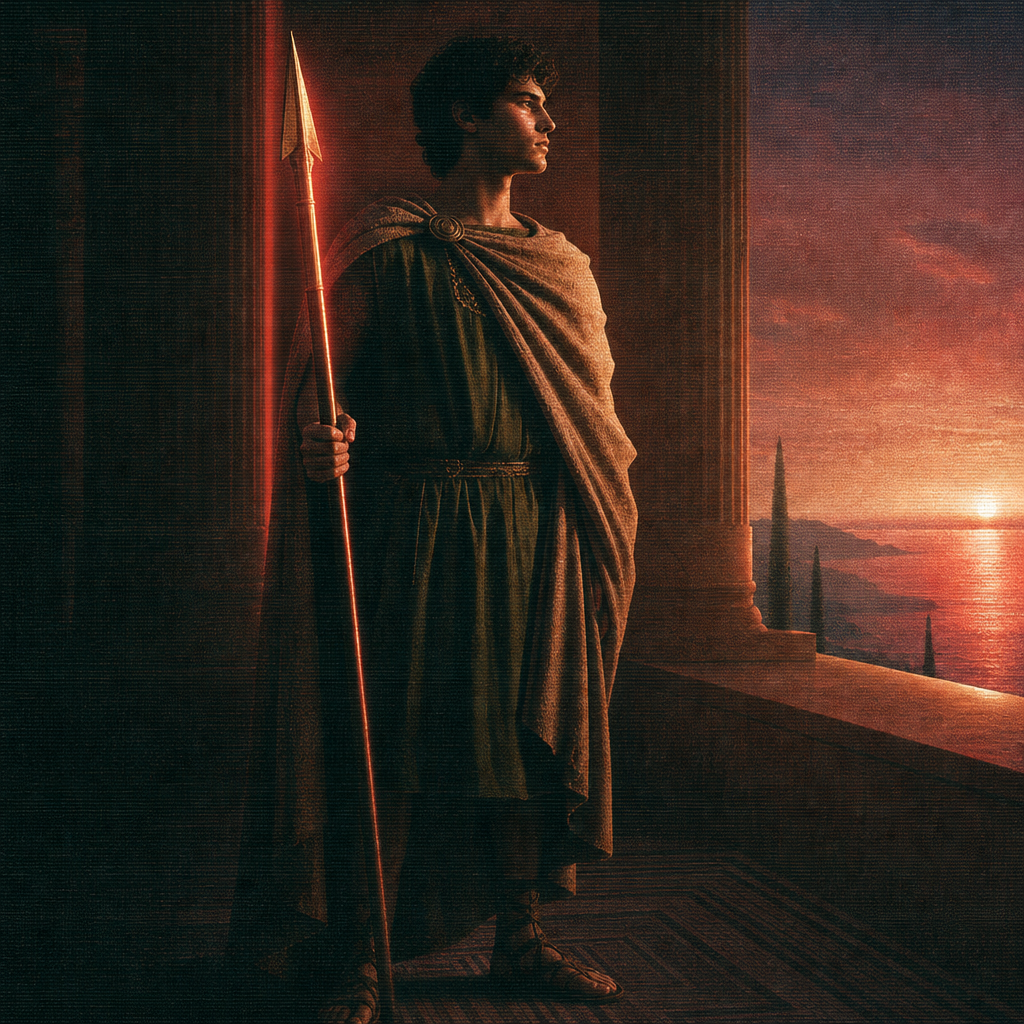
As soon as early-born, rosy-fingered Dawn appeared, Odysseus’ dear son rose from his bed and put on his clothes. He slung a sharp sword from his shoulder, bound fine sandals beneath his smooth feet, and stepped out of his bedroom like a god to look upon. At once he ordered the clear-voiced heralds to summon the long-haired Achaeans to the assembly. The heralds cried the summons, and the men gathered quickly. When they had assembled and were all gathered together, he set out for the assembly place holding a bronze spear in his hand—not alone, for two swift hounds followed at his side. Athena poured a wondrous grace over him, and all the people marveled at him as he came forward. He sat down in his father’s seat, and the elders gave way to him.
Read Ancient Greek Source (Odyssey.2.1–Odyssey.2.14)
Then the hero Aegyptius was the first to speak among them, a man bent with old age who knew countless things. For his own dear son, the spearman Antiphus, had gone with godlike Odysseus in the hollow ships to Ilion, land of fine horses; the savage Cyclops had killed him in his vaulted cave and made him his last meal. Three other sons remained to him: one of them, Eurynomus, kept company with the suitors, while the other two constantly tended their father’s estate. Yet even so, he could not forget that lost son as he mourned and grieved; weeping for him, he addressed the assembly and said:
Read Ancient Greek Source (Odyssey.2.15–Odyssey.2.24)
“Hear me now, men of Ithaca, and listen to what I say. We have held no assembly or council session since the day noble Odysseus sailed away in the hollow ships. Who has summoned us like this today? What need presses so hard on one of the young men, or on one of those who are older? Has he heard some news of our army returning, which he can report to us clearly after learning it first himself? Or is there some other public matter he wants to set forth and speak about? He seems a worthy man to me—may he be blessed! May Zeus himself bring to fulfillment whatever good he has in mind.”
Read Ancient Greek Source (Odyssey.2.25–Odyssey.2.34)
So he spoke, and Odysseus’ dear son rejoiced at the auspicious words. Eager to speak, he did not stay seated much longer, but stood in the middle of the assembly; and the herald Peisenor, a man skilled in wise counsel, placed the staff in his hand. First, turning to the old man, he spoke to him directly:
Read Ancient Greek Source (Odyssey.2.35–Odyssey.2.39)
“Old sir, the man who called the people together is not far off—you will soon know for yourself: it is I, and grief hits me hardest of all. I have heard no news of our army returning that I could report to you clearly after learning it first myself, nor is there any other public matter I am setting forth and speaking about. It is my own need, because trouble has fallen upon my house in two ways. First, I have lost my noble father, who once was king over you here and was as gentle as a father. And now comes a far greater evil, which will soon shatter my whole house completely and destroy all my livelihood. Suitors have beset my mother against her will—the very sons of the men who are noblest here. They shrink from going to the house of her father Icarius, so that he himself might arrange his daughter’s marriage and give her to whomever he chooses and finds most pleasing. Instead, they crowd into our house day after day, slaughtering our cattle, our sheep, and our fat goats; they feast and drink the dark-gleaming wine recklessly, and our great wealth is being wasted. For there is no man here such as Odysseus was, to drive this ruin from the house. As for us, we are in no way able to defend it; even hereafter we will only prove pitiful and untrained in fighting strength. Yet I would defend myself if only I had the power.
Read Ancient Greek Source (Odyssey.2.40–Odyssey.2.62)
“For what has been done is no longer bearable, and my house has been ruined beyond all decency. Feel indignation yourselves, and feel shame before the neighboring peoples who live all around us; and fear the wrath of the gods, lest they turn against you in anger at these evil deeds. I beg you by Olympian Zeus and by Themis, who both dissolves and convenes the assemblies of men: hold back, my friends, and leave me alone to wear away in my bitter grief—unless perhaps my father, noble Odysseus, ever did harm out of malice to the Achaeans in fine leg armor, and in payback for that you are maliciously doing me harm by egging these men on. Yet it would be better for me if you yourselves were devouring my heirlooms and my livestock. If you were the ones eating them, some day there might be restitution; for until then we would go up and down the town pressing our claim and demanding our goods back, until everything had been repaid. As it is, you cast helpless pains into my heart.”
Read Ancient Greek Source (Odyssey.2.63–Odyssey.2.79)
So he spoke in anger, and dashed the staff to the ground, bursting into tears; and pity seized all the people. Then all the others stayed silent, and no one had the heart to answer Telemachus with harsh words; Antinous alone answered and said to him:
Read Ancient Greek Source (Odyssey.2.80–Odyssey.2.84)
“Telemachus, high-talking, unrestrained in temper, what a speech you have made to put us to shame! You would like to fasten the blame on us. Yet the Achaean suitors are in no way to blame for your trouble, but your own mother, who knows subtleties beyond anyone else. For three years have already gone by, and the fourth will soon be past, since she began cheating the hearts in the breasts of the Achaeans. She gives hope to all and makes promises to each man, sending out messages, while her mind intends something else. And she devised this other trick in her heart: setting up a great loom in the halls, she began to weave a fine, wide web, and straightway she said to us: ‘Young men, my suitors, since noble Odysseus is dead, wait, eager though you are for my marriage, until I finish this cloth—so that my threads are not wasted in vain—a burial shroud for the hero Laertes, for the day when the deadly fate of long-sorrowing death strikes him down, lest any of the Achaean women throughout the land reproach me if he who won great possessions should lie without a shroud.’ So she spoke, and our proud hearts were persuaded. Then by day she would weave at the great web, and by night she would unravel it, setting torches beside her. So for three years she escaped notice by her trick and fooled the Achaeans; but when the fourth year came and the seasons brought it round, one of her women, who knew the truth clearly, told us, and we caught her in the act of unraveling the shining web. So she was forced to finish it, much against her will.
Read Ancient Greek Source (Odyssey.2.85–Odyssey.2.110)
“Now the suitors give you this answer, so that you may know it in your own heart, and all the Achaeans may know it too: send your mother back, and order her to marry whomever her father urges and she herself prefers. But if she goes on tormenting the sons of the Achaeans much longer, relying in her heart on all that Athena has given her beyond other women—skill in exquisite handiwork, a fine mind, and clever schemes, such as we have never heard of even in the women of old, the Achaean women with lovely braids who lived long ago, Tyro and Alcmene and Mycene in her bright crown, not one of whom knew such designs as Penelope, though in this one thing she did not think rightly—then your livelihood and your wealth will be devoured so long as she holds to this purpose that the gods are now putting in her breast. She is winning great renown for herself, but for you she leaves the loss of much of your livelihood. As for us, we will not go back to our estates or anywhere else until she marries whichever of the Achaeans she wishes.”
Read Ancient Greek Source (Odyssey.2.111–Odyssey.2.128)
Clear-headed Telemachus answered him: “Antinous, I cannot possibly drive from this house against her will the woman who bore me, who raised me. My father is off in some other land, alive or dead, and it would be hard for me to pay back a heavy price to Icarius if of my own accord I send my mother away. From her father I will suffer harm, and a god will send still more, since my mother will call down the hated Furies as she leaves the house, and the reproach of men will fall on me. So I will never speak that word. But if your own hearts are outraged by all this, leave my halls! See to other feasts, eating your own provisions and taking turns from house to house. Yet if it seems to you better and more profitable that one man’s livelihood be ruined without compensation, then strip it bare; and I will cry out to the everlasting gods, in hope that Zeus may grant that your deeds be paid back in full. Then inside these halls you would perish unavenged.”
Read Ancient Greek Source (Odyssey.2.129–Odyssey.2.145)
So spoke Telemachus, and for him far-sounding Zeus sent two eagles flying down from high on the mountain peak. For a while the pair flew on with the gusts of the wind, side by side, gliding on outstretched wings. But when they reached the middle of the noisy assembly, they wheeled around, beating their thick feathers, and looked down on the heads of them all, their gaze boding ruin. Then, tearing with their talons at each other’s cheeks and around each other’s necks, they darted away to the right across the men’s houses and town. The men were stunned by the birds when they saw them with their own eyes, and turned over in their minds what was about to come to pass.
Read Ancient Greek Source (Odyssey.2.146–Odyssey.2.156)
Then the old hero Halitherses spoke among them, the son of Mastor, who alone surpassed all men of his generation in reading birds and declaring what was fated. With goodwill toward them he addressed the assembly and said: “Listen to me now, men of Ithaca, to what I have to say, and to the suitors above all I declare and speak this warning: a great disaster is rolling toward them. For Odysseus will not be away from his loved ones much longer; even now, somewhere near at hand, he is planting slaughter and doom for these men, every one of them. And he will be a bane to many others besides who live in clear-seen Ithaca. Long before that happens, let us work out how to put a stop to them—or better, let them stop of their own accord, for that is far best for them right now. I do not prophesy as an untested novice, but as one who knows well. For I say that everything has been fulfilled for that man just as I told him when the Argives embarked for Ilion, and resourceful Odysseus went with them. I said that after suffering many hardships and losing all his companions, unknown to everyone, in the twentieth year he would come home—and now all of it is coming true.”
Read Ancient Greek Source (Odyssey.2.157–Odyssey.2.176)
Then Eurymachus, son of Polybus, answered him: “Old man, come now, go on home and prophesy to your own children, lest they suffer some harm in days to come! In these matters I am a far better prophet than you. Plenty of birds fly to and fro under the rays of the sun, and not all of them carry omens. As for Odysseus, he perished far away—and how I wish that you too had died with him! Then you would not be spouting so many prophecies, or egging Telemachus on when he is already angry, looking for a gift for your household in hope that he might give you one. But I will tell you plainly, and it will be done: if you, with all your ancient lore, win over a younger man with cunning words and stir him up to rage, first of all, it will only make things more painful for him—and even so, he will not be able to accomplish a thing on account of these men—while on you, old man, we will lay a fine that will gall your heart to pay, and the grief of it will be hard for you to bear. To Telemachus I myself will give this counsel before everyone: let him command his mother to go back to her father’s house. They will arrange the wedding and make ready the bridal gifts—lavish ones, all that should go with a beloved daughter. For until then, I do not think the sons of the Achaeans will stop their relentless courting, since we fear no one at all—certainly not Telemachus, full of words though he is—nor do we care about any prophecy that you, old man, utter in vain; you only make yourself hated all the more. His property too will be ruthlessly devoured, and no restitution will ever be made, so long as she puts off the Achaeans in her marriage. Waiting day after day, we rival one another for her excellence, and do not go after other women whom any one of us might properly wed.”
Read Ancient Greek Source (Odyssey.2.177–Odyssey.2.207)
Clear-headed Telemachus answered him: “Eurymachus, and all you other proud suitors, on these matters I will no longer plead with you or speak further, for by now the gods and all the Achaeans know them. Come then, give me a swift ship and twenty companions who will make the crossing with me there and back. For I am going to Sparta and to sandy Pylos to ask after the homecoming of my long-absent father, in hope that some mortal may tell me, or I may hear a rumor from Zeus, which most of all brings news to humankind. If I hear that my father is alive and on his way home, then hard-pressed though I am, I could hold out for one more year. But if I hear that he is dead and no longer among the living, I will return to my dear fatherland, heap up a burial mound for him, perform the funeral rites with all the rich honors due to him, and give my mother to a husband.”
Read Ancient Greek Source (Odyssey.2.208–Odyssey.2.223)
Having spoken thus, he sat back down, and among them rose Mentor, who was a companion of blameless Odysseus; when Odysseus sailed away in the ships, he had entrusted his whole household to him, bidding them obey the old man and charging him to keep everything safe and sound. With goodwill toward them he addressed the assembly and said: “Hear me now, men of Ithaca, and listen to what I say. Never again let any scepter-bearing king be willingly kind and gentle, or know justice in his heart, but let him always be harsh and do lawless things, since not one man among the people he ruled remembers godlike Odysseus, though he was as gentle as a father. Yet I do not begrudge the proud suitors for doing violent deeds out of the malice they weave in their minds; for they stake their own heads as they violently devour the house of Odysseus, who they say will never return. No, my indignation now is for the rest of the people, seeing how all of you sit in silence, and though you are many, do not even confront these few suitors with words and put a stop to them.”
Read Ancient Greek Source (Odyssey.2.224–Odyssey.2.241)
Then Leocritus, son of Euenor, answered him: “Mentor, you troublemaker, out of your wits, what a thing to say, stirring them up to put a stop to us! It is a hard thing, even with greater numbers, to fight men over a feast. For even if Odysseus of Ithaca himself were to come back and find the noble suitors feasting throughout his house, and set his heart on driving them out of the hall, his wife would take no joy in his coming, much as she longs for him, but right there he would meet a shameful fate if he fought against greater numbers. You have spoken out of turn. Come now, let the people scatter, each to his own work, and let Mentor and Halitherses speed this boy on his voyage, since they have been friends of his father’s house from the beginning. Yet I think he will sit for a long time waiting for reports and gather his news right here in Ithaca, and never accomplish this voyage.” So he spoke, and quickly broke up the assembly. The people scattered, each man to his own house, while the suitors went to the palace of godlike Odysseus.
Read Ancient Greek Source (Odyssey.2.242–Odyssey.2.259)
But Telemachus walked away alone to the shore of the sea, washed his hands in the gray salt water, and prayed to Athena: “Hear me, you god who came yesterday to our house and told me to take a ship across the misty sea to seek word of the homecoming of my father, who has been gone so long; yet the Achaeans are delaying all of this, and the suitors most of all, in their wicked arrogance.”
Read Ancient Greek Source (Odyssey.2.260–Odyssey.2.266)
So he spoke in prayer, and Athena came near to him, taking the likeness of Mentor in both build and voice, and addressing him, she spoke winged words: “Telemachus, you will be neither a coward nor a fool hereafter, if indeed your father’s noble spirit has been instilled in you—such a man as he was for fulfilling both deed and word. Then this voyage of yours will not be in vain or unfulfilled. But if you are not the true son of him and of Penelope, then I have no hope that you will accomplish what you set your mind to. For few sons indeed turn out the equal of their father; most are worse, and only a few are better than their father. Still, since you will be neither a coward nor a fool hereafter, and the shrewdness of Odysseus has not altogether forsaken you, there is hope then that you will bring these deeds to completion. So now pay no heed to the plans and schemes of the senseless suitors, for they are neither thoughtful nor just, nor do they know anything of death and the black doom that now stands close beside them, for all of them to perish in a single day. As for you, the voyage your heart desires will not be delayed much longer; for such a companion of your father’s am I to you that I will rig a swift ship for you and go along with you myself. Go back to the house now and mingle with the suitors, and make ready provisions and pack everything tight in vessels—wine in two-handled jars, and barley meal, the marrow of men, in stout leather skins—while I go through the town for companions and quickly gather volunteers. There are ships in plenty in sea-girt Ithaca, both new and old; of these I will look out for you whichever one is best, and once we have quickly rigged her, we will launch her on the wide sea.”
Read Ancient Greek Source (Odyssey.2.267–Odyssey.2.295)
So spoke Athena, daughter of Zeus, and Telemachus did not linger there much longer once he had heard the voice of the god. He set out for the house, his heart troubled within him, and found the proud suitors at the palace, skinning goats and singeing fattened hogs in the courtyard. Antinous walked straight up to Telemachus with a laugh, clasped his hand, and spoke to him, calling him by name: “Telemachus, you lofty talker, unbridled in temper, let no other ugly deed or word trouble the heart in your chest, but eat and drink with me, just as you used to do. The Achaeans will see to all of these things for you—a ship and a picked crew of oarsmen—so that you may all the sooner reach sacred Pylos in search of news of your noble father.”
Read Ancient Greek Source (Odyssey.2.296–Odyssey.2.308)
Clear-headed Telemachus answered him: “Antinous, there is no way that among arrogant men like you I can feast in silence and take my pleasure at ease. Is it not enough that in the past you stripped away so many fine possessions of mine, you suitors, while I was still a child? Now that I am grown, and by listening to the words of others I learn the truth, and my spirit rises within me, I will try my utmost to hurl grim fates upon you, either by going to Pylos or right here in this land. I will go indeed, and the voyage I speak of will not be in vain, though I sail as a passenger, since neither a ship nor oarsmen are mine to command—for so, no doubt, it seemed more profitable to you.”
Read Ancient Greek Source (Odyssey.2.309–Odyssey.2.320)
He spoke, and easily pulled his hand out of the hand of Antinous, while the suitors busied themselves with the feast through the hall. They jeered at him and traded cutting remarks, and one of the arrogant young men would say: “Surely Telemachus is plotting murder against us! Either he will bring back defenders from sandy Pylos or even from Sparta, since he is so terribly eager to go; or else he means to visit Ephyra, that rich plowland, to bring back life-destroying poisons from there, drop them into the mixing bowl, and destroy us all.” And then another of the arrogant young men would say: “Who knows whether he himself, sailing off in a hollow ship, may perish far from his friends, wandering just like Odysseus? That way he would make even more work for us, for we would divide up all his possessions, while the house itself we would give to his mother to keep, and to whichever man marries her.”
Read Ancient Greek Source (Odyssey.2.321–Odyssey.2.336)
So they spoke, while he went down to his father’s high-roofed storeroom, a wide chamber where gold and bronze lay piled, along with clothing in chests and plenty of fragrant olive oil. There too, great jars of old, sweet-tasting wine stood holding the unmixed, divine drink inside them, ranged in a row along the wall, in case Odysseus should ever return home again, even after enduring many griefs. Shutting the room were tightly fitted double doors that locked; and inside, night and day, a housekeeper kept watch, guarding everything with the shrewdness of her mind—Eurycleia, daughter of Ops, son of Peisenor. Telemachus called her into the storeroom then and spoke to her: “Nurse, come draw sweet wine for me into two-handled jars, the finest and most mellow after that which you guard with that ill-fated man in mind, in case Zeus-born Odysseus should come from somewhere, having escaped death and dark fate. Fill twelve of them, and fit them all tightly with lids. And pour barley meal for me into well-stitched leather bags; let there be twenty measures of mill-crushed barley grain. Keep this to yourself alone, and have all these things gathered and ready, for at evening I will come take them, as soon as my mother goes up to her upper chamber and turns her thoughts to sleep. I am going to Sparta and to sandy Pylos to ask after my dear father’s homecoming, in hope I may hear some word.”
Read Ancient Greek Source (Odyssey.2.337–Odyssey.2.360)
So he spoke, and his dear nurse Eurycleia gave a cry of grief, and lamenting, she spoke to him in winged words: “Why, my dear child, has such a thought as this come into your mind? Where do you want to go over the wide earth, when you are an only, cherished son? Zeus-born Odysseus perished far from his homeland among a foreign people. And the moment you leave, these men will plot to kill you by treachery and divide all these goods among themselves. No, stay right here in charge of what is yours; you have no need at all to suffer misery and wander over the barren sea.”
Read Ancient Greek Source (Odyssey.2.361–Odyssey.2.370)
Clear-headed Telemachus answered her in turn: “Take heart, nurse, for this plan is not without a god. But swear to me not to tell my dear mother any of this until the eleventh or twelfth day comes, or until she misses me herself and hears that I have set out, so that she does not mar her lovely skin with weeping.” So he spoke, and the old woman swore a great oath by the gods. And when she had sworn and completed the oath, at once she drew wine for him into the two-handled jars, and poured barley meal for him into the well-stitched leather bags. Then Telemachus went back into the hall and joined the company of the suitors.
Read Ancient Greek Source (Odyssey.2.371–Odyssey.2.381)
Then the goddess, bright-eyed Athena, thought of another thing. Taking the likeness of Telemachus, she went everywhere through the city, and standing beside each man she spoke her word, bidding them gather at evening by the swift ship. Next, she asked Noemon, the splendid son of Phronius, for a swift ship, and he gladly promised it to her. The sun went down and all the streets grew dark with shadow; and then she hauled the swift ship down to the sea, and placed in it all the gear that ships with sturdy benches carry. She moored it at the outer edge of the harbor, and around her the noble companions gathered in a body, while the goddess heartened each man. Then the goddess, bright-eyed Athena, thought of another thing. She set off for the house of godlike Odysseus, and there she poured sweet sleep over the suitors, making their minds wander as they drank, and knocked the cups from their hands. They rose to go to their beds through the city, and did not sit much longer, for sleep was falling heavy on their eyelids. Then bright-eyed Athena, taking the likeness of Mentor in both build and voice, called Telemachus out in front of the well-built halls and spoke to him: “Telemachus, your companions in fine leg armor are already sitting at the oars, waiting for your word to set out. Come, let us go, so we do not delay the voyage any longer.”
Read Ancient Greek Source (Odyssey.2.382–Odyssey.2.404)
Speaking thus, Pallas Athena led the way with swift steps, and he followed in the footsteps of the deity. When they came down to the ship and the sea, they found their long-haired companions on the shore. Then Telemachus in his sacred strength spoke among them: “Come, friends, let us bring the provisions aboard, for everything is already gathered together in the hall. My mother knows nothing of it, and among the enslaved women only one has heard the plan.” So he spoke and led the way, and they went with him. Bringing everything down to the ship with sturdy benches, they stowed it aboard, just as the dear son of Odysseus commanded. Then Telemachus went aboard the ship; Athena went first and sat down in the stern of the vessel, and right beside her Telemachus took his seat. The crew cast off the stern cables, climbed aboard themselves, and sat down on the rowing benches. Bright-eyed Athena sent them a favoring breeze, a brisk West Wind, singing over the wine-dark sea. Telemachus urged on his companions and ordered them to lay hold of the tackle, and they obeyed his call. Lifting the fir mast into the hollow mast-socket, they raised it upright and made it fast with the forestays, and hauled up the white sails with well-twisted oxhide ropes. The wind swelled the middle of the sail, and the dark wave roared loud around the stem as the ship gathered way; she raced over the waves, cutting her path through the water. When they had made fast the tackle throughout the swift black ship, they set up mixing bowls brimming with wine, and poured libations to the immortal, ever-living gods, and above all of them to the bright-eyed daughter of Zeus. All night long and through the dawn the ship cleft her way.