Book 18: The Beggar Irus and Penelope Before the Suitors
Ὀδύσσεια · Book 18 · Classix Modern English Reading Edition
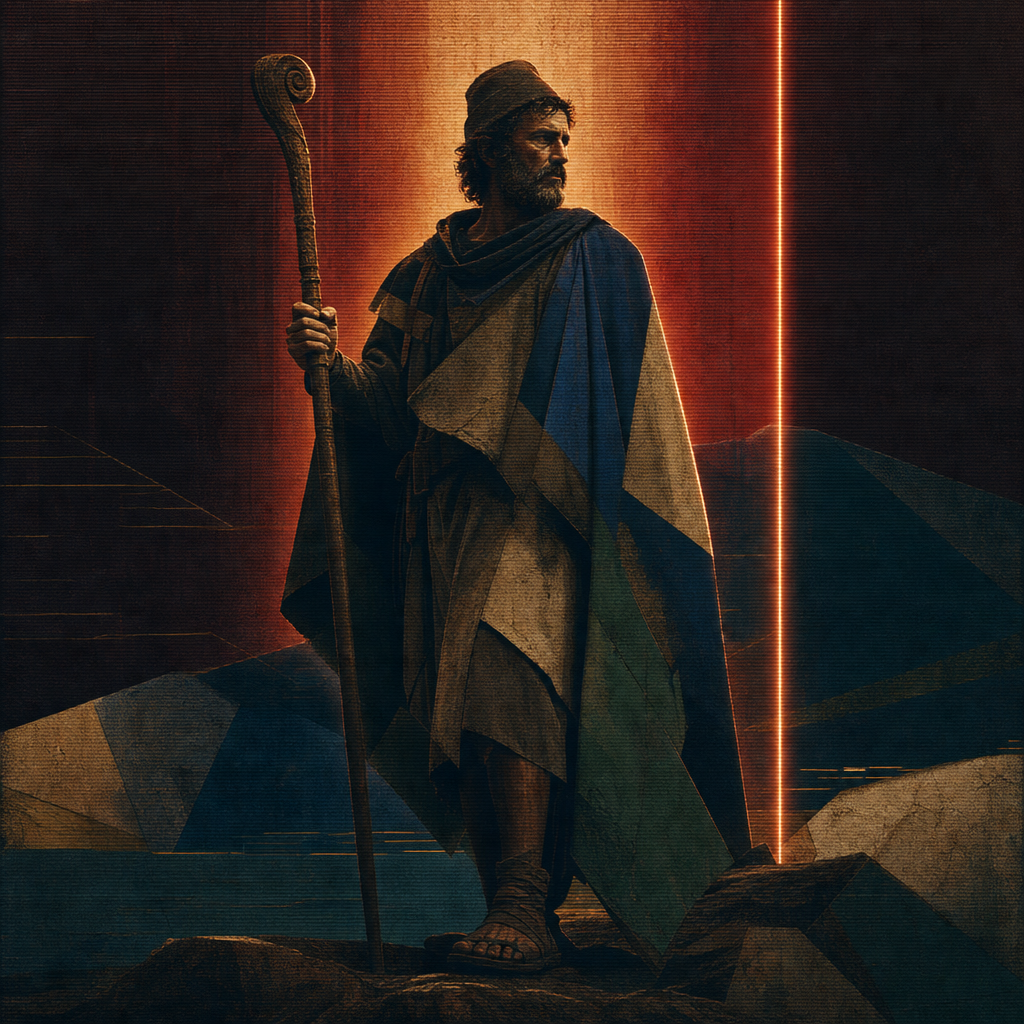
A beggar came along, known throughout the town. He went begging through Ithaca and was famous for his ravenous belly, always eating and drinking. He had neither strength nor power, though he was a very large man to look at. Arnaeus was his name, the one his honored mother had given him at birth, but all the young men called him Irus, because he would run messages whenever anyone asked. He came now to drive Odysseus from his own house, abusing him with these flying words:
Read Ancient Greek Source (Odyssey.18.1–Odyssey.18.9)
“Out of the doorway, old man, before you get dragged out by the foot! Can’t you see them all winking at me, telling me to haul you off? I’m holding back out of shame. Get up, or this quarrel of ours will soon come to blows.”
Read Ancient Greek Source (Odyssey.18.10–Odyssey.18.13)
Odysseus, master of schemes, looked at him darkly. “What’s wrong with you? I’m doing you no harm, saying nothing against you. Nor do I begrudge anyone taking plenty and giving it to you. This threshold will hold us both. You have no reason to begrudge another man his share. You seem to be a wanderer like me; the gods are the ones who grant prosperity. Don’t keep challenging me to fight. You might make me angry, and old as I am, I might bloody your chest and lips. Then I’d have even more peace tomorrow. I doubt you’d come back a second time to the hall of Odysseus, Laertes’ son.”
Read Ancient Greek Source (Odyssey.18.14–Odyssey.18.24)
The tramp Irus answered angrily. “Listen to this glutton rattling on like an old woman at an oven! I could give him a nasty time with both fists, knock every tooth out of his jaws onto the ground, like a sow caught eating crops. Hitch up your rags now, so everyone here can watch us fight. How could you stand up to a younger man?” So there before the tall doors, on the polished threshold, the two of them quarreled with all their hearts.
Read Ancient Greek Source (Odyssey.18.25–Odyssey.18.33)
Antinous, in all his lordly vigor, heard them. Laughing with pleasure, he called to the suitors. “Friends, nothing like this has ever happened before! What entertainment a god has brought into this house! The stranger and Irus are challenging each other to a fistfight. Let’s set them at it at once.” They all leaped up laughing and crowded around the beggars in their wretched clothes.
Read Ancient Greek Source (Odyssey.18.34–Odyssey.18.41)
Antinous, Eupeithes’ son, addressed them. “Listen, proud suitors, while I tell you something. Here on the fire are goats’ stomachs, stuffed with fat and blood, which we put aside for supper. Whichever man wins and proves the stronger can stand up and choose any one he likes. From now on he’ll always feast with us, and we won’t let another beggar in to ask for food.” So Antinous said, and his proposal pleased them.
Read Ancient Greek Source (Odyssey.18.42–Odyssey.18.50)
Odysseus, master of schemes, spoke with a trick in mind. “Friends, an old man worn down by trouble cannot fight a younger man. But my cursed belly drives me on, to be beaten down by blows. Come, all of you swear a binding oath that no one, favoring Irus, will strike me a wicked blow with his heavy hand and help this man overpower me.” They all swore as he asked. Once they had sworn and completed the oath, Telemachus spoke in his strength. “Stranger, if your heart and courage urge you to fend this man off, don’t fear any of the other Achaeans. Whoever strikes you will have several men to fight. I am your host, and the princes Antinous and Eurymachus, both men of sense, support me.” They all approved.
Read Ancient Greek Source (Odyssey.18.51–Odyssey.18.66)
Odysseus tucked his rags around his loins, revealing his fine, powerful thighs, his broad shoulders, chest and sturdy arms. Athena stood close and filled out the limbs of the shepherd of his people. All the suitors were astonished beyond measure. One man would turn to his neighbor and say, “Irus will soon be no Irus at all. He’s brought trouble on himself! Look at the thigh that old man shows beneath his rags.” So they spoke, and Irus’ heart was badly shaken. Even so, the servants hitched up his clothes and dragged him forward by force, terrified, the flesh trembling on his limbs.
Read Ancient Greek Source (Odyssey.18.67–Odyssey.18.77)
Antinous rebuked him, calling him by name. “You great ox, I wish you’d never existed, never been born, if you quake and tremble so before this old man, worn down by the trouble that has come on him. I tell you this, and I will do it: if he beats you and proves the stronger, I’ll put you aboard a black ship and send you to the mainland, to King Echetus, the ruin of all men. He’ll slice off your nose and ears with merciless bronze, tear out your genitals, and give them raw to the dogs to divide.” At that, an even greater trembling seized Irus’ limbs.
Read Ancient Greek Source (Odyssey.18.78–Odyssey.18.88)
They led him into the middle, and both men raised their fists. Then steadfast, godlike Odysseus considered whether to hit him so that he would fall there and die, or to strike lightly and stretch him on the ground. As he thought, the better course seemed to be a light blow, so the Achaeans would not recognize him. They raised their hands. Irus struck his right shoulder; Odysseus hit Irus on the neck below the ear and crushed the bones inward. Red blood came straight from his mouth. He fell bleating in the dust, his teeth clacking together as his feet kicked the earth. The splendid suitors threw up their hands and nearly died laughing.
Read Ancient Greek Source (Odyssey.18.89–Odyssey.18.100)
Odysseus took him by the foot and dragged him through the entrance into the courtyard, to the portico doors. There he sat him against the courtyard wall and put a staff in his hand. “Sit here now and keep the pigs and dogs away. Don’t you go playing lord over strangers and beggars, wretch that you are, or you may bring something worse on yourself.” With that he slung his ugly, ragged bag over his shoulders; its strap was a twisted cord.
Read Ancient Greek Source (Odyssey.18.101–Odyssey.18.109)
He went back and sat on the threshold. The others went inside, laughing pleasantly and greeting him with words. “Stranger, may Zeus and the other immortal gods give you whatever you most desire, whatever delights your heart! You’ve stopped that insatiable fellow from roaming through our town. Soon we’ll send him to the mainland, to King Echetus, the ruin of all men.” So they spoke, and godlike Odysseus welcomed their words as an omen. Antinous set a great stomach beside him, filled with fat and blood. Amphinomus took two loaves from the basket and put them before him, raised a golden cup to him and said, “Health to you, stranger, old father. May prosperity be yours hereafter, though many troubles hold you now.”
Read Ancient Greek Source (Odyssey.18.110–Odyssey.18.123)
Odysseus, master of schemes, answered him. “Amphinomus, you seem to me a man of good sense. Your father was such a man: I used to hear the good name of Nisus of Dulichium, an upright and wealthy man. They say you are his son, and you look like a considerate man yourself. That is why I’ll speak. Take it to heart and listen. Of all the creatures that breathe and move upon the earth, none that earth nourishes is frailer than a human being. He never thinks he will suffer evil while the gods give him strength and his knees are quick. But when the blessed gods bring misery too, he bears it, unwilling, with an enduring heart. The mind of people on this earth changes with the day the father of gods and men brings upon them.
Read Ancient Greek Source (Odyssey.18.124–Odyssey.18.137)
“I too once seemed destined to prosper among men. I did many reckless things, giving way to strength and violence, trusting in my father and my brothers. So let no man ever be wholly lawless. Let him quietly accept the gifts the gods may give. What reckless schemes I see these suitors making, wasting the property and dishonoring the wife of a man who, I say, will not be long away from his friends and native land. He is very near. May some god take you safely home, so you don’t meet him when he returns to his own country. For I don’t think he and the suitors will part without bloodshed once he comes beneath this roof.”
Read Ancient Greek Source (Odyssey.18.138–Odyssey.18.150)
He poured a libation, drank the honey-sweet wine, and put the cup back in the hands of that leader of men. Amphinomus walked through the hall with a troubled heart, shaking his head. His spirit foresaw disaster. Yet even so he did not escape his doom. Athena had bound him too, to be overcome by the hands and spear of Telemachus. He went back and sat on the chair from which he had risen.
Read Ancient Greek Source (Odyssey.18.151–Odyssey.18.157)
Then the gray-eyed goddess Athena put it into the mind of Icarius’ daughter, thoughtful Penelope, to appear before the suitors: she would set their hearts fluttering and gain greater honor from her husband and son than before. Penelope gave a strained laugh and spoke. “Eurynome, I feel a longing I never felt before: to show myself to the suitors, though I hate them still. And I could say something to my son for his good: he mustn’t keep company with these overbearing suitors, who speak so well but harbor evil thoughts.”
Read Ancient Greek Source (Odyssey.18.158–Odyssey.18.168)
Eurynome the housekeeper answered her. “Yes, child, everything you say is right. Go and speak to your son; hold nothing back. But wash yourself and anoint your cheeks. Don’t go with your face all stained with tears. It does you harm to grieve endlessly like this. Your son has reached the age you prayed above all to see, when you asked the immortals to let his beard grow.”
Read Ancient Greek Source (Odyssey.18.169–Odyssey.18.176)
Thoughtful Penelope replied, “Eurynome, don’t urge me, even out of kindness, to wash and anoint myself with oil. The gods who live on Olympus destroyed my radiance when he sailed away in the hollow ships. But tell Autonoe and Hippodameia to come and stand beside me in the hall. I won’t go among the men alone. I feel ashamed.” So she spoke, and the old woman passed through the hall to tell the women and urge them to come.
Read Ancient Greek Source (Odyssey.18.177–Odyssey.18.186)
Then gray-eyed Athena thought of something else. She poured sweet sleep over Icarius’ daughter, who leaned back in her chair and slept, all her joints relaxed. Meanwhile the divine goddess gave her immortal gifts, so the Achaeans would marvel at her. First she cleansed her lovely face with the immortal beauty that Cytherea, goddess of the fine crown, uses when she goes to the lovely dance of the Graces. She made Penelope look taller and fuller, and made her skin whiter than sawn ivory. Then the divine goddess went away. The white-armed attendants came from the hall, talking as they approached. Sweet sleep released Penelope, and she wiped her cheeks with her hands and spoke.
Read Ancient Greek Source (Odyssey.18.187–Odyssey.18.200)
“Soft drowsiness has covered me, despite all my suffering. If only holy Artemis would give me a death as soft, this instant, so I would no longer waste my life grieving in my heart, longing for my dear husband and all his excellence. He surpassed all the Achaeans.” With these words she came down from her bright upper rooms, not alone: two attendants followed her. When that radiant woman reached the suitors, she stood beside a pillar of the strongly built roof, holding her shining veil before her cheeks, a faithful attendant at either side. The suitors’ knees went weak; desire enchanted their hearts. Every one of them prayed to lie beside her in bed.
Read Ancient Greek Source (Odyssey.18.201–Odyssey.18.213)
She addressed her dear son Telemachus. “Telemachus, your judgment and your thoughts are no longer sound. As a child you had a better grasp of what was wise. Now you’re grown and have reached the measure of youth, and a stranger looking at your height and beauty might call you a prosperous man’s son, yet your judgment and thoughts are no longer right. What is this that has happened in our hall? You let the stranger be treated so shamefully! What if a guest sitting here in our house came to harm through such cruel handling? The shame and disgrace among men would be yours.”
Read Ancient Greek Source (Odyssey.18.214–Odyssey.18.225)
Sensible Telemachus answered her. “Mother, I don’t blame you for being angry. In my heart I understand and know what is good and what is worse. Before, I was still a child. But I can’t always think wisely. These men sitting all around me, full of wicked thoughts, knock me off balance from every side, and I have no helpers. Still, the fight between the stranger and Irus did not come about at the suitors’ wish; the stranger proved the stronger. Father Zeus, Athena and Apollo, if only the suitors in our house were beaten like that now, nodding their heads, some in the courtyard and some inside, every man’s limbs unstrung! Just as Irus sits there now by the courtyard doors, his head drooping like a drunk’s, unable to stand upright on his feet or make his way home, wherever his home may be, because his limbs have lost their strength.”
Read Ancient Greek Source (Odyssey.18.226–Odyssey.18.242)
While they were speaking to each other, Eurymachus addressed Penelope. “Daughter of Icarius, thoughtful Penelope, if all the Achaeans throughout Iasian Argos could see you, still more suitors would be feasting in your house tomorrow morning. You surpass all women in beauty, stature and the balanced mind within.”
Read Ancient Greek Source (Odyssey.18.243–Odyssey.18.249)
Thoughtful Penelope answered him. “Eurymachus, the immortals destroyed my excellence, my beauty and my figure when the Argives sailed for Ilium and my husband Odysseus went with them. If he returned to watch over my life, my fame would be greater and more splendid. But now I grieve. Some god has sent so many troubles upon me.
Read Ancient Greek Source (Odyssey.18.250–Odyssey.18.256)
“When he left his native land, he took my right hand by the wrist and said, ‘Wife, I don’t think all the Achaeans in fine leg armor will come back safely from Troy, unharmed. They say the Trojans are fighting men, spearmen and archers, riders of swift horses, who can very quickly decide the great struggle of war that spares neither side. So I don’t know whether a god will bring me back or I’ll be taken there at Troy. Everything here must be your concern. Remember my father and mother in our house, as you do now, or even more, while I am far away. But when you see our son with a beard, marry whomever you choose and leave your own home.’
Read Ancient Greek Source (Odyssey.18.257–Odyssey.18.270)
“That is what he said. Now it is all coming true. A night will come when a hateful marriage overtakes me, wretched woman that I am, whose happiness Zeus has taken away. But this dreadful grief touches my heart and spirit: this was never the suitors’ custom in the past. Men who wish to court a noble woman, a rich man’s daughter, and compete for her, bring their own cattle and fat sheep to feast the girl’s friends, and give her splendid gifts. They don’t eat another man’s livelihood without paying for it.”
Read Ancient Greek Source (Odyssey.18.271–Odyssey.18.280)
Steadfast, godlike Odysseus rejoiced at her words, because she was drawing gifts from them and charming their hearts with gentle speech, while her mind was intent on something else. Antinous, Eupeithes’ son, answered her. “Daughter of Icarius, thoughtful Penelope, accept whatever gifts any Achaean wishes to bring here. It isn’t right to refuse a gift. But we won’t go back to our work or anywhere else until you marry whichever of the Achaeans is best.”
Read Ancient Greek Source (Odyssey.18.281–Odyssey.18.289)
So Antinous said, and his proposal pleased them. Each sent a herald to fetch gifts. For Antinous his herald brought a great, beautiful, patterned robe, fitted with twelve golden pins and their curved fastenings. For Eurymachus one immediately brought an elaborate golden necklace, strung with amber, bright as the sun. Eurydamas’ servants brought two earrings, each with three mulberry-like beads, gleaming with beauty. From lord Peisander, Polyctor’s son, a servant brought a necklace, a very lovely ornament. Each of the other Achaeans brought another fine gift. Then the radiant woman went up to her upper rooms, and her attendants carried the beautiful gifts beside her.
Read Ancient Greek Source (Odyssey.18.290–Odyssey.18.303)
The men turned to dancing and lovely song, enjoying themselves as they waited for evening. Dark evening came upon their pleasure. At once they set three braziers in the hall to give them light. Around them they laid dry wood, long seasoned, hard and sapless, freshly split with bronze, and mixed in torches. The enslaved women of steadfast Odysseus took turns tending the light. Then Odysseus himself, sprung from Zeus and master of schemes, spoke to them. “Women of Odysseus, your long-absent lord, go into the rooms where your honored queen is. Sit beside her in the chamber and turn your spindles to cheer her, or comb wool with your hands. I’ll provide the light for all these men. Even if they want to wait for Dawn on her fine throne, they won’t outlast me. I can endure a great deal.”
Read Ancient Greek Source (Odyssey.18.304–Odyssey.18.319)
The women laughed and looked at one another. Lovely-cheeked Melantho abused him shamelessly. Dolius was her father, but Penelope had brought her up, caring for her like her own child and giving her toys to delight her. Even so, she felt no grief for Penelope in her heart; she slept with Eurymachus and loved him. She reviled Odysseus. “You miserable stranger, you must have lost your wits. Why won’t you go and sleep in a smithy, or somewhere in a gathering place? Instead you keep talking here, bold as you please among all these men, with no fear in your heart. Has wine gone to your head, or is this how your mind always works, babbling nonsense? Are you beside yourself because you beat the tramp Irus? A better man than Irus may soon get up, beat your head with his powerful fists, and drive you out of the house drenched in blood.”
Read Ancient Greek Source (Odyssey.18.320–Odyssey.18.336)
Odysseus, master of schemes, looked at her darkly. “I’ll go straight to Telemachus, you dog, and tell him what you’re saying, so he can cut you limb from limb on the spot.” His words sent the women scattering in terror. They went through the hall, each one’s limbs weakened by fear: they believed he meant what he said. He stood beside the blazing braziers to keep them bright, looking at everyone. His heart turned other things over within him, things that would indeed come to pass.
Read Ancient Greek Source (Odyssey.18.337–Odyssey.18.345)
Athena would not let the proud suitors hold back entirely from their bitter insults, so that grief would sink still deeper into the heart of Odysseus, Laertes’ son. Eurymachus, Polybus’ son, began to speak, mocking Odysseus and making his companions laugh. “Listen, suitors of our renowned queen, while I say what the heart in my chest commands. This man hasn’t come to Odysseus’ house without divine help. At any rate, the torchlight seems to shine from his head: there isn’t a hair on it, not the tiniest!” Then he addressed Odysseus, sacker of cities. “Stranger, would you work for hire if I took you on at an outlying farm? You’d have a proper wage for building stone walls and planting tall trees. I’d give you food all year, clothes to wear and shoes for your feet. But you’ve learned bad habits; you won’t be willing to get on with work. You’d rather go cowering through the town, begging to feed your insatiable belly.”
Read Ancient Greek Source (Odyssey.18.346–Odyssey.18.364)
Odysseus, master of schemes, answered him. “Eurymachus, if only you and I could compete at work in spring, when the days grow long, out in a meadow! I’d have a well-curved sickle and you another like it, and we’d test ourselves at work without eating until deep dusk, with plenty of grass to cut. Or if there were oxen to drive, the very best, great fiery ones, both well fed on grass, the same age and equally strong, with no lack of power, and a field of four plow-measures where the soil yielded to the plow, then you would see whether I could cut a furrow straight from end to end. Or if the son of Cronus stirred up war somewhere today, and I had a shield, two spears and an all-bronze helmet fitted to my temples, you would see me fighting among the foremost. You wouldn’t be talking insults about my belly then.
Read Ancient Greek Source (Odyssey.18.365–Odyssey.18.380)
“You are very insolent, and your mind is hard. You imagine yourself a great and powerful man, because you associate with a small number of men who are no good. But if Odysseus came back to his native land, these doors, wide as they are, would suddenly seem too narrow as you fled through the entrance and outside.”
Read Ancient Greek Source (Odyssey.18.381–Odyssey.18.386)
Eurymachus grew angrier still. He looked at him darkly and shot back, “You wretch, I’ll soon give you trouble for talking so boldly among all these men, without a trace of fear. Has wine gone to your head, or is this how your mind always works, babbling nonsense? Are you beside yourself because you beat the tramp Irus?” With that he seized a footstool. Odysseus dropped down by the knees of Amphinomus of Dulichium, afraid of Eurymachus. The stool struck the cupbearer’s right hand. The pitcher fell to the ground with a boom, and the man cried out and fell backward in the dust.
Read Ancient Greek Source (Odyssey.18.387–Odyssey.18.398)
The suitors made an uproar through the shadowy hall. One would look at his neighbor and say, “If only that stranger had died wandering somewhere else before he came here! Then he wouldn’t have caused all this commotion. Now we quarrel over beggars, and our fine feast brings no pleasure, because worse things prevail.” Then Telemachus spoke in his strength. “What is wrong with you? You’re raving! You can no longer contain your food and drink. Some god must be stirring you up. You’ve feasted well; go home and lie down when you feel the urge. I’m driving no one out.” They all bit their lips, astonished that Telemachus spoke so boldly.
Read Ancient Greek Source (Odyssey.18.399–Odyssey.18.411)
Amphinomus, the splendid son of lord Nisus, Aretias’ son, addressed them. “Friends, no one should get angry and lash out with hostile words at something fairly said. Don’t mistreat the stranger, or any other of the slaves in godlike Odysseus’ house. Come, let the cupbearer make a first serving into the cups, so we can pour libations and go home to bed. Leave the stranger here in Odysseus’ hall for Telemachus to look after: it is his dear house the man has come to.” His words pleased them all. The hero Mulius, a herald from Dulichium and Amphinomus’ attendant, mixed a bowl of wine for them. He went up to each man and served him. They poured libations to the blessed gods and drank the honey-sweet wine. When they had poured and drunk as much as they wanted, each went home to bed.