Book 16: Odysseus Reveals Himself to Telemachus
Ὀδύσσεια · Book 16 · Classix Modern English Reading Edition
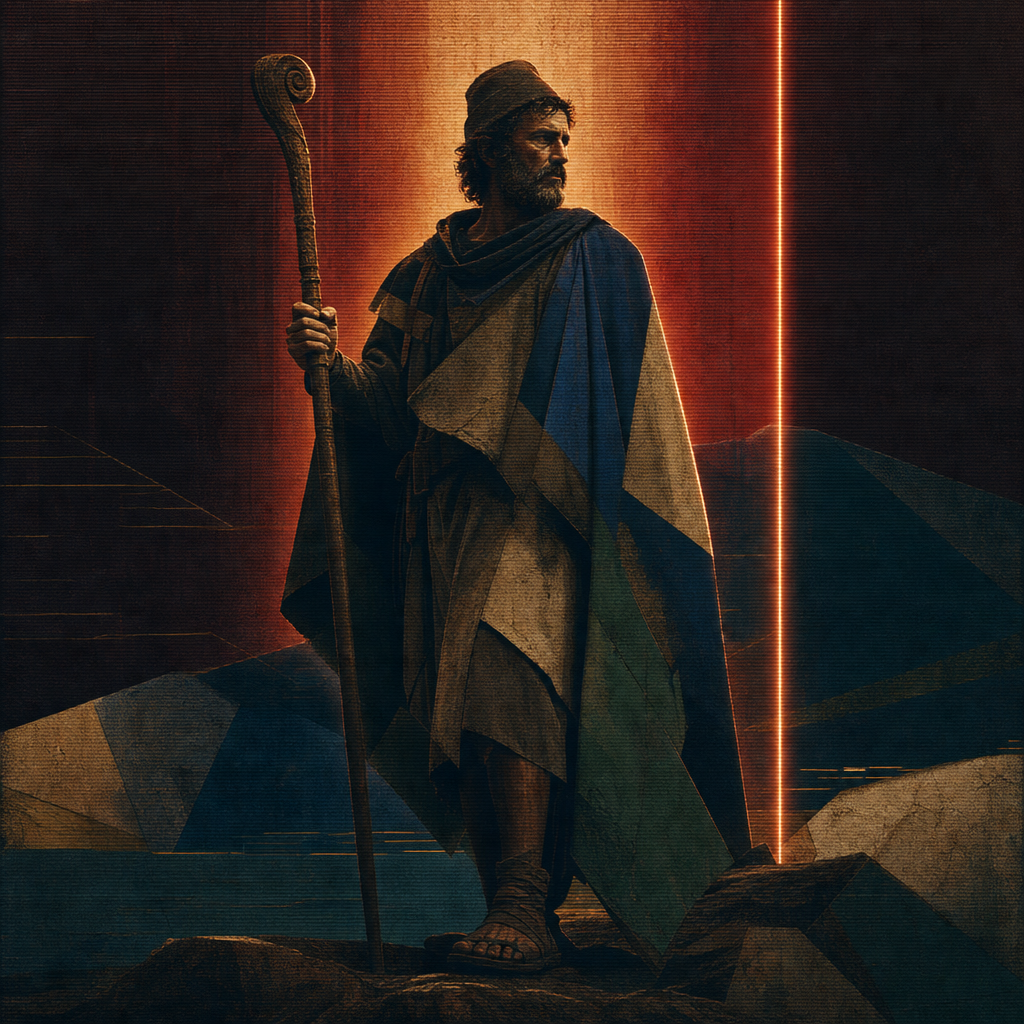
At dawn Odysseus and the noble swineherd lit the fire and prepared breakfast in the hut, after sending the herdsmen out with the gathered pigs. The barking dogs fawned around Telemachus as he approached and did not bark. Noble Odysseus noticed them wagging their tails and heard the sound of footsteps. At once he spoke winged words to Eumaeus: “Eumaeus, some companion of yours must be coming, or someone else you know. The dogs are not barking; they are fawning around him. I can hear footsteps.” Before he had finished, his dear son stood in the doorway. The swineherd sprang up in amazement. The vessels he was using to mix gleaming wine fell from his hands. He went to meet his young master and kissed his head, both his beautiful eyes, and both hands. Warm tears fell from him.
Read Ancient Greek Source (Odyssey.16.1–Odyssey.16.16)
As a loving father welcomes his own son home from a distant land in the tenth year, an only, dearly loved son for whom he has suffered much—so the noble swineherd threw his arms around godlike Telemachus and kissed him all over, as if he had escaped from death. Through his grief he spoke these winged words: “You have come, Telemachus, sweet light of my life! I thought I would never see you again after you sailed for Pylos. Come in, dear child, so I can delight in seeing you here, newly home from abroad. You do not often visit the farm or the herdsmen. You stay in town: that is what has pleased you, watching that destructive crowd of suitors.” Sensible Telemachus answered: “I will do that, father. It is for your sake I have come, to see you with my own eyes and hear whether my mother still stays in our halls or whether another man has married her, and Odysseus’s bed lies covered in foul cobwebs for lack of anyone to lie in it.” The swineherd, leader of men, answered: “She certainly stays in your halls, her heart enduring. Her nights and days are always spent in misery and tears.”
Read Ancient Greek Source (Odyssey.16.17–Odyssey.16.39)
He took Telemachus’s bronze spear. The young man went in and crossed the stone threshold. His father Odysseus rose to give him his seat, but Telemachus stopped him from across the room: “Stay seated, stranger. We will find a seat elsewhere on our own farm. There is a man here who will make one ready.” Odysseus went back and sat. For Telemachus the swineherd spread green brushwood with a fleece on top, and Odysseus’s dear son sat there. The swineherd set beside them platters of roast meat left from the previous day’s meal, quickly piled bread into baskets, and mixed honey-sweet wine in an ivy-wood cup. He sat opposite godlike Odysseus. They reached for the good food set before them. When they had satisfied their desire for food and drink, Telemachus said to the noble swineherd: “Father, where has this stranger come to you from? How did his sailors bring him to Ithaca, and who did they claim to be? I do not think he came here on foot.”
Read Ancient Greek Source (Odyssey.16.40–Odyssey.16.59)
You answered him, Eumaeus the swineherd: “Child, I will tell you the whole truth. He claims to come from broad Crete. He says he has wandered through many cities of mortals: a divine power spun that fate for him. Now he has escaped from a Thesprotian ship and come to my farm. I will put him in your hands. Do as you wish; he declares himself your suppliant.” Sensible Telemachus answered: “Eumaeus, your words pain my heart. How can I welcome the stranger in my house? I am young myself and do not yet trust my hands to fight off a man who attacks me. My mother’s heart is divided: should she stay here beside me and care for the house, respecting her husband’s bed and what people say, or follow whichever is the best of the Achaeans courting her in the hall and offers the most? Since the stranger has come to your house, I will give him a fine cloak and tunic, a two-edged sword, and sandals for his feet. I will send him wherever his heart and spirit urge. Or, if you wish, keep him here and care for him at the farm. I will send clothing and all the food he needs, so he will not wear you and your companions out. But I would not let him go there among the suitors. Their reckless outrage is too great. They may mock him, and it would grieve me terribly. Even a strong man can do little against many: they are far more powerful.”
Read Ancient Greek Source (Odyssey.16.60–Odyssey.16.89)
Long-suffering noble Odysseus said: “Friend, since I too may answer, my heart is being eaten away as I listen to what you say the suitors are recklessly devising in your house against your will, a man like you! Tell me: do you submit willingly? Do the people throughout the land hate you, following some god’s voice? Or do you find fault with brothers, the men whose fighting a man can count on even when a great quarrel breaks out? If only I were young with the spirit I have now, or a son of excellent Odysseus, or Odysseus himself! Then let a stranger cut off my head if I did not become a disaster to them all when I entered the hall of Odysseus, son of Laertes. And if their numbers overcame me alone, I would rather be killed and die in my own halls than always watch these shameful deeds: guests abused, enslaved women dragged roughly through the beautiful house, wine drained away, and bread eaten to no purpose, without end, for a business that never reaches its goal.”
Read Ancient Greek Source (Odyssey.16.90–Odyssey.16.111)
Sensible Telemachus answered: “Stranger, I will tell you plainly. The whole people do not hate me or rage against me. Nor do I find fault with brothers, the men whose fighting a man can count on even when a great quarrel breaks out. The son of Cronus has made our line run through only sons. Arceisius had only one son, Laertes. My grandfather had only one son, Odysseus. Odysseus had me alone and left me in his halls without ever enjoying my companionship. So now countless enemies are in the house. All the leading men who rule the islands—Dulichium, Same, and wooded Zacynthus—and all who hold power in rocky Ithaca court my mother and wear the house away. She neither refuses the hateful marriage nor can she bring it to completion. They eat up my house and will soon tear me apart as well. But these things lie on the gods’ knees. Father, go quickly and tell sensible Penelope I am safe and have returned from Pylos. I will stay here. Come back after telling her alone. Let no other Achaean learn of it: many are plotting trouble for me.”
Read Ancient Greek Source (Odyssey.16.112–Odyssey.16.134)
You answered him, Eumaeus the swineherd: “I understand; I take your meaning. You are giving orders to someone who can think. But tell me this plainly: should I also go on the same journey to bring word to unfortunate Laertes? Until now, though he grieved greatly for Odysseus, he still oversaw the farm work and ate and drank in the house with the enslaved men whenever his heart urged. But since you sailed to Pylos, they say he has not eaten or drunk as before, or looked at the work. He sits groaning and weeping in grief, and the flesh wastes away around his bones.” Sensible Telemachus answered: “That is all the more painful, but we must leave him, though we grieve. If mortals could choose everything for themselves, we would choose my father’s day of return first. Take your message and come straight back. Do not wander through the fields to see him. Tell my mother to send the housekeeper secretly as quickly as possible. She can take the news to the old man.”
Read Ancient Greek Source (Odyssey.16.135–Odyssey.16.153)
He sent the swineherd on his way. Eumaeus took his sandals in his hands, tied them beneath his feet, and went toward town. Athena noticed him leaving the farm. She came near in the form of a woman, beautiful and tall, skilled in splendid handiwork. She stood before the hut’s entrance, visible to Odysseus. Telemachus did not see or notice her face to face: the gods do not show themselves clearly to everyone. But Odysseus and the dogs saw her. The dogs did not bark; they fled whining to the other side of the farm. She signaled with her eyebrows. Noble Odysseus understood, left the hut, went outside the great yard wall, and stood before her. Athena said: “Son of Laertes, descended from Zeus, resourceful Odysseus, tell your son now. Do not keep it hidden. Then the two of you can plan the suitors’ death and doom and go to the famous city. I myself will not be away from you long: I am eager to fight.”
Read Ancient Greek Source (Odyssey.16.154–Odyssey.16.171)
Athena touched him with her golden wand. First she put a freshly washed cloak and tunic about his chest, and increased his stature and youthful vigor. His skin grew dark again, his cheeks filled out, and a dark beard grew around his chin. Then she went away, and Odysseus entered the hut. His dear son was astonished. In fear he turned his eyes aside, thinking it might be a god, and spoke these winged words: “Stranger, you look different now from before. Your clothes are different, and your skin is no longer the same. You must be one of the gods who hold broad heaven. Be gracious, so we may give you welcome sacrifices and finely made golden gifts. Spare us!” Long-suffering noble Odysseus answered: “I am no god. Why compare me to the immortals? I am your father, for whose sake you groan and suffer so much, submitting to the violence of men.”
Read Ancient Greek Source (Odyssey.16.172–Odyssey.16.189)
He kissed his son and let a tear run from his cheek to the ground. Before, he had always held his tears firmly back. Telemachus still did not believe he was his father and answered again: “You are not Odysseus, my father. Some divine power is enchanting me, to make me grieve and groan still more. No mortal man could contrive this by his own wits unless a god himself came and easily made him young or old at will. Just now you were an old man in miserable clothes. Now you look like the gods who hold broad heaven.” Resourceful Odysseus answered: “Telemachus, it is not right to marvel so excessively or stand astonished at your dear father here in the house. No other Odysseus will come here. Here I am, the man you see, home in my native land in the twentieth year after suffering and wandering far. This change is the work of Athena, leader of the spoil. She has made me as she wishes, for she has the power: now like a beggar, now like a young man with fine clothes against his skin. It is easy for the gods who hold broad heaven both to glorify a mortal and to bring him low.”
Read Ancient Greek Source (Odyssey.16.190–Odyssey.16.212)
He sat, and Telemachus threw his arms around his good father, weeping and shedding tears. A longing for lament rose in both of them. They cried aloud, more piercingly than birds—sea eagles or hooked-taloned vultures whose chicks farmers have taken away before the chicks could fly. So pitifully the tears fell from beneath their brows. The sun would have set while they were still grieving if Telemachus had not quickly spoken to his father: “Dear father, what ship did your sailors bring you here to Ithaca on? Who did they claim to be? I do not think you came here on foot.” Long-suffering noble Odysseus answered: “Child, I will tell you the truth. The Phaeacians brought me, men famed for their ships, who carry home anyone who comes to them. They brought me sleeping over the sea in a swift ship and set me down in Ithaca. They gave me splendid gifts, an abundance of bronze and gold and woven clothing. By the gods’ will these lie in caves. Now I have come here at Athena’s urging so we can plan how to kill our enemies. Come, count and describe the suitors for me, so I know how many they are and what kind of men. Then I can weigh it in my good heart and consider whether the two of us can stand against them alone or whether we should seek others.”
Read Ancient Greek Source (Odyssey.16.213–Odyssey.16.239)
Sensible Telemachus answered: “Father, I have always heard of your great fame, your skill with the spear and your wise judgment. But you have spoken far too boldly. I am astonished. Two men could not fight so many strong opponents. There are not merely ten suitors, or even twenty, but many more. Here is their number. From Dulichium there are fifty-two chosen young men, and six servants follow them. From Same there are twenty-four men; from Zacynthus, twenty young Achaeans; from Ithaca itself, twelve leading men in all. With them are Medon the herald and the inspired singer, and two attendants skilled in carving meat. If we meet them all together inside, I fear you will pay for their violence bitterly and terribly on your return. If you can think of any defender who would willingly help us, consider who it might be.”
Read Ancient Greek Source (Odyssey.16.240–Odyssey.16.257)
Long-suffering noble Odysseus said: “I will tell you; take it to heart and listen. Consider whether Athena and father Zeus will be enough for us, or whether I should think of some other defender.” Sensible Telemachus answered: “Those are two fine defenders you name, though they sit high in the clouds. They have power over other men as well, and over the immortal gods.” Long-suffering noble Odysseus said: “Those two will not stay long apart from the fierce fighting when Ares’s strength decides between the suitors and us in my halls. Now, at dawn, go home and mingle with the arrogant suitors. Later the swineherd will bring me to town, looking like a wretched old beggar. If they dishonor me in the house, let the heart in your breast endure my suffering. Even if they drag me through the hall by my feet and out the door, or throw things at me, bear the sight. Tell them to stop their folly, speaking gently to persuade them. But they will not listen: their destined day is close beside them.
Read Ancient Greek Source (Odyssey.16.258–Odyssey.16.280)
“I will tell you something else; take it to heart. When Athena of many counsels puts it into my mind, I will nod to you. Understand my signal, and lift all the weapons of war that lie in your halls and put them away in the far corner of the high storeroom, every one. Soothe the suitors with gentle words when they ask because they miss them: ‘I have put them out of the smoke. They no longer look as they did when Odysseus left them to sail for Troy. The fire’s breath has spoiled them all over. And the son of Cronus put a greater thought in my mind: you might get drunk, quarrel among yourselves, wound each other, and disgrace the feast and the courtship. Iron itself draws a man on.’ Leave just two swords, two spears, and two oxhide shields for the two of us to take in our hands, so we can rush in and seize them. Pallas Athena and Zeus the planner will bewilder the others.
Read Ancient Greek Source (Odyssey.16.281–Odyssey.16.298)
“I will tell you something else; take it to heart. If you are truly mine, of our blood, let no one hear that Odysseus is in the house. Do not let Laertes know, or the swineherd, any of the household people, or Penelope herself. You and I alone will learn the women’s disposition. We might still test some of the enslaved men too: who honors us and fears us in his heart, and who cares nothing and dishonors you, a man like you.” His glorious son answered: “Father, you will come to know my spirit, I think. No foolishness has hold of me. But I do not think this will benefit us both. I urge you to consider it. You will spend a long time needlessly testing each man as you go round the farms, while in the house they sit at ease, insolently devouring your possessions without restraint. I do urge you to find out about the women, those who dishonor you and those who are innocent. But I would not have us test the men about the farms. Let us attend to that later, if you really know some sign from aegis-bearing Zeus.”
Read Ancient Greek Source (Odyssey.16.299–Odyssey.16.320)
While they talked, the well-built ship that had brought Telemachus and all his companions from Pylos came down to Ithaca. When they reached the deep harbor, they hauled the black ship onto land. Proud attendants carried off their gear and took the beautiful gifts straight to Clytius’s house. They sent a herald to Odysseus’s house to tell thoughtful Penelope that Telemachus was on the farm and had ordered the ship to sail to town, so the noble queen would not be afraid in her heart and shed tender tears. The herald and the noble swineherd met, both bringing the same message to the woman. When they reached the godlike king’s house, the herald said among the enslaved women: “My queen, your dear son is home.” But the swineherd stood close to Penelope and told her everything her dear son had ordered him to say. When he had delivered the whole message, he left the enclosure and hall and went back to the pigs.
Read Ancient Greek Source (Odyssey.16.321–Odyssey.16.341)
The suitors were distressed and downcast at heart. They left the hall, went outside the great yard wall, and sat before the doors. Eurymachus, son of Polybus, spoke first: “Friends, Telemachus has accomplished a great deed, this insolent journey! We said he would not bring it off. Come, let us launch our best black ship and gather seafaring rowers to tell those men to return home as quickly as possible.” Before he had finished, Amphinomus turned from his place and saw a ship within the deep harbor, its men furling sail and holding oars in their hands. He laughed pleasantly and said to his companions: “Let us send no message. Here they are inside already. Either a god told them, or they saw the ship pass and could not catch her.” They rose, went to the seashore, and quickly hauled the black ship onto land. Proud attendants carried off their gear.
Read Ancient Greek Source (Odyssey.16.342–Odyssey.16.360)
They went together to the assembly place and would let no one else sit among them, young or old. Antinous, son of Eupeithes, said: “Ah, how the gods have freed this man from trouble! By day our lookouts sat on the windy heights, always in relays. At sunset we never spent the night on land. We sailed the swift ship at sea and waited for bright Dawn, watching for Telemachus so we could catch and kill him. Meanwhile a divine power brought him home. Now let us plan a miserable death for Telemachus here. He must not escape us. I do not think we can carry this business through while he lives. He himself is knowledgeable in counsel and thought, and the people no longer favor us entirely. Come, before he gathers the Achaeans into assembly—for I do not think he will let it go: he will be furious and stand up before them all to say we planned his utter murder and failed to catch him. They will not approve when they hear our evil deeds. They may harm us and drive us from our own land to some other people’s country. Let us catch and kill him on the farm away from town, or on the road, and keep his livelihood and possessions, dividing them fairly among ourselves. We can give the house to his mother and whichever man marries her. If this proposal displeases you and you want him to live and keep everything his father left, let us no longer gather here and eat up his abundant, pleasing possessions. Let each man court her from his own house with marriage gifts. Then she can marry whoever gives most and comes as her destined husband.”
Read Ancient Greek Source (Odyssey.16.361–Odyssey.16.392)
They all fell silent. Then Amphinomus addressed them, the glorious son of Nisus and grandson of lord Aretias. He led the suitors from Dulichium, rich in wheat and grass, and his words pleased Penelope most of all: he had good sense. With goodwill toward them he said: “Friends, I would not wish to kill Telemachus. It is a dreadful thing to kill royal stock. First let us ask the gods’ will. If the decrees of great Zeus approve, I myself will kill him and urge all the rest to do it. If the gods turn us away, I tell you to stop.” Amphinomus’s words pleased them. They rose at once, went to Odysseus’s house, and sat on polished seats.
Read Ancient Greek Source (Odyssey.16.393–Odyssey.16.408)
Thoughtful Penelope now formed another plan: to appear before the suitors in their outrageous violence. She had learned of the murder planned for her son in the hall, for Medon the herald, who had heard their counsels, told her. She went to the hall with her women attendants. When this radiant woman reached the suitors, she stood beside a pillar of the solidly built roof, holding her shining veil before her cheeks. She rebuked Antinous: “Antinous, insolent schemer, they say you are the best of your age in Ithaca at counsel and speech. So you are nothing of the kind! Madman, why are you plotting Telemachus’s death and doom? You pay no heed to suppliants, whose witness is Zeus. It is unholy to plot harm against one another. Do you not know how your father came here in flight, afraid of the people? They were furious with him because he had joined Taphian raiders and harmed the Thesprotians, who were our allies. They wanted to kill him, tear out his dear heart, and eat up his great, welcome wealth. But Odysseus restrained them and held them back, eager though they were. Now you dishonor his house and eat it up, court his wife, seek to kill his son, and grieve me deeply! I order you to stop and tell the others to stop too.”
Read Ancient Greek Source (Odyssey.16.409–Odyssey.16.433)
Eurymachus, son of Polybus, answered: “Daughter of Icarius, thoughtful Penelope, take heart. Do not let these things trouble you. There is no man, nor will there ever be one, nor could one be born, who will lay hands on your son Telemachus while I live and look upon the earth. I will tell you plainly, and it will be fulfilled: any attacker’s dark blood would soon flow around my spear. For Odysseus, sacker of cities, often sat me on his knees, put roast meat into my hands, and held red wine to my lips. So Telemachus is by far the dearest of all men to me, and I tell him not to fear death from the suitors. There is no escaping death from a god.” So he reassured her, while he himself was arranging the boy’s destruction. She went upstairs to her shining rooms and wept for Odysseus, her dear husband, until bright-eyed Athena cast sweet sleep over her eyelids.
Read Ancient Greek Source (Odyssey.16.434–Odyssey.16.451)
At evening the noble swineherd came back to Odysseus and his son. They had sacrificed a yearling pig and were busily preparing supper. Athena had stood close, struck Odysseus, son of Laertes, with her wand, and made him an old man again. She put miserable clothes about his skin, so the swineherd would not recognize him face to face and go to tell sensible Penelope, unable to keep it to himself.
Read Ancient Greek Source (Odyssey.16.452–Odyssey.16.459)
Telemachus was first to speak: “You are back, noble Eumaeus. What news is there in town? Have the proud suitors already come home from the ambush, or are they still watching for me on my way back?” You answered him, Eumaeus the swineherd: “I did not think to ask or inquire about that as I went through town. My heart urged me to deliver the message and come back here as quickly as possible. A swift messenger from your companions met me, a herald who was first to speak to your mother. But I do know this, for I saw it with my own eyes. I was already above the city, where Hermes’s hill is, when I saw a swift ship coming down into our harbor. Many men were in her, and she was laden with shields and double-pointed spears. I thought it was them, but I do not know.” At this, mighty Telemachus smiled, looking at his father and avoiding the swineherd’s eyes. When they had finished their work and prepared the feast, they dined, and their hearts lacked nothing of an equal share. When they had satisfied their desire for food and drink, they thought of bed and took the gift of sleep.