Book 4: Telemachus at Sparta with Menelaus and Helen
Ὀδύσσεια · Book 4 · Classix Modern English Reading Edition
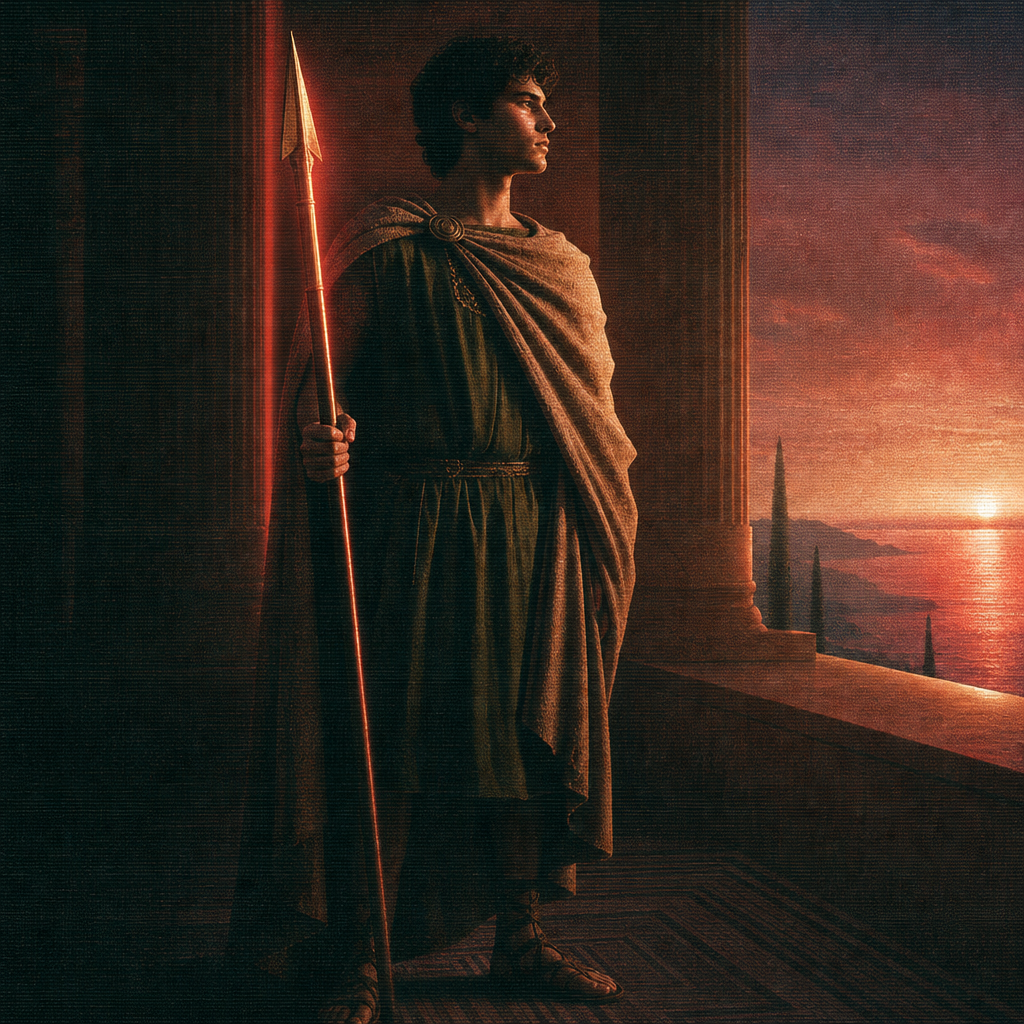
They reached hollow Lacedaemon, cleft with deep ravines, and drove straight to the palace of glorious Menelaus. They found him giving a wedding feast to his many kinsmen for his son and his faultless daughter inside his house. He was sending his daughter to the son of Achilles, breaker of battle lines. At Troy he had first promised and pledged to give her to him, and now the gods were bringing the marriage about. With horses and chariots he was sending her to the famous city of the Myrmidons, whom Achilles’ son ruled. For his son, strong Megapenthes, his cherished child by an enslaved woman, he was bringing Alector’s daughter from Sparta. The gods had granted Helen no more children after she bore her lovely daughter Hermione, who had the beauty of golden Aphrodite. So they were feasting throughout the great high-roofed hall, the neighbors and kinsmen of glorious Menelaus, delighting in the banquet; among them an inspired singer sang to the lyre, while two tumblers in the crowd, as he led the music, wheeled and somersaulted through the middle.
Read Ancient Greek Source (Odyssey.4.1–Odyssey.4.19)
Meanwhile the hero Telemachus and Nestor’s splendid son halted with their horses at the palace gateway. Lord Eteoneus, the ready attendant of glorious Menelaus, came out and saw them. He went through the halls to bring word to the shepherd of his people, and stood beside him to speak these winged words: “Menelaus, fostered by Zeus, two strangers are here, two men who look as though they come from great Zeus’s own line. Shall we unharness their swift horses, or send them on to find another host?”
Read Ancient Greek Source (Odyssey.4.20–Odyssey.4.29)
Deeply angered, fair-haired Menelaus answered him: “You never used to be a fool, Eteoneus, son of Boethous. Now you talk nonsense like a child. You and I ate many meals at other men’s tables before we came back here. May Zeus spare us misery from now on! Unharness the strangers’ horses and bring the men inside to feast.”
Read Ancient Greek Source (Odyssey.4.30–Odyssey.4.36)
So he spoke, and Eteoneus hurried through the hall and called to other nimble attendants to follow along with him. They loosed the sweating horses from under the yoke, tethered them at their stalls beside the mangers, tossed in spelt for them and mixed white barley through it, tilted the chariot against the gleaming entry walls, and led the men themselves into the godlike palace. Seeing it, they marveled as they looked through the home of the king fostered by Zeus; for a radiance like the sun's or the moon's shone through the high-roofed palace of glorious Menelaus.
Read Ancient Greek Source (Odyssey.4.37–Odyssey.4.46)
Then, when they had taken their fill of gazing with their eyes, they stepped into polished bathtubs and bathed. And when the serving women had bathed them and rubbed them with olive oil, and draped thick woolen cloaks and tunics around them, they sat down on high-backed chairs beside Menelaus, son of Atreus.
Read Ancient Greek Source (Odyssey.4.47–Odyssey.4.51)
A maidservant brought water for their hands and poured it from a pitcher, lovely and golden, out over a silver basin so they could wash; and she set a polished table beside them. The worthy housekeeper brought bread and set it before them, laying out many dishes, giving generously from her stores. A carver lifted and served platters of meat of every kind, and placed golden cups beside them.
Read Ancient Greek Source (Odyssey.4.52–Odyssey.4.58)
Welcoming the two of them, fair-haired Menelaus spoke: “Take some food and be glad. Afterward, once you have shared our meal, we will ask who you are. Your parents’ breeding is plain in you: you come from kings fostered by Zeus, men who bear the scepter. Base men could never father sons like you.”
Read Ancient Greek Source (Odyssey.4.59–Odyssey.4.64)
So he spoke, and set before them the rich chine of an ox, lifting the roasted meat in his own hands—the portion of honor served to himself. And they reached out their hands to the good food spread ready before them.
Read Ancient Greek Source (Odyssey.4.65–Odyssey.4.67)
When they had put aside their desire for food and drink, Telemachus spoke to Nestor's son, leaning his head close so that the others would not hear: “Look, son of Nestor, dear to my heart, at the flash of bronze throughout the echoing halls, and of gold, amber, silver, and ivory. The court of Olympian Zeus must be like this inside, such untold wealth is here; awe takes hold of me as I look upon it.”
Read Ancient Greek Source (Odyssey.4.68–Odyssey.4.75)
Fair-haired Menelaus caught what he was saying, and calling out to them both, he spoke winged words: “Dear children, no mortal man could rival Zeus; for his house and his treasures are immortal. Among men there may or may not be someone to rival my wealth. I brought it home in ships after much suffering and wandering, returning in the eighth year. I roamed through Cyprus and Phoenicia and among the Egyptians; I reached the Ethiopians, the Sidonians, and the Erembians, and Libya, where lambs grow horns as soon as they are born. For there the flocks bear young three times in the course of a full year. There neither master nor shepherd ever goes short of cheese or meat, or of sweet milk, for the ewes always yield milk to draw all year round.
Read Ancient Greek Source (Odyssey.4.76–Odyssey.4.89)
“Yet while I was out in those lands gathering a great fortune, wandering far, another man killed my brother by stealth, off his guard, through the treachery of his accursed wife. So I take no joy in ruling over these possessions. You must have heard of this from your fathers, whoever they may be: how much I suffered, and how I lost a well-established household that held so many fine things. I wish I had only a third share of these things in my halls to live on, and that the men were still safe who perished then on the broad plain of Troy, far from horse-pasturing Argos.
Read Ancient Greek Source (Odyssey.4.90–Odyssey.4.99)
“I often sit in our halls grieving and weeping for them all. Sometimes tears ease my heart; sometimes I stop, for we soon have our fill of chilling grief. Yet for all of them together, grieving though I am, I do not mourn as much as for one man. Remembering him makes sleep and food hateful to me. No Achaean struggled and endured as much as Odysseus. Suffering was to be his lot, and mine a grief for him that never fades: he has been away so long, and we do not know whether he is alive or dead. Surely they are mourning him now—old Laertes and thoughtful Penelope, and Telemachus, whom he left at home a newborn child.”
Read Ancient Greek Source (Odyssey.4.100–Odyssey.4.112)
His words stirred Telemachus’ longing to weep for his father. At the mention of him, tears fell from his eyes to the ground; with both hands he held his purple cloak before his face. Menelaus noticed and pondered in his mind and heart whether to let him mention his father himself, or to question him first and ask about everything.
Read Ancient Greek Source (Odyssey.4.113–Odyssey.4.119)
While he was turning this over in his mind and heart, out from her fragrant, high-roofed chamber came Helen, like Artemis of the golden distaff. At her side, Adreste set a finely crafted chair, Alcippe brought a rug of soft wool, and Phylo carried a silver basket that Alcandra had given Helen. Alcandra was the wife of Polybus, who lived in Egyptian Thebes, where houses hold the greatest treasures. Polybus gave Menelaus two silver bathtubs, two tripods, and ten talents of gold. And besides these, his wife gave Helen beautiful gifts of her own: she presented a golden distaff and a wheeled basket of silver, its rim finished with gold. Her attendant Phylo brought this and set it beside her, heaped full of finely spun yarn, and across it lay the distaff holding violet-dark wool. Helen sat in the chair with a footstool beneath her feet, and at once she questioned her husband on every point:
Read Ancient Greek Source (Odyssey.4.120–Odyssey.4.137)
“Do we know, Menelaus, cherished by Zeus, who these men claim to be who have come to our house? Will I be wrong, or speak the truth? My heart urges me to speak. I have never seen anyone, man or woman, resemble another so closely. I am astonished at how much this man resembles the son of great-hearted Odysseus, Telemachus, left behind in the house as a newborn by that man, when because of me, shameless and dog-eyed, you Achaeans came up under Troy, stirring up bold war.”
Read Ancient Greek Source (Odyssey.4.138–Odyssey.4.146)
Fair-haired Menelaus answered her: “Now I see it too, wife, just as you say. Such were that man's feet and such were his hands, the glance of his eyes, his head, and the hair above. And just now, as I was remembering Odysseus and speaking of all he suffered and labored through for my sake, this young man shed bitter tears from beneath his brows, holding his purple cloak up in front of his eyes.”
Read Ancient Greek Source (Odyssey.4.147–Odyssey.4.154)
Then Peisistratus, son of Nestor, spoke to him in reply: “Menelaus, son of Atreus, cherished by Zeus, leader of men, this is truly that man's son, just as you say. But he is reserved, and feels shy about speaking freely before you on his first visit. We both listen to your voice with the delight we would take in a god’s. The Gerenian horseman Nestor sent me along to go with him as his escort, for Telemachus longed to see you and hoped you might help him with advice or action. A son suffers many griefs at home when his father is gone and he has no one else to help him. So it is with Telemachus now: his father is away, and there is no one else among his people to ward off trouble for him.”
Read Ancient Greek Source (Odyssey.4.155–Odyssey.4.167)
Fair-haired Menelaus answered him: “Ah, truly the son of a dear friend has come to my house, the son of a man who endured many hard struggles for my sake! I thought that when he returned I would cherish him above all the other Argives, if to the two of us a return across the sea had been granted in our swift ships by Olympian, far-thundering Zeus. I would have given him a city in Argos and built him a house, bringing him from Ithaca with his possessions, his son and all his people. I would have cleared out one of the towns around us, towns under my own rule. Then, living here, we would have been together often, and nothing else would have parted us in our love and our joy, until the black cloud of death wrapped around us. But a god himself must have begrudged us that, who denied that wretched man alone his homecoming.”
Read Ancient Greek Source (Odyssey.4.168–Odyssey.4.182)
So he spoke, and stirred in them all a longing to weep. Argive Helen wept, daughter of Zeus; Telemachus wept, and Menelaus, son of Atreus; nor did the son of Nestor keep his eyes dry of tears, for in his heart he remembered noble Antilochus, whom the glorious son of shining Dawn had killed. Remembering him, he spoke winged words:
Read Ancient Greek Source (Odyssey.4.183–Odyssey.4.189)
“Son of Atreus, you are wise beyond all mortal men—so old Nestor used to say whenever we remembered you in his halls and questioned one another. If you will, listen to me now. I take no pleasure in weeping after supper; early-born Dawn will come again. Not that I blame anyone for mourning a mortal who has died and met his fate. This is the only tribute left for wretched mortals: to cut their hair and let tears fall down their cheeks. For a brother of mine is dead too, by no means the worst of the Argives. You must have known him, for I myself never met him or saw him; yet people say he excelled all others, Antilochus, unmatched in speed of foot and as a fighter.”
Read Ancient Greek Source (Odyssey.4.190–Odyssey.4.202)
Fair-haired Menelaus answered him: “My friend, you have spoken just as a sensible man would speak and act, even one much older than you. For you come from such a father, and so you speak with wisdom. The children of a man to whom Cronus’ son spins good fortune, at birth and at marriage, are easy to recognize. So he has blessed Nestor all his days: the old man grows old in comfort at home, and his sons are wise and outstanding with the spear.
Read Ancient Greek Source (Odyssey.4.203–Odyssey.4.211)
“So let us put aside the weeping that came over us before, and turn our thoughts once more to supper. Let the attendants pour water over our hands. There will be talk in the morning too for Telemachus and me to share in full with each other.” So he spoke, and Asphalion poured water over their hands, the ready attendant of glorious Menelaus. And they reached out their hands to the good food set ready before them.
Read Ancient Greek Source (Odyssey.4.212–Odyssey.4.218)
Then Helen, daughter of Zeus, thought of something else: at once she cast a drug into the wine they were drinking from—a drug to quiet all pain and anger, bringing forgetfulness of every trouble. Whoever swallowed it down, once it was mixed in the wine bowl, would not let a tear fall down his cheeks all that day, not even if his mother and father died, not even if right before him his brother or his own dear son were cut down with bronze while he watched with his own eyes. Such were the cunning drugs the daughter of Zeus possessed—good ones, given to her by Polydamna, the wife of Thon, a woman of Egypt, where the grain-giving earth bears the greatest store of drugs, many of them good when mixed, and many deadly. There every man is a healer skilled above all other men, for truly they are of the blood of Paeeon.
Read Ancient Greek Source (Odyssey.4.219–Odyssey.4.232)
When she had dropped the drug in and ordered the wine poured out, she took up the talk again and spoke to them: “Menelaus, son of Atreus, cherished by Zeus, and you others here, sons of noble men—now to one man, now to another, the god Zeus gives both good and evil, for he has power over all things. So sit now in the hall and feast, and take pleasure in our stories, for I will tell what is fitting.
Read Ancient Greek Source (Odyssey.4.233–Odyssey.4.239)
“I could not recount or name them all, all the trials that steadfast Odysseus endured; but what a deed that strong man did and endured in the land of the Trojans, where you Achaeans suffered such hardships! He beat his own body with disfiguring blows, threw wretched rags across his shoulders, and looking like a household slave, slipped into the wide-streeted city of his enemies. Hiding who he was, he made himself look like someone else—a beggar, the last thing he was by the ships of the Achaeans. In that guise he slipped into the city of the Trojans, and they suspected nothing—none of them; I alone recognized him even as he was, and I questioned him, though in his cunning he kept evading me. Only when I had bathed him and rubbed him with olive oil, dressed him in clothes, and swore a mighty oath never to give Odysseus away to the Trojans before he got back to the swift ships and the shelters—only then did he lay out for me the whole plan of the Achaeans.
Read Ancient Greek Source (Odyssey.4.240–Odyssey.4.256)
“Then, after killing many Trojans with his long-edged bronze, he returned to the Argives and brought back a wealth of intelligence. Then the other Trojan women wailed piercingly, but my own heart was glad, for my heart had already turned toward going back home, and I grieved for the blind folly Aphrodite gave me when she led me there, away from my dear native land. I had left my daughter, my marriage chamber and my husband, a man lacking nothing in either mind or looks.”
Read Ancient Greek Source (Odyssey.4.257–Odyssey.4.264)
Fair-haired Menelaus answered her: “Yes, wife, you have told all this as it should be told. By now I have come to know the counsel and mind of many heroes, and I have traveled over many lands; yet with my own eyes I have never seen anything like the heart inside steadfast Odysseus.
Read Ancient Greek Source (Odyssey.4.265–Odyssey.4.270)
“What a deed that strong man did and endured there too, inside the smooth-hewn horse, where all of us, the best of the Argives, sat bringing slaughter and doom to the Trojans! Then you came there. Some god who wanted to give the Trojans glory must have urged you on, and godlike Deiphobus came with you. Three times you walked around our hollow ambush, feeling it with your hands. You called the best of the Danaans by name, imitating the voice of each Argive’s wife. Now Tydeus' son and I and brilliant Odysseus, sitting in the middle of the men, heard you call out. Diomedes and I both wanted to spring up, either to come out or to answer at once from inside. But Odysseus held us back and checked us, eager as we were. Then all the other sons of the Achaeans kept silent, except Anticlus, who alone was about to answer you with a word; but Odysseus clamped his hands over the man's mouth, gripping him relentlessly with his strong hands, and saved all the Achaeans, holding him fast until Pallas Athena led you away.”
Read Ancient Greek Source (Odyssey.4.271–Odyssey.4.289)
Clear-headed Telemachus answered him: “Menelaus, son of Atreus, cherished by Zeus, leader of men, that makes it all the more bitter, for none of this warded off his grim destruction, not even if the heart inside him had been made of iron. But come, send us to our beds, so that now at last we may lie down and take comfort in sweet sleep.”
Read Ancient Greek Source (Odyssey.4.290–Odyssey.4.295)
So he spoke, and Argive Helen ordered her serving women to set up beds under the portico and lay fine purple bedding on them, spread carpets over the top, and place thick woolen cloaks above to pull over themselves. The women went out from the hall with torches in their hands and made up the beds, and a herald led the guests out. So the two of them slept right there in the forecourt of the palace—the hero Telemachus and the splendid son of Nestor—while the son of Atreus slept in the innermost chamber of the high house, and beside him lay long-robed Helen, shining among women.
Read Ancient Greek Source (Odyssey.4.296–Odyssey.4.305)
When early-born, rosy-fingered Dawn appeared, Menelaus, strong at the war cry, rose from his bed, put on his clothes, slung a sharp sword over his shoulder, and bound fine sandals beneath his shining feet. He stepped from his chamber, godlike in appearance, sat beside Telemachus, and addressed him by name:
Read Ancient Greek Source (Odyssey.4.306–Odyssey.4.311)
“What need has brought you here, hero Telemachus, to bright Lacedaemon across the broad back of the sea? Is it a public matter or your own? Tell me the plain truth.”
Read Ancient Greek Source (Odyssey.4.312–Odyssey.4.314)
Clear-headed Telemachus answered him: “Menelaus, son of Atreus, cherished by Zeus, leader of men, I came in the hope that you could tell me some news of my father. My household is being eaten away, my rich estates are ruined, and the house is full of hostile men. Day after day they slaughter my thick-fleeced sheep and shambling, curved-horned cattle—my mother’s suitors, in their overbearing arrogance.
Read Ancient Greek Source (Odyssey.4.315–Odyssey.4.321)
“That is why I have come to your knees now, in hope you might be willing to tell me of his grim death—whether you saw it yourself with your own eyes, or heard word of it from some other wanderer, for his mother bore him to sorrow beyond all men. Do not soften your words out of regard for me or out of pity, but tell me plainly whatever you chanced to see. I beg you—if ever my father, noble Odysseus, promised you any word or deed and made it good in the land of the Trojans, where you Achaeans suffered such hardships, remember it for me now, and tell me the plain truth.”
Read Ancient Greek Source (Odyssey.4.322–Odyssey.4.331)
With a heavy groan, fair-haired Menelaus answered him: “What a disgrace! Weaklings, wanting to lie in a stout-hearted man’s bed! A doe puts her newborn suckling fawns to sleep in a mighty lion’s thicket, then goes to feed on the mountain slopes and grassy glens. The lion comes back to his lair and brings a brutal death to her and her young. So Odysseus will bring a brutal death to those men.
Read Ancient Greek Source (Odyssey.4.332–Odyssey.4.340)
“Father Zeus, Athena and Apollo, if only Odysseus would come among the suitors as he was in well-built Lesbos, when he stood up to wrestle Philomeleides in a contest and threw him down hard, to the joy of all the Achaeans! They would all find a swift death and a bitter marriage.
Read Ancient Greek Source (Odyssey.4.341–Odyssey.4.346)
“As for what you ask and beg of me, I will not sidestep it or deceive you. I will not hide or hold back a single word of what the unerring Old Man of the Sea told me.
Read Ancient Greek Source (Odyssey.4.347–Odyssey.4.350)
“In Egypt, though I was still eager to return here, the gods held me back, because I had not offered them complete hecatombs; and the gods always wished their commands to be remembered. Now there is a certain island in the heavy-surging sea in front of Egypt, and they call it Pharos, as far offshore as a hollow ship in a full day's run can cover, when a whistling fair wind blows from behind. In it is a harbor with good mooring, from which men launch balanced ships out into the open sea, once they have drawn dark water. There the gods held me for twenty days, and never once did the fair winds appear, blowing across the salt water, the winds that serve as escorts for ships over the broad back of the sea.
Read Ancient Greek Source (Odyssey.4.351–Odyssey.4.362)
“And now all our provisions would have given out, and the strength of my men, if one of the gods had not pitied me and saved me—the daughter of mighty Proteus, the Old Man of the Sea, Eidothea; for it was her heart most of all that I moved. She met me as I wandered alone, apart from my companions; for they were always roaming around the island, fishing with bent hooks, as hunger wore at their bellies. Standing close beside me, she spoke and addressed me:
Read Ancient Greek Source (Odyssey.4.363–Odyssey.4.370)
“‘Are you so foolish, stranger, so little in your right mind? Or are you giving up willingly, enjoying your misery? You have been held on this island so long without finding a way out, while your companions’ courage wastes away.’
Read Ancient Greek Source (Odyssey.4.371–Odyssey.4.374)
“So she spoke, and I answered her in turn: ‘I will tell you plainly, whichever of the goddesses you are, that I am not held back here of my own will at all; no, I must have offended the immortals who hold wide heaven. But tell me—for the gods know everything—which immortal is holding me in bonds and barring my way, and how I can return across the sea that teems with fish.’
Read Ancient Greek Source (Odyssey.4.375–Odyssey.4.381)
“So I spoke, and the shining goddess answered me at once: ‘Then I will tell you, stranger, with complete truth. An unerring Old Man of the Sea frequents this place, immortal Proteus of Egypt, who knows the depths of the whole sea, a servant of Poseidon; they say he is my father and begot me. If you could ambush him and seize him, he would tell you the route and its distance, and how to return across the sea that teems with fish. And he will tell you too, Zeus-nourished king, if you wish, whatever evil and good has happened in your halls while you have been gone on your long and painful journey.’
Read Ancient Greek Source (Odyssey.4.382–Odyssey.4.393)
“So she spoke, and I answered her in turn: ‘Devise the ambush yourself now for the divine old man, so he does not spot me first or learn of it beforehand and escape; for a god is hard for a mortal man to master.’
Read Ancient Greek Source (Odyssey.4.394–Odyssey.4.397)
“So I spoke, and the shining goddess answered me at once: ‘Then I will tell you, stranger, with complete truth. When the sun has climbed to the middle of the sky, then the unerring Old Man of the Sea comes out of the salt water under the breath of Zephyrus, hidden by a dark ripple, and once he comes ashore, he lies down to sleep under the hollow caves. Around him the web-footed seals of the fair sea-goddess sleep in a huddle, having emerged from the gray surf, breathing out the sharp stench of the deep sea. I will lead you there as soon as Dawn appears and lay you down in a row; and you must choose carefully three companions, the best you have beside your well-benched ships. And I will tell you all the old man's cunning tricks.
Read Ancient Greek Source (Odyssey.4.398–Odyssey.4.410)
“‘First he will go along the seals and count them. Once he has counted them all and looked them over, he will lie down in their midst, like a shepherd among his flocks of sheep. As soon as you see him settled down to sleep, then put all your mind to strength and force, and hold him fast right there, however fiercely he strives and struggles to escape. He will try you by turning into every kind of creature that moves upon the earth, and into water and blazing fire; but you must hold him unflinchingly and squeeze him all the harder. Yet when at last he questions you in words himself, in the very shape you saw him in when he lay down to sleep, then hold back your force and set the old man free, hero, and ask which god is afflicting you, and how you can return across the sea that teems with fish.’
Read Ancient Greek Source (Odyssey.4.411–Odyssey.4.424)
“Speaking so, she plunged beneath the surging sea. But I headed toward the ships, where they stood on the sands, and as I went my heart surged with many thoughts. When I came down to the ship and the sea, we made supper ready. Immortal night came on, and we lay down to sleep beside the breaking surf.
Read Ancient Greek Source (Odyssey.4.425–Odyssey.4.430)
“When early-born, rosy-fingered Dawn appeared, then along the shore of the wide-wayed sea I walked, earnestly entreating the gods; and I brought three companions, those I trusted most for any venture. Meanwhile she had plunged into the broad lap of the sea and brought up from the deep four skins of seals—all of them freshly flayed—as she devised a trap for her father. Having scooped out beds in the sea-sands, she sat waiting; and we came right up to her. She laid us down in a row, and cast a skin over each of us.
Read Ancient Greek Source (Odyssey.4.431–Odyssey.4.440)
“That ambush would have been unbearable, for the deadly stench of the sea-fed seals tormented us—who could lie down to sleep beside a beast of the sea? But she herself saved us and thought of a great relief: she brought sweet-scented ambrosia and placed it under each man’s nose. Its fragrance overcame the beasts’ stench.
Read Ancient Greek Source (Odyssey.4.441–Odyssey.4.446)
“All morning we waited with patient hearts. Then the seals came thronging up from the salt sea, and they lay down in rows along the breaking surf. At noon the old man came up from the salt sea and found his seals, all sleek and well-fed; he went down the line and counted their number. He counted us first among the sea-beasts, and in his heart he suspected no trick; then he too lay down to sleep.
Read Ancient Greek Source (Odyssey.4.447–Odyssey.4.453)
“With a shout we rushed upon him and threw our arms around him. Yet the old man did not forget his cunning craft: first of all he turned into a bearded lion, and then a serpent, a leopard, and a huge boar; he turned into running water and a tree crowned with high leaves. But we held on unflinchingly with patient hearts.
Read Ancient Greek Source (Odyssey.4.454–Odyssey.4.459)
“At last, when the old man skilled in dark wiles grew weary, he questioned me and spoke to me in words: ‘Son of Atreus, which god helped you plan this ambush, to seize me against my will? What do you need?’
Read Ancient Greek Source (Odyssey.4.460–Odyssey.4.463)
“So he spoke, and I answered him: ‘You know, old man. Why ask these questions to put me off? I have been held on this island so long without finding a way out, and my heart is wasting away. Tell me—for the gods know everything—which immortal is holding me in bonds and barring my way, and how I can return across the sea that teems with fish.’
Read Ancient Greek Source (Odyssey.4.464–Odyssey.4.470)
“So I spoke, and at once he answered me: ‘You should by all means have offered to Zeus and the other gods fine sacrifices before embarking, so that as quickly as possible you might reach your native land, sailing over the wine-dark sea. For it is not your fate to see your loved ones and come to your well-built house and your native land until you return to the waters of the Aegyptus, the sky-fed river, and offer sacred hecatombs to the immortal gods who hold wide heaven. Then the gods will grant you the journey you long for.’
Read Ancient Greek Source (Odyssey.4.471–Odyssey.4.480)
“So he spoke, and my heart was shattered within me, because he ordered me to cross the misty sea once more and go to Egypt, a long and grueling way. Even so, I answered him in these words: ‘All this I will carry out, old man, just as you command.
Read Ancient Greek Source (Odyssey.4.481–Odyssey.4.485)
“‘But come, tell me this and give me an honest account: did all those Achaeans return unharmed with their ships, whom Nestor and I left behind when we sailed from Troy? Or did any meet a bitter death aboard his ship or among his own people, after winding up the war?’
Read Ancient Greek Source (Odyssey.4.486–Odyssey.4.490)
“So I spoke, and at once he answered me: ‘Son of Atreus, why do you ask me this? You have no need to know, or to learn what is in my mind; for I tell you, you will not go long without weeping once you hear the whole truth. Many of those men were killed, and many were left alive; yet of the leaders of the bronze-armored Achaeans, only two perished on the way home—as for the fighting, you yourself were there. And one is still alive somewhere, held back on the wide sea.
Read Ancient Greek Source (Odyssey.4.491–Odyssey.4.498)
“‘Ajax was destroyed amid his long-oared ships. First Poseidon drove him ashore at Gyrae upon the great crags, and rescued him from the sea; and he would have escaped his doom, hated though he was by Athena, had he not flung out an arrogant boast in blind folly: he claimed that in spite of the gods he had escaped the great gulf of the sea. Poseidon heard him shouting his loud boast; at once he seized his trident in his strong hands and struck the Gyraean rock, splitting it in two. One part stayed in its place, while the broken crag fell into the sea—the very piece on which Ajax had sat in his blind folly—and it carried him down into the boundless, surging deep. So he perished there, once he had drunk the salt water.
Read Ancient Greek Source (Odyssey.4.499–Odyssey.4.511)
“‘Your brother, though, escaped the fates and slipped away in his hollow ships, for Queen Hera saved him. But just as he was about to reach the steep height of Malea, a storm snatched him up and carried him, groaning heavily, over the sea that teems with fish, to the edge of the land where Thyestes once lived and where his son Aegisthus then made his home. At last, when a safe return appeared possible even from there, the gods changed the wind back and Agamemnon and his men reached home. Full of joy he stepped out upon his native soil, grasping and kissing his homeland; and from his eyes the warm tears poured down, so glad was he to see his land.
Read Ancient Greek Source (Odyssey.4.512–Odyssey.4.523)
“‘But from a lookout post a watchman spotted him, a man whom scheming Aegisthus had brought and stationed there, promising as pay two talents of gold. The man had kept watch for a full year, lest the king pass by unseen and summon his furious strength. He ran to the palace to bring the news to the shepherd of the people. Aegisthus at once devised a treacherous plan. He chose twenty of the best men in the land and stationed them in ambush, while ordering a feast prepared elsewhere. Then he went with horses and chariots to invite Agamemnon, shepherd of his people, brooding on a shameful deed. Agamemnon suspected nothing of the death awaiting him. Aegisthus brought him back, gave him dinner and killed him, as a man slaughters an ox at the manger. Not one of the companions who followed Agamemnon survived, nor any of Aegisthus’ men: all were killed in the halls.’
Read Ancient Greek Source (Odyssey.4.524–Odyssey.4.537)
“So he spoke, and my heart was shattered within me. I sat on the sands and wept, and my heart no longer wished to live and look upon the light of the sun. When I had had my fill of weeping and writhing on the ground, the unerring Old Man of the Sea spoke to me: ‘Son of Atreus, do not go on weeping so relentlessly. It will do us no good. Try instead to reach your homeland as quickly as you can. Either you will find Aegisthus still alive, or Orestes will have killed him before you get there, and you may arrive in time for the funeral feast.’
Read Ancient Greek Source (Odyssey.4.538–Odyssey.4.547)
“So he spoke, and my heart and proud spirit warmed again in my chest, grieving though I was, and I spoke to him in winged words: ‘Now I know about those two. But name the third man, the one still held on the wide sea, alive or dead. Grieving though I am, I want to hear.’
Read Ancient Greek Source (Odyssey.4.548–Odyssey.4.553)
“So I spoke, and he answered me at once: ‘It is the son of Laertes, whose home is in Ithaca. I saw him on an island shedding thick tears in the halls of the nymph Calypso, who by force holds him back; he cannot reach his native land, for he has no oared ships at hand and no companions to carry him over the broad back of the sea. Yet for you, Zeus-cherished Menelaus, it is not ordained to die and meet your fate in horse-pasturing Argos; instead, to the Elysian plain and the ends of the earth the immortals will send you, where fair-haired Rhadamanthus dwells, and where life is easiest for mortals. No snow falls there, nor heavy winter storm, nor ever any rain, but Ocean always sends up the clear-blowing breezes of the West Wind to cool and refresh people—because you have Helen as your wife, and to the gods you are the son-in-law of Zeus.’
Read Ancient Greek Source (Odyssey.4.554–Odyssey.4.569)
“With these words he plunged beneath the surging sea. Then I walked back to the ships with my godlike companions, and my heart surged darkly with many thoughts as I went. When we reached the ship and the sea, we made supper ready. Immortal night came on, and we lay down to sleep beside the breaking surf.
Read Ancient Greek Source (Odyssey.4.570–Odyssey.4.575)
“When early-born, rosy-fingered Dawn appeared, first of all we hauled our ships down into the bright salt water, set the masts and sails inside the balanced hulls, and the crew went aboard and sat down at the oarlocks; sitting in rows, they struck the gray sea with their oars. Back in the sky-fed river of Egypt I moored the ships and offered full hecatombs. Once I had stayed the anger of the everlasting gods, I heaped up a burial mound for Agamemnon, so his glory might never die. After finishing all this I set sail for home, and the immortals gave me a fair wind and sent me swiftly to my dear homeland.
Read Ancient Greek Source (Odyssey.4.576–Odyssey.4.586)
“Now stay here in my halls until the eleventh or twelfth day. Then I will send you off well, with splendid gifts: three horses and a polished chariot. I will also give you a fine cup, so you can pour offerings to the immortal gods and remember me all your days.”
Read Ancient Greek Source (Odyssey.4.587–Odyssey.4.592)
Thoughtful Telemachus answered him in turn: “Son of Atreus, do not keep me here a long time. Truly, I could bear to sit beside you for a whole year, and no longing for home or for my parents would take hold of me, for as I listen to your stories and your words I take deep delight in them. Yet already my companions grow restless in sacred Pylos, while you keep me here so long.
Read Ancient Greek Source (Odyssey.4.593–Odyssey.4.599)
“Whatever gift you give me, let it be a treasure I can carry and store. Horses I will not take to Ithaca, but will leave them here for your own delight; for you rule over a wide plain where there is plenty of clover and sedge, and wheat and spelt and broad-growing white barley. In Ithaca there are no wide running-courses and no meadow at all: it is pasture for goats, yet lovelier to me than a land that feeds horses. For none of the islands is fit for driving horses or rich in meadows, of those that lie sloped in the sea—and Ithaca least of all.”
Read Ancient Greek Source (Odyssey.4.600–Odyssey.4.608)
So he spoke, and Menelaus, strong in the battle cry, smiled, stroked him with his hand, and spoke to him directly: “You come of good blood, dear child, to judge by the way you speak. So I will exchange these gifts for you, as I easily can. Of all the gifts that lie stored as treasures in my house, I will give you the one that is finest and most precious: I will give you a finely wrought mixing bowl; it is solid silver all through, with its rim finished in gold, the work of Hephaestus. The hero Phaedimus gave it to me, king of the Sidonians, when his house sheltered me on my journey home; and now I wish to bestow it on you.”
Read Ancient Greek Source (Odyssey.4.609–Odyssey.4.619)
While they were speaking to one another in this way, the banquet guests came into the palace of the godlike king. They drove in sheep and brought wine that strengthens men, while their wives in fine head-veils sent bread for them. So these men busied themselves with the meal in the halls.
Read Ancient Greek Source (Odyssey.4.620–Odyssey.4.624)
Meanwhile, in front of the palace of Odysseus, the suitors were amusing themselves throwing discuses and hunting spears on the leveled courtyard floor, just as before, full of insolence. Antinous was sitting there, along with godlike Eurymachus, the leaders of the suitors, who stood far above the rest in ability. Noemon, the son of Phronius, came up close to them and questioned Antinous directly: “Antinous, do we know when Telemachus will return from sandy Pylos, or not? He went off taking my ship, and now I need it myself to cross over to spacious Elis, where I have mares—twelve of them, with hardy young mules still nursing beneath them, unbroken; I want to drive one of them back and break it in.”
Read Ancient Greek Source (Odyssey.4.625–Odyssey.4.637)
So he spoke, and they were stunned at heart, for they had not thought that Telemachus had gone to Neleian Pylos, but rather that somewhere there in the countryside he was out among the flocks or with the swineherd.
Read Ancient Greek Source (Odyssey.4.638–Odyssey.4.640)
Then Antinous, son of Eupeithes, answered him: “Tell me the plain truth: when did he leave? Were the young men who went with him chosen from Ithaca, or were they his own hired laborers and slaves? He could have managed that too. And tell me truly, so I know: did he take your black ship by force, against your will, or did you give it willingly when he asked you?”
Read Ancient Greek Source (Odyssey.4.641–Odyssey.4.647)
Noemon, the son of Phronius, answered him: “I gave it to him willingly myself. What else could anyone do when a man of his standing, with heavy cares in his heart, asks a favor? It would be hard to refuse the gift. Those young men who are the finest in the land next to ourselves went with him; and going aboard as their leader I noticed Mentor—or a god, who looked like him in every way. Yet this is what baffles me: I saw noble Mentor here yesterday at daybreak, though earlier he had boarded the ship for Pylos.”
Read Ancient Greek Source (Odyssey.4.648–Odyssey.4.656)
With those words he went off to his father's house, and the proud hearts of both men were stung with angry wonder. Together they made the suitors sit down and stopped their games.
Read Ancient Greek Source (Odyssey.4.657–Odyssey.4.659)
Antinous, son of Eupeithes, spoke out among them in bitter anger; his dark chest was brimming with fury, and his eyes blazed like fire: “Outrageous! What a bold piece of work has been defiantly carried out—this voyage of Telemachus, which we said he would never accomplish. Against the will of so many of us, a young boy has simply gone off, launching a ship and picking the finest men in the land. He will go on to be an even greater trouble hereafter; yet upon himself may Zeus destroy his strength, before he reaches the full measure of youth. But come, give me a fast ship and twenty companions, so that I may watch for him and ambush him on his way back in the strait between Ithaca and rugged Samos, and make this sea-voyage for his father's sake end in misery for him.”
Read Ancient Greek Source (Odyssey.4.660–Odyssey.4.672)
So he spoke, and they all praised his words and urged him on. At once they rose and went into the house of Odysseus.
Read Ancient Greek Source (Odyssey.4.673–Odyssey.4.674)
Nor was Penelope long without word of the plans that the suitors were plotting deep in their hearts; for the herald Medon told her, who had overheard their counsels while standing outside the courtyard, as they wove their scheme within. He went through the halls to bring the news to Penelope; and as he stepped over the threshold, Penelope spoke to him:
Read Ancient Greek Source (Odyssey.4.675–Odyssey.4.680)
“Herald, why have the proud suitors sent you forward? Was it to tell the serving women of godlike Odysseus to stop their work and prepare a feast for them? May they never woo again, nor ever gather together anywhere else—may they dine here now for the very last and final time! You gather here constantly and shear away so much of our livelihood, the wealth of wise Telemachus. Did you never hear from your fathers, when you were children, what Odysseus was like among your parents? He never did or said anything unjust to anyone in the community, though kings commonly hate one man and favor another. He never wronged any man at all. But your hearts and your shameful deeds are plain to see: there is no gratitude afterward for the good he did.”
Read Ancient Greek Source (Odyssey.4.681–Odyssey.4.695)
Then thoughtful Medon answered her: “If only, my queen, this were the worst of the evil! But another thing far greater and much more grievous the suitors are plotting, which may the son of Cronus never fulfill: they are eager to kill Telemachus with sharp bronze on his way home; for he went in search of news of his father to sacred Pylos and to glorious Lacedaemon.”
Read Ancient Greek Source (Odyssey.4.696–Odyssey.4.702)
So he spoke, and right where she stood her knees and dear heart went slack; for a long time speechlessness gripped her; her two eyes filled with tears, and her full voice was caught in her throat. At last she found words and answered him:
Read Ancient Greek Source (Odyssey.4.703–Odyssey.4.706)
“Herald, why has my son gone? There was no need at all for him to board fast-sailing ships, which serve as the sea's horses for men, and cross over the wide expanse of water. Was it so that not even his name should be left among mankind?”
Read Ancient Greek Source (Odyssey.4.707–Odyssey.4.710)
Then thoughtful Medon answered her: “I do not know whether some god stirred him up, or whether his own heart moved him to go to Pylos, so that he might learn either of his father's return or whatever fate he has met.” Having spoken thus, he went away through the house of Odysseus.
Read Ancient Greek Source (Odyssey.4.711–Odyssey.4.715)
Heart-wasting grief poured over her, and she could no longer bear to sit upon a chair, though there were many in the house, but she sank down on the threshold of her finely built chamber, wailing piteously; and around her the serving women whimpered, all of them, young and old alike throughout the halls. Sobbing bitterly, Penelope spoke among them:
Read Ancient Greek Source (Odyssey.4.716–Odyssey.4.721)
“Listen to me, my friends, for the Olympian has given me sorrows beyond all the women who were born and raised together with me. First I lost my noble, lion-hearted husband, who excelled among the Danaans in every kind of virtue—a noble man, whose fame is wide through Hellas and mid-Argos. And now the storm-winds have snatched away my beloved son without fame from the halls, and I did not even hear him set out. Hard-hearted women, not one of you even thought in her mind to wake me from my bed, though you knew full well in your hearts when he went aboard that hollow black ship. For if I had learned that he was planning this journey, then surely he would either have stayed here, eager as he was for the trip, or else he would have left me dead in the halls.
Read Ancient Greek Source (Odyssey.4.722–Odyssey.4.734)
“Someone go quickly and call old Dolius, my slave, whom my father gave me when I came here. He tends my orchard with its many trees. Let him sit beside Laertes and tell him everything at once. Perhaps Laertes can weave some plan in his mind and go out to appeal in grief to the people who want to destroy his own descendant, the son of godlike Odysseus.”
Read Ancient Greek Source (Odyssey.4.735–Odyssey.4.741)
Then her dear nurse Eurycleia spoke to her in reply: “Dear child, kill me with pitiless bronze or let me stay in the hall; I will not hide the truth from you. I knew all of this, and I gave him everything he commanded, bread and sweet wine; and he took a great oath from me not to tell you before the twelfth day had come, or until you yourself missed him and heard that he had departed, so that you would not mar your fair skin with weeping. But wash yourself and put clean garments on your body, go up to the upper chamber with your attendant women, and pray to Athena, daughter of Zeus who bears the aegis; for she can save him then, even from death. And do not distress an old man already in distress; for I do not think that to the blessed gods the lineage of Arceisius's son is utterly hateful, but there will still be someone left to hold these high-roofed halls and the rich fields far away.”
Read Ancient Greek Source (Odyssey.4.742–Odyssey.4.757)
So she spoke, and lulled her lament, and held her eyes from weeping.
Read Ancient Greek Source (Odyssey.4.758–Odyssey.4.758)
Penelope bathed, took clean clothes for her body, went up to the upper chamber with her serving women, placed barley grains in a basket, and prayed to Athena: “Hear me, tireless daughter of aegis-bearing Zeus! If ever in these halls resourceful Odysseus burned for you the fat thigh-pieces of ox or sheep, remember them now for my sake, and save my dear son, and ward off the suitors in their wicked arrogance.” So she spoke and raised the ritual cry, and the goddess heard her prayer.
Read Ancient Greek Source (Odyssey.4.759–Odyssey.4.767)
Down in the shadowy halls the suitors broke into an uproar, and one of the arrogant young men would say: “Surely now the much-courted queen is preparing a marriage for us, and has no idea that murder has been made ready for her son.” So one of them would say, though they did not know how things truly stood.
Read Ancient Greek Source (Odyssey.4.768–Odyssey.4.772)
Then Antinous addressed them and spoke: “Fools, stop all this reckless boasting, every one of you, or someone may carry word inside. Come, let us rise in silence just as we are and carry out the plan that pleased the hearts of us all.”
Read Ancient Greek Source (Odyssey.4.773–Odyssey.4.777)
With that he chose twenty of their best men, and they went down to a swift ship at the edge of the sea. First of all they hauled the ship down into deep water, set the mast and sails inside the black ship, fitted the oars into their leather loops, everything in due order, and spread the white sails. Their proud attendants brought them their weapons. They moored the ship well out in the roadstead and came ashore themselves; there they took their supper and waited for evening to come.
Read Ancient Greek Source (Odyssey.4.778–Odyssey.4.786)
Meanwhile, up in her chamber, wise Penelope lay fasting, touching neither food nor drink, turning over in her mind whether her noble son would escape death or be cut down by the arrogant suitors. Just as a lion broods among a crowd of men, afraid when they draw their treacherous circle around him, so many thoughts were churning in her when sweet sleep came upon her; she sank back and slept, and all her limbs went slack.
Read Ancient Greek Source (Odyssey.4.787–Odyssey.4.794)
Then the goddess, bright-eyed Athena, thought of another plan. She fashioned a phantom in the likeness of a woman—Iphthime, daughter of great-hearted Icarius, whom Eumelus had married, making his home in Pherae. She sent it to the house of godlike Odysseus to make weeping, grieving Penelope cease from her wailing and tearful lament. It slipped into the bedroom beside the strap of the door-bolt, stood above her head, and spoke to her:
Read Ancient Greek Source (Odyssey.4.795–Odyssey.4.803)
“Are you sleeping, Penelope, your heart weighed down with grief? The gods who live at ease do not allow you to weep or be distressed, for your son is still destined to return; he has committed no offense at all against the gods.”
Read Ancient Greek Source (Odyssey.4.804–Odyssey.4.807)
Then wise Penelope answered her, slumbering very sweetly at the gates of dreams: “Why have you come here, sister? You have not often visited before, since you live so very far away. And you tell me to stop grieving over the many pains that torment my mind and heart—I who first lost my noble, lion-hearted husband, surpassing the Danaans in every kind of excellence, a good man whose fame is wide through Hellas and midmost Argos. And now my beloved son has gone off in a hollow ship, a mere boy, unpracticed in hardship or assemblies. For him I grieve even more than for that other; I tremble for him and fear that something may happen to him, either among the people where he has gone, or out on the sea; for many enemies are plotting against him, eager to kill him before he reaches his native land.”
Read Ancient Greek Source (Odyssey.4.808–Odyssey.4.823)
The dim phantom answered her and said: “Take heart, and do not let your mind be so terribly afraid. For such a guide goes with him, one whom other men too have prayed to have stand beside them, since she has the power—Pallas Athena. And she pities you in your grief; she is the one who sent me now to tell you these things.”
Read Ancient Greek Source (Odyssey.4.824–Odyssey.4.829)
Then wise Penelope spoke to her again: “If you are indeed a goddess and have heard a goddess’s voice, come, tell me also about that wretched man, whether he is still alive somewhere and sees the light of the sun, or is already dead and in the house of Hades.”
Read Ancient Greek Source (Odyssey.4.830–Odyssey.4.834)
The dim phantom answered her and said: “I will not tell you for certain whether he is alive or dead. It is wrong to speak empty words.”
Read Ancient Greek Source (Odyssey.4.835–Odyssey.4.837)
Speaking thus, it slipped past the bolt of the doorpost into the breaths of the winds. And she sprang up from sleep, the daughter of Icarius, and her heart was warmed that so clear a dream had come to her in the dead of night.
Read Ancient Greek Source (Odyssey.4.838–Odyssey.4.841)
Meanwhile the suitors went aboard and sailed the watery ways, plotting sheer murder for Telemachus in their hearts. There is a rocky island in the sea between Ithaca and rugged Samos: Asteris, a small island with twin harbors where ships can lie. There the Achaeans waited to ambush him.