Book 22: The Death of Hector
Ἰλιάς · Book 22 · Classix Modern English Reading Edition
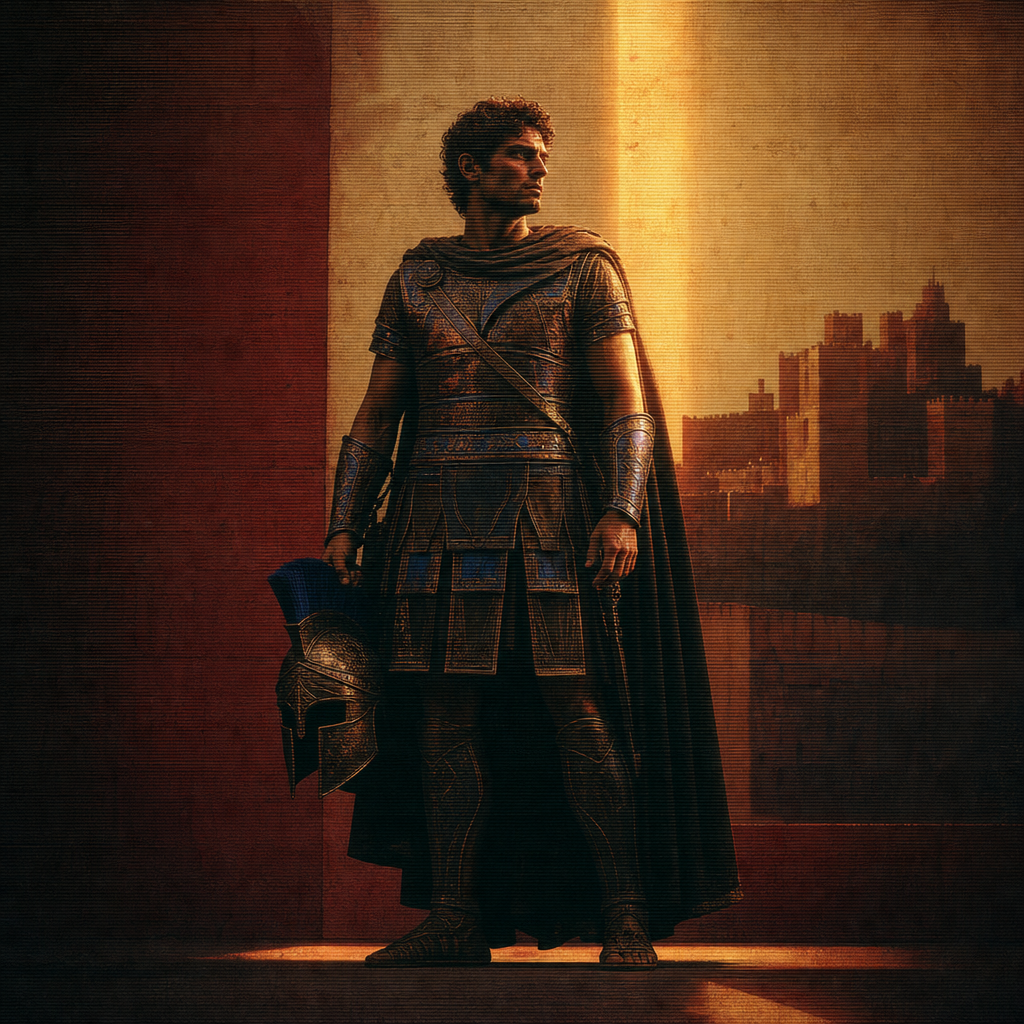
So the Trojans, having fled in panic into the city like fawns, were cooling off their sweat and drinking to slake their thirst as they leaned against the fine battlements. Meanwhile the Achaeans marched closer to the wall, their shields braced against their shoulders. But deadly fate bound Hector to stay right there, in front of Ilion and the Scaean Gates.
Read Ancient Greek Source (Iliad.22.1–Iliad.22.6)
Then Phoebus Apollo spoke to the son of Peleus: “Why, son of Peleus, do you chase me on your swift feet, a mortal yourself pursuing an immortal god? Even now you have not recognized that I am a god, so relentlessly do you rage. Have you no care for your work against the Trojans you routed, who have now crowded into the city while you turned aside here? You will never kill me, for I am not fated to die.”
Read Ancient Greek Source (Iliad.22.7–Iliad.22.13)
Bitterly angered, swift-footed Achilles answered him: “You have thwarted me, far-worker, most ruinous of all the gods, by turning me away from the wall to come here! Otherwise many more would have bitten the earth with their teeth before ever reaching Ilion. Now you have robbed me of great glory and saved those men with ease, since you had no fear of vengeance to come. I would certainly make you pay, if only the power were mine.”
Read Ancient Greek Source (Iliad.22.14–Iliad.22.20)
So he spoke, and strode toward the city in fierce pride, rushing on like a prize-winning horse with its chariot that runs lightly at full stretch across the plain; so Achilles plied his swift feet and knees. Old Priam was the first to see him with his own eyes as he sped blazing across the plain like the star that rises in late summer, whose brilliant rays shine out among the many stars in the dead of night—the one people call by name Orion’s Dog. Brightest of all it is, yet it is made a sign of evil and brings burning fever upon wretched mortals; just so the bronze flashed around his chest as he ran.
Read Ancient Greek Source (Iliad.22.21–Iliad.22.32)
The old man groaned aloud; lifting his hands high, he beat his head, and with a loud groan he cried out, begging his dear son. But Hector stood firm in front of the gates, fiercely eager to fight Achilles. Stretching out his hands, the old man spoke to him piteously:
Read Ancient Greek Source (Iliad.22.33–Iliad.22.37)
“Hector, my dear child, do not stand alone, cut off from the others, waiting for this man, or you will quickly meet your doom, brought down by the son of Peleus, since he is far stronger—that ruthless man! If only he were as dear to the gods as he is to me! Soon then the dogs and vultures would eat him as he lay dead, and terrible grief would lift from my heart; for he has robbed me of many brave sons, killing them or selling them off to distant islands. Even now, among the Trojans crowded into the city, I cannot see two of my sons, Lycaon and Polydorus, whom Laothoe, a queen among women, bore to me. Still, if they are alive in the enemy camp, we will ransom them afterward with bronze and gold; there is plenty inside, for the famed old king Altes gave rich gifts with his daughter. But if they are already dead and in the house of Hades, it will be sorrow to my heart and to their mother—the two of us who gave them life—yet for the rest of our people the sorrow will be briefer, unless you too die, brought down by Achilles. Come inside the wall, my child, so that you may save the men and women of Troy, and not hand great glory to Peleus’s son while you yourself are stripped of your own dear life. And take pity on me too, wretched as I am, while my mind is still whole—ill-fated, whom the Father, Cronus’s son, will destroy under a bitter doom on the threshold of old age, after I have looked upon many horrors: my sons slaughtered, my daughters dragged away, the bedchambers pillaged, little children dashed to the ground in the dreadful slaughter, and my sons’ wives dragged off by the murderous hands of the Achaeans. And last of all, once some man stabs me or strikes me with a cast of sharp bronze and takes the life from my limbs, at the outer doors the dogs will tear my raw flesh—the very dogs I raised in my halls to feed at my table and guard my gates, who will lap up my blood and, maddened in their hearts, lie in the forecourt. For a young man it is altogether fitting, when he is killed in battle, hacked by the sharp bronze, to lie there; whatever shows of him, even in death, all is noble. But when dogs defile the gray head and the gray beard and the genitals of a slaughtered old man, that is the most pitiful thing that comes to wretched mortals.”
Read Ancient Greek Source (Iliad.22.38–Iliad.22.76)
So the old man spoke, and with his hands he tore at his gray hair, plucking it from his head; yet he could not move Hector’s heart. And on the other side his mother wailed, shedding tears; loosening the fold of her robe, with her other hand she held out her breast, and shedding tears she spoke winged words to him: “Hector, my child, respect this and take pity on me myself, if ever I gave you the breast that soothes away care. Remember those times, dear child, and beat off this deadly man from inside the wall; do not stand out in front to face him—so ruthless! For if he kills you, never shall I mourn you on a bier, my dear young shoot whom I myself bore, nor will your richly dowered wife; instead, far away from us both, beside the ships of the Argives, the swift dogs will devour you.”
Read Ancient Greek Source (Iliad.22.77–Iliad.22.89)
So the two of them wept and spoke to their dear son, pleading with him earnestly; yet they could not move Hector’s heart, and he waited for huge Achilles as he came ever closer. As a mountain snake waits for a man at its den—fed on poisonous herbs and filled with terrible wrath, glaring dreadfully as it coils around its lair—so Hector, filled with unquenchable fury, would not give ground, leaning his shining shield against a jutting tower. Deeply troubled, he spoke to his own great-hearted spirit:
Read Ancient Greek Source (Iliad.22.90–Iliad.22.98)
“Ah me! If I go inside the gates and the walls, Polydamas will be the first to heap reproach upon me, since he urged me to lead the Trojans back to the city during this last ruinous night, when brilliant Achilles rose up. But I did not listen—though it would have been far better. Now, since I have destroyed my people through my own reckless folly, I feel shame before the Trojan men and the Trojan women in their trailing robes, lest someone else, a worse man than I, should say: ‘Hector trusted in his own strength and destroyed his people.’ So they will speak; and for me then it would be far better to face Achilles man to man, either to kill him and return home, or to die gloriously at his hands in front of the city. Or what if I lay down my bossed shield and heavy helmet, prop my spear against the wall, go out myself to meet peerless Achilles, and promise him that Helen and all the possessions with her—every last thing that Alexander brought to Troy in his hollow ships, which was the beginning of our quarrel—will be given to the sons of Atreus to take away, and that besides this we will share out with the Achaeans other wealth, all that this city holds hidden; and afterward take an oath from the Trojans, sworn through their elders, to hide nothing away, but divide everything in two—all the wealth our lovely city encloses within its walls? Yet why does my own heart debate these things with me? Let me not go out to approach him: he will show me no pity and have no respect for me at all, but kill me naked as I am, just like a woman, once I have stripped off my armor. This is no time to talk with him from oak tree or from rock, chatting softly the way a young girl and a youth—a young girl and a youth—whisper to one another. Better to clash with him in battle as quickly as we can: let us see to which of us the Olympian grants the glory.”
Read Ancient Greek Source (Iliad.22.99–Iliad.22.130)
So he pondered as he waited; and Achilles came near him, like Enyalius, the warrior with the tossing helmet-plume, brandishing over his right shoulder the Pelian ash spear, terrible to see; and around him the bronze shone like the flare of blazing fire or of the rising sun. Trembling seized Hector when he saw him, and he could no longer bear to stand his ground there, but left the gates behind and ran in fear; and the son of Peleus lunged after him, trusting in his swift feet. As a falcon in the mountains, fastest of all winged birds, swoops effortlessly after a trembling dove—she darts away from under him in terror, while close behind, screaming shrilly, he lunges again and again, his spirit driving him to seize her—so Achilles flew straight on in fury, and Hector fled in terror beneath the wall of the Trojans, driving his swift knees on.
Read Ancient Greek Source (Iliad.22.131–Iliad.22.144)
Past the lookout post and the wind-swept wild fig tree, out from under the wall they raced ever onward along the wagon track, and came to the two fair-flowing basins, where the double springs of eddying Scamander bubble up from the ground. One of them runs with warm water, and all around it steam rises from the surface as if from a blazing fire; while the other, even in summer, pours forth cold as hail, or chilly snow, or ice formed out of water. Right beside them stand the wide washing-troughs, fine basins of stone, where the wives and lovely daughters of the Trojans used to wash their shining garments in the old days of peace, before the sons of the Achaeans came.
Read Ancient Greek Source (Iliad.22.145–Iliad.22.156)
Past that spot the two of them ran, one fleeing, one pursuing behind: a brave man fled in front, and a far greater man pursued him at breakneck speed; for it was no sacrificial beast or oxhide they were striving to win, the prizes given for men’s footraces, but they ran for the life of horse-taming Hector. And as prize-winning single-hoofed horses swing around the turning post at a flat-out gallop, when a great prize is set out—a tripod or a woman, in honor of a man who has died—so the two of them circled three times around the city of Priam on swift feet, while all the gods looked down.
Read Ancient Greek Source (Iliad.22.157–Iliad.22.166)
Among them the father of men and gods began to speak: “Ah, a man dear to me is being chased around the wall before my own eyes, and my heart grieves for Hector, who has burned so many thigh-pieces of oxen for me on the peaks of many-ridged Ida, and at other times on the highest citadel; yet now brilliant Achilles chases him around the city of Priam on his swift feet. Come then, you gods, consider and take counsel: shall we rescue him from death, or shall we now at last bring him down, brave though he is, at the hands of Achilles, son of Peleus?”
Read Ancient Greek Source (Iliad.22.167–Iliad.22.176)
Then the bright-eyed goddess Athena answered him: “Father, lord of the bright lightning and dark clouds, what a thing to say! A mortal man, long ago doomed by fate—do you really mean to release him back from harsh-sounding death? Do it, then; but not all the rest of us gods will approve.”
Read Ancient Greek Source (Iliad.22.177–Iliad.22.181)
Cloud-gathering Zeus answered her: “Take heart, Tritogeneia, dear child; I am not speaking in full earnest, and I wish to be kind to you. Do as your mind inclines, and hold back no longer.” With these words he spurred on Athena, who was already eager, and she darted down from the peaks of Olympus.
Read Ancient Greek Source (Iliad.22.182–Iliad.22.187)
Meanwhile swift Achilles kept hard after Hector, driving him relentlessly. As a hound in the mountains chases the fawn of a deer after flushing it from its bed, through glens and wooded hollows—and even if it slips out of sight for a moment, crouching under a thicket, the hound tracks its scent and runs unswervingly until he finds it—so Hector could not slip out of sight of the swift-footed son of Peleus. Whenever Hector made a break toward the Dardanian Gates to rush beneath the strong-built towers, hoping the men above might defend him with their missiles, every time Achilles outran him and headed him off toward the plain, while he himself kept flying along the city side. As in a dream a man cannot catch someone who flees, and the one cannot escape any more than the other can run him down, so Achilles could not overtake him on foot, nor could Hector break away. Yet how could Hector have escaped the fates of death so long, if Apollo had not come near him for the very last and final time and roused his strength and his swift knees? And brilliant Achilles kept shaking his head at his troops, forbidding them to hurl their bitter missiles at Hector, for fear someone else might hit him and win the glory, and he himself come second.
Read Ancient Greek Source (Iliad.22.188–Iliad.22.207)
But when for the fourth time they reached the springs, the Father held out his golden scales and placed in them two fates of long-sorrowing death, one for Achilles and one for horse-taming Hector. He grasped them by the middle and lifted: down sank Hector’s appointed day, dropping toward the house of Hades, and Phoebus Apollo left him.
Read Ancient Greek Source (Iliad.22.208–Iliad.22.213)
Then the bright-eyed goddess Athena came to the son of Peleus, and standing close beside him spoke winged words: “Now at last, shining Achilles, dear to Zeus, I trust the two of us will carry great glory back to the ships for the Achaeans by cutting down Hector, insatiable as he is for battle. No longer now can he escape from us, not even if far-working Apollo should suffer every agony, groveling again and again before Father Zeus who holds the aegis. But stand here now and catch your breath, while I go to this man and persuade him to fight you face-to-face.” So Athena spoke, and he obeyed, glad at heart, and stood leaning on his bronze-barbed ash spear.
Read Ancient Greek Source (Iliad.22.214–Iliad.22.225)
She left him there and overtook brilliant Hector, taking on the build and tireless voice of Deiphobus. Standing close beside him, she spoke winged words: “Dear brother, swift Achilles is pressing you hard, chasing you on fast feet around Priam’s city. Come, let us make our stand here and hold our ground to fight him off.”
Read Ancient Greek Source (Iliad.22.226–Iliad.22.231)
Then great Hector of the flashing helmet answered her: “Deiphobus, even before this you were by far the dearest to me of all the brothers born to Hecuba and Priam, and now I mean to honor you in my heart even more, since you dared for my sake, once you saw me with your own eyes, to come outside the wall while the others stay inside.”
Read Ancient Greek Source (Iliad.22.232–Iliad.22.237)
Then the bright-eyed goddess Athena answered him: “Dear brother, it is true that our father and honored mother begged me one after another, clasping my knees, and my comrades around me too, to stay there inside, for they are all trembling in terror of him; but my heart within me was worn down by bitter grief. Now let us charge straight at him and fight, and let there be no sparing of spears, so we may see whether Achilles kills us both and carries our bloody armor back to the hollow ships, or goes down under your spear.” So Athena spoke, and in her cunning led the way.
Read Ancient Greek Source (Iliad.22.238–Iliad.22.247)
When the two men advancing on each other were close, great Hector of the flashing helmet spoke first to him: “Son of Peleus, I will no longer run from you as I did before! Three times I fled around the great city of Priam, and never dared wait for your attack. But now my spirit urges me to stand and face you, whether I kill you or am killed. Come then, let us call the gods here to witness, for they will be the best witnesses and guardians of our pact: I will not ruthlessly defile your body, if Zeus grants me endurance to win and I take your life; once I have stripped your glorious armor, Achilles, I will give your corpse back to the Achaeans. And you do the same.”
Read Ancient Greek Source (Iliad.22.248–Iliad.22.259)
Glaring at him from beneath his brows, swift-footed Achilles replied: “Hector, you whom I can never forgive, do not talk to me of pacts. Just as there are no trusted oaths between lions and men, and wolves and lambs share no harmony of heart but are bent on hatred for one another to the end, so there can be no friendship between you and me, nor will there be any oaths between us before one or the other falls and gluts with his blood Ares, the tough-shielded warrior. Summon up all your skill and courage; now above all you must be a spearman and a fearless fighter. There is no escape for you any longer; Pallas Athena will soon bring you down with my spear. Now you will pay all at once for all my grief over the comrades you killed in your fury with the spear.”
Read Ancient Greek Source (Iliad.22.260–Iliad.22.272)
He spoke, balanced his long-shadowed spear, and hurled it. Watching it come straight at him, glorious Hector dodged it: seeing it ahead of time, he crouched down, and the bronze spear flew over him and stuck fast in the earth. Pallas Athena snatched it up and gave it back to Achilles, unseen by Hector, shepherd of the people.
Read Ancient Greek Source (Iliad.22.273–Iliad.22.277)
Then Hector spoke to the peerless son of Peleus: “You missed! So after all, godlike Achilles, you knew nothing from Zeus of my doom, though you claimed you did. You were only a glib talker and a trickster with words, trying to make me cower before you and forget my strength and valor. You will not plant your spear in my back as I flee—drive it straight through my chest as I charge right at you, if a god has granted you that! Now in your turn dodge my spear of bronze. I wish you would take its full length into your flesh! Then the war would become far lighter for the Trojans with you dead and gone, for you are their greatest ruin.”
Read Ancient Greek Source (Iliad.22.278–Iliad.22.288)
He spoke, balanced his long-shadowed spear, and hurled it, and struck the center of the son of Peleus’s shield without missing; yet the spear rebounded far off the shield. Hector was angered that his swift shaft had flown from his hand in vain, and he stood downcast, for he had no other ash spear. With a loud shout he called to Deiphobus of the white shield, asking him for a long spear; but the man was nowhere near him.
Read Ancient Greek Source (Iliad.22.289–Iliad.22.295)
Then Hector knew the truth in his heart and said: “Ah, no—truly the gods have summoned me to my death! I thought the hero Deiphobus was here beside me, but he is inside the wall, and Athena has deceived me. Now grim death is close upon me, no longer far off, and there is no way out. Long ago this must have been the pleasure of Zeus and the far-shooting son of Zeus, even though before now they gladly protected me; now my fate has overtaken me. Still, let me not die without a struggle and without glory, but after doing some great deed for men yet to come to hear of.”
Read Ancient Greek Source (Iliad.22.296–Iliad.22.305)
So he spoke, and drew the sharp sword that hung huge and heavy beside his flank. Gathering himself, he swooped like a high-flying eagle that plunges toward the plain through dark clouds to snatch a tender lamb or a cowering hare; so Hector swooped, brandishing his sharp sword. Achilles charged too, his heart filled with savage fury; in front of his chest he held his shield, beautiful and finely crafted, and he nodded with his shining four-ridged helmet, while around it tossed the lovely golden plumes that Hephaestus had set thick along the crest. And as a star moves among the other stars in the dead of night—the Evening Star, the fairest star set in the sky—so a gleam flashed from the keen point of the spear that Achilles poised in his right hand, plotting death for brilliant Hector and scanning his fine body to see where it would most easily give way.
Read Ancient Greek Source (Iliad.22.306–Iliad.22.321)
All the rest of his body was covered by the bronze armor, that fine gear he had stripped from strong Patroclus when he killed him; yet flesh showed where the collarbones divide the neck from the shoulders, at the gullet, where the destruction of life comes quickest. There, as Hector charged at him, brilliant Achilles drove with his spear, and the point went clean through his tender neck; yet the heavy-bronzed ash spear did not sever his windpipe, so that he could still speak to him and answer in words.
Read Ancient Greek Source (Iliad.22.322–Iliad.22.329)
He crashed into the dust, and brilliant Achilles boasted over him: “Hector, you must have thought, as you stripped Patroclus of his armor, that you would be safe, and you gave no thought to me because I was far away—you fool! Far away from him, a much greater avenger, I myself was left behind beside the hollow ships, and it is I who have unstrung your knees. Now dogs and birds will tear you apart in shame, while the Achaeans will bury him with full honors.”
Read Ancient Greek Source (Iliad.22.330–Iliad.22.336)
His strength failing, Hector of the flashing helmet spoke to him: “I beg you by your life, by your knees, and by your parents, do not let the dogs devour me beside the ships of the Achaeans. Accept instead bronze and gold in abundance, gifts that my father and my honored mother will give you, and give my body back to my home, so that the Trojans and the Trojans’ wives may give me, in death, my share of the funeral fire.”
Read Ancient Greek Source (Iliad.22.337–Iliad.22.343)
Glaring at him from beneath his brows, swift-footed Achilles answered: “Do not beg me by my knees, you dog, or by my parents! I only wish my fury and my heart would drive me to hack your flesh away and eat it raw for what you have done, as surely as no man exists who can keep the dogs from your head—not even if they bring and weigh out ten or twenty times your ransom here, and promise still more besides; not even if Priam, descendant of Dardanus, should command them to weigh out your body in gold—not even so will your honored mother lay you on a bier and mourn over the son she herself bore, but dogs and birds will divide and devour you whole.”
Read Ancient Greek Source (Iliad.22.344–Iliad.22.354)
Dying, Hector of the flashing helmet spoke to him: “Truly I see you for what you are; I was never going to persuade you, for the heart in your chest is made of iron. Take care now, lest I become a cause of the gods’ wrath against you on that day when Paris and Phoebus Apollo destroy you, brave as you are, at the Scaean Gates.”
Read Ancient Greek Source (Iliad.22.355–Iliad.22.360)
Even as he spoke, death closed over him, and his soul flew from his limbs and went down to the house of Hades, weeping for its fate, leaving manhood and youth behind. Even though he was dead, brilliant Achilles spoke to him: “Die! As for my own fate, I will accept it whenever Zeus and the other immortal gods wish to bring it to pass.”
Read Ancient Greek Source (Iliad.22.361–Iliad.22.366)
He spoke, and wrenched his bronze spear from the corpse and laid it aside; then from the shoulders he stripped the bloody armor. The other sons of the Achaeans came running around him, and they gazed in wonder at the build and the admirable beauty of Hector; yet not a man stood beside him without stabbing his body. Looking at his neighbor, one man would say to another: “Strange how much softer to handle Hector is now than when he set the ships ablaze with roaring fire!” So each man would speak, standing beside him to drive his weapon home.
Read Ancient Greek Source (Iliad.22.367–Iliad.22.375)
When swift-footed, brilliant Achilles had stripped the body, he stood among the Achaeans and spoke winged words: “Friends, leaders and rulers of the Argives, since the gods have granted that we conquer this man, who did us more harm than all the others put together, come, let us make a trial in arms around the city, so we may learn what purpose the Trojans still have in mind—whether they will abandon their high citadel now that this man has fallen, or whether they are determined to hold out even though Hector is no more. Yet why does my own heart debate these things with me? Beside the ships lies a corpse unwept, unburied—Patroclus. I will never forget him, so long as I am among the living and my own knees have power to move. And even if men forget the dead in the house of Hades, even there I will remember my dear companion. Come now, young men of the Achaeans, singing a song of triumph, let us go back to the hollow ships and bring this body with us. We have won great glory; we have killed brilliant Hector, to whom the Trojans throughout their city prayed as to a god.”
Read Ancient Greek Source (Iliad.22.376–Iliad.22.394)
He spoke, and devised shameful treatment for brilliant Hector. Behind both feet he pierced the tendons from heel to ankle, threaded oxhide thongs through them, and bound them to his chariot, leaving the head to trail behind. Mounting the chariot and lifting the famous armor aboard, he lashed the horses to a run, and not unwillingly they flew onward. A cloud of dust rose from Hector as he was dragged; around him his dark hair streamed out, and his whole head, once so handsome, lay low in the dust; for now Zeus had given him over to his enemies to defile in his own native land.
Read Ancient Greek Source (Iliad.22.395–Iliad.22.404)
So his whole head was fouled with dust. And now his mother tore her hair, cast her shining veil far away, and gave a great piercing cry at the sight of her son. Pitifully his dear father groaned, and all around them the people were gripped by wailing and lamentation throughout the city. It was most like what would happen if all steep Ilion were smoldering with fire from its summit down. The people could barely hold the old man back in his frantic grief, desperate as he was to rush out through the Dardanian Gates. He begged them all, rolling in the dung and calling out to each man by his own name:
Read Ancient Greek Source (Iliad.22.405–Iliad.22.415)
“Hold off, friends, and despite your care for me, let me go out from the city alone and come to the ships of the Achaeans. Let me entreat this reckless man, this doer of violent deeds, in hope that he may respect my years and have pity on my old age. After all, his own father is such a man as I am—Peleus, who fathered him and reared him to be a curse to the Trojans; yet on me above all others Achilles has laid sorrow, for he has killed so many of my sons in the flower of their youth. Yet for all of them I do not mourn so much, deep as my grief is, as for one alone, for whom sharp anguish will carry me down to the house of Hades—Hector. If only he had died in my arms! Then we could have had our fill of weeping and wailing, both the ill-fated mother who bore him and I myself.”
Read Ancient Greek Source (Iliad.22.416–Iliad.22.428)
So he spoke, weeping, and the citizens groaned in answer. Among the Trojan women Hecuba led the insistent lament: “My child, wretched that I am! Why should I live on in terrible suffering now that you are dead? Night and day you were my pride throughout the city, and a help to all the Trojan men and women through the town, who welcomed you like a god; for truly you were their great glory while you were alive. Now death and fate have overtaken you.”
Read Ancient Greek Source (Iliad.22.429–Iliad.22.436)
So she spoke, weeping; but his wife had heard nothing yet about Hector, for no true messenger had come to tell her that her husband had stayed outside the gates. Instead, she was weaving at the loom in the inner room of the high house, a double cloak of purple, working bright flowers into the pattern. She had called through the hall to her attendants with their lovely braids to set a great three-legged cauldron over the fire, so there would be a warm bath for Hector when he returned from battle—poor innocent, she did not know that far, very far from any bath, bright-eyed Athena had brought him down at the hands of Achilles.
Read Ancient Greek Source (Iliad.22.437–Iliad.22.446)
Then she heard the wailing and the groans from the tower. Her limbs shook, and the shuttle fell from her hand to the ground. Once again she spoke to her serving women with their lovely braids: “Come here, two of you follow me, so I can see what has happened. I heard the voice of my honored mother-in-law, and in my own breast my heart leaps up to my mouth, and beneath me my knees are frozen stiff. Some disaster is close at hand for Priam’s children. May the word stay far from my ear! Yet I am terribly afraid that brilliant Achilles has cut my bold Hector off alone from the city and is driving him toward the plain, and has already put an end to the ruinous courage that always possessed him; for he would never stay back in the crowd of men, but always charged far out in front, yielding to no one in his might.”
Read Ancient Greek Source (Iliad.22.447–Iliad.22.459)
So speaking, she rushed through the hall like a maenad, her heart pounding, and her attendants went with her. When she reached the tower and the crowd of men, she stood on the wall and looked out, and she saw him being dragged in front of the city; swift horses were dragging him ruthlessly toward the hollow ships of the Achaeans. Black night swept down over her eyes; she fell backward and gasped out her breath. Far from her head she cast the shining bindings of her hair: the frontlet, the netted cap, the braided headband, and the veil that golden Aphrodite had given her on the day when Hector of the flashing helmet led her home from the house of Eetion, after he had given countless bridal gifts. Around her crowded her husband’s sisters and his brothers’ wives, who held her up among them, stunned to the point of death. When she caught her breath again and her spirit returned to her breast, she lifted her voice in deep sobs and spoke among the Trojan women:
Read Ancient Greek Source (Iliad.22.460–Iliad.22.476)
“Hector, how wretched I am! To a single fate, then, we were born, both of us—you in Troy in the house of Priam, and I in Thebe under wooded Placus, in the house of Eetion, who raised me when I was little, an ill-fated father and a doomed child—how I wish he had never begotten me! Now you go to the house of Hades beneath the secret depths of the earth, and leave me behind in bitter mourning, a widow in the halls; and our boy is still only an infant—the child of you and me, two ill-fated parents. Neither will you be a help to him, Hector, since you are dead, nor will he be to you. For even if he escapes the tearful war of the Achaeans, toil and sorrow will always lie ahead for him hereafter, for other men will take away his fields. The day that orphans a child cuts him off from all his playmates; he always hangs his head, and his cheeks are wet with tears. In his need the boy goes up to his father’s companions, pulling one by his cloak and another by his tunic. Of those who pity him, one holds out a small cup for a moment: it wets his lips, but does not wet his palate. And a boy with both parents living shoves him away from the feast, striking him with his fists and lashing him with insults: ‘Get out of here! Your father does not feast with us.’ In tears the boy comes back to his widowed mother—Astyanax, who before this, on his own father’s knees, ate only marrow and the rich fat of sheep; and when sleep took him and he stopped his childish play, he would sleep in a bed, in the arms of his nurse, on a soft couch, his heart filled with good things. Now he will suffer much, bereft of his dear father—Astyanax, as the Trojans call him by name, because you alone defended their gates and their long walls. But now, beside the curved ships, far from your parents, wriggling maggots will eat you, naked as you are, once the dogs have had their fill—though your clothes lie in the halls, fine and graceful garments made by the hands of women. All of these I will burn up in the blazing fire—no help to you, since you will never lie in them, but to be your glory before the men and women of Troy.” So she spoke, weeping, and the women groaned in answer.