Book 6: Hector and Andromache in Troy
Ἰλιάς · Book 6 · Classix Modern English Reading Edition
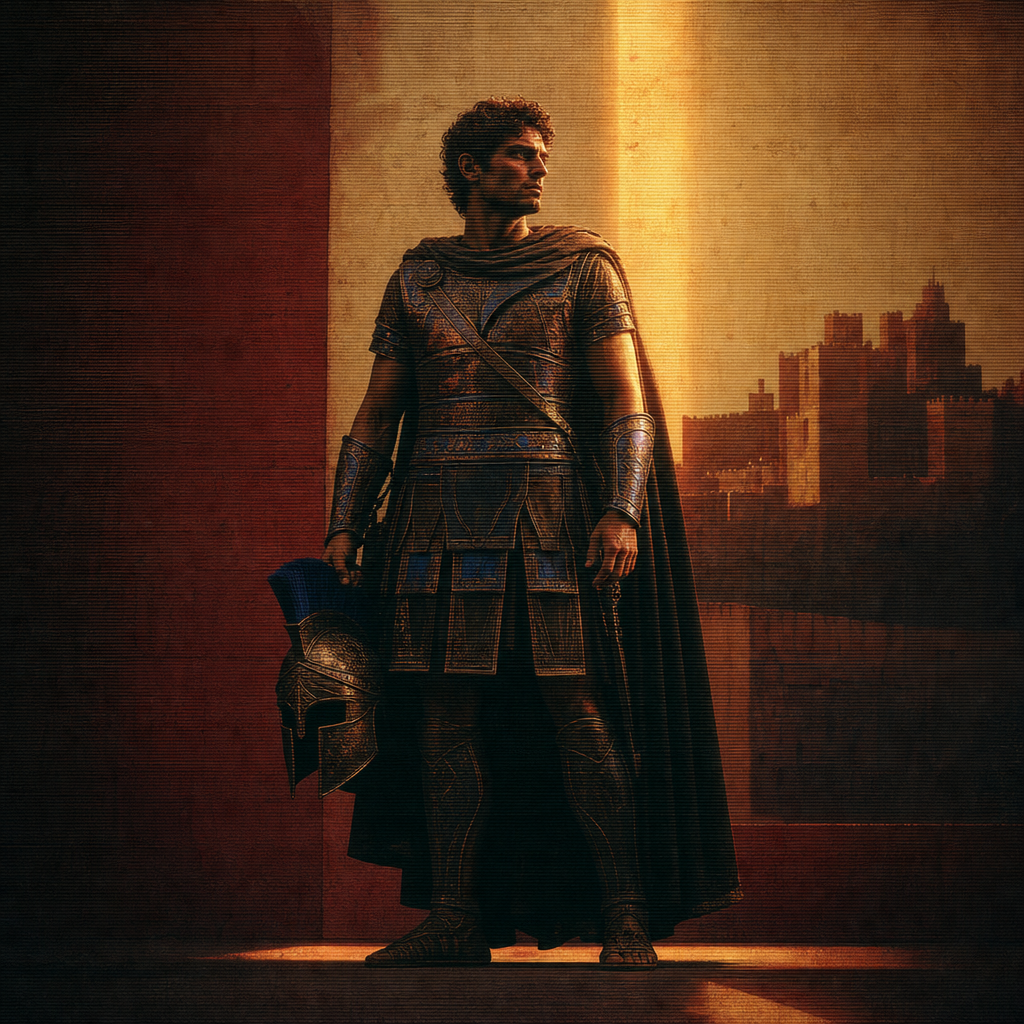
Now the grim clash of Trojans and Achaeans was left to them alone, and the fighting surged back and forth across the plain as they aimed their bronze-tipped spears at one another between the currents of the Simois and the Xanthus.
Read Ancient Greek Source (Iliad.6.1–Iliad.6.4)
First, Telamonian Ajax, bulwark of the Achaeans, broke a Trojan battle line and brought light to his companions, striking the man who was finest among the Thracians, Eussorus's son Acamas, brave and tall. He struck him first on the ridge of his horsehair-crested helmet and drove the spear into his forehead; the bronze point pierced right through the bone, and darkness covered his eyes.
Read Ancient Greek Source (Iliad.6.5–Iliad.6.11)
Then Diomedes, strong in the war cry, killed Axylus, Teuthras's son, who lived in well-built Arisbe. He was rich in livelihood and dear to people, for he lived in a house by the road and welcomed everyone. Yet not one of those guests stepped in front of him then to ward off miserable death; Diomedes stripped the life from both of them—from Axylus himself and his attendant Calesius, who served then as driver of his horses—and both went down into the earth.
Read Ancient Greek Source (Iliad.6.12–Iliad.6.19)
Euryalus killed and stripped Dresus and Opheltius, and then went after Aesepus and Pedasus, whom a nymph, the naiad Abarbarea, once bore to blameless Bucolion. Bucolion was the son of proud Laomedon, his eldest by birth, though his mother bore him in secret; while tending his sheep he lay with the nymph in love, and she conceived and gave birth to twin sons. Now the son of Mecisteus unstrung their strength and shining limbs too, and stripped the armor from their shoulders.
Read Ancient Greek Source (Iliad.6.20–Iliad.6.28)
Steadfast Polypoetes killed Astyalus; Odysseus brought down Pidytes of Percote with his bronze spear, and Teucer killed noble Aretaon. Nestor's son Antilochus slew Ablerus with his shining spear, while Agamemnon, lord of men, killed Elatus, who lived in steep Pedasus beside the banks of the fair-flowing Satnioeis. The warrior Leitus caught Phylacus as he fled, and Eurypylus killed and stripped Melanthius.
Read Ancient Greek Source (Iliad.6.29–Iliad.6.36)
Then Menelaus, strong in the war cry, took Adrestus alive. His two horses, bolting in terror across the plain, had tangled in a tamarisk branch, snapped the curved chariot at the tip of the pole, and run on by themselves toward the city, where the rest were fleeing in panic. Adrestus himself was hurled from the car beside the wheel, flat on his face in the dust, and Atreus's son Menelaus stood right beside him holding his long-shadowed spear. Adrestus caught him by the knees and begged him: "Take me alive, son of Atreus, and accept a worthy ransom! Many treasures lie stored in my wealthy father's house—bronze and gold and iron forged with hard labor. From these my father would gladly give you boundless ransom if he heard I was alive beside the ships of the Achaeans."
Read Ancient Greek Source (Iliad.6.37–Iliad.6.50)
So he spoke, and he was winning over the heart in Menelaus's chest. Soon he would have handed him over to his attendant to lead back to the swift ships of the Achaeans; but Agamemnon came running to meet him, and shouted a sharp rebuke: "Soft-hearted Menelaus, why do you care so much for these men? Have you really been treated so wonderfully in your home by the Trojans? Let not one of them escape sheer destruction and our hands—not even the child in his mother's womb, the boy she carries, let not even him escape, but let all of them together perish utterly out of Ilion, unmourned and wiped from sight."
Read Ancient Greek Source (Iliad.6.51–Iliad.6.60)
With these words the warrior turned his brother's mind, urging what was fitting; and with his hand Menelaus shoved the warrior Adrestus away from him. Then lord Agamemnon stabbed him in the flank; Adrestus fell backward, and the son of Atreus planted his heel on his chest and wrenched out the ash spear.
Read Ancient Greek Source (Iliad.6.61–Iliad.6.65)
Then Nestor shouted aloud and called out to the Argives: "Friends, Danaan warriors, attendants of Ares, let no man lag behind now, greedy for spoils, staying back to carry the greatest load to the ships. No, let us kill men! Afterward, at your ease, you will strip those spoils too from the dead corpses across the plain." With these words he stirred the courage and spirit of every man.
Read Ancient Greek Source (Iliad.6.66–Iliad.6.72)
Then once more the Trojans, driven by the war-loving Achaeans, would have climbed back inside Ilion, broken by their own weakness, had Priam's son Helenus, by far the best of bird-seers, not stepped up to Aeneas and Hector and spoken: "Aeneas and Hector, since the weight of battle rests most of all on you among the Trojans and Lycians, because you are the best at every venture, both in fighting and in counsel, stand your ground right here! Go everywhere through the ranks and hold the army back in front of the gates, before they tumble fleeing into their wives' arms once again and become a joy to our enemies. Then, once the two of you have rallied all our battle lines, the rest of us will stay right here and fight the Danaans, hard-pressed as we are, for necessity drives us on. But you, Hector, go into the city and speak to your mother and mine. Let her gather the older women at the temple of bright-eyed Athena on the high citadel, unlock the doors of the sacred house with the key, and take the robe that seems to her the loveliest and largest in her hall, and by far the dearest to her own heart, and lay it upon the knees of rich-haired Athena. And let her promise to sacrifice twelve heifers to her in the temple, yearlings untouched by the goad, if she will take pity on the city and the Trojans' wives and their helpless children, so that she may hold Tydeus's son back from sacred Ilion—that savage spearman, that mighty master of rout, whom I declare to have proved the strongest of the Achaeans. Never did we fear even Achilles like this, that leader of men, though they say he is born of a goddess; this man rages past all measure, and no one can rival his strength."
Read Ancient Greek Source (Iliad.6.73–Iliad.6.101)
So he spoke, and Hector did not disobey his brother. At once he leaped in his armor from his chariot to the ground; brandishing sharp spears, he went everywhere through the army, urging them to fight, and roused the grim clash of battle. The Trojans wheeled around and stood facing the Achaeans; and the Argives gave ground and stopped their slaughter, thinking that one of the immortals from the starry sky had come down to defend the Trojans, by the way they wheeled around. Then Hector shouted aloud and called on the Trojans: "High-hearted Trojans and allies famed from afar, be men, my friends, and remember your furious strength, while I go to Ilion and tell the elders who sit in council and our own wives to pray to the gods and promise offerings of a hundred cattle." With these words Hector of the flashing helmet strode away; and against his ankles and his neck beat the black hide, the rim that ran along the outer edge of his bossed shield.
Read Ancient Greek Source (Iliad.6.102–Iliad.6.118)
Now Glaucus, son of Hippolochus, and the son of Tydeus came together in the space between both armies, eager to fight. When the two had come close, advancing on each other, Diomedes, strong in the war cry, spoke first to him: "Who are you, bravest of mortal men? For I have never seen you before in the battle where men win glory; yet today you have stepped far out in front of all others in your daring, since you have stood your ground before my long-shadowed spear. Unlucky are the parents whose sons face my strength. But if you are one of the immortals come down from the sky, I would not fight against the heavenly gods. For not even Dryas's son, mighty Lycurgus, lived long when he strove with the heavenly gods: he once chased the nurses of raving Dionysus down the sacred mountain of Nysa, and all together they flung their wands to the ground as man-slaying Lycurgus struck them with an ox-goad. Dionysus in terror plunged beneath the wave of the sea, and Thetis took the frightened god to her breast, for a violent shuddering gripped him at the man's threats. Then the gods who live at ease were angered at Lycurgus, and the son of Cronus struck him blind; nor did he live much longer, since he had become hated by all the immortal gods. So I too would not wish to fight the blessed gods. But if you are one of the mortals who eat the fruit of the plowed earth, come closer, so that all the sooner you may meet your death."
Read Ancient Greek Source (Iliad.6.119–Iliad.6.143)
Then the shining son of Hippolochus answered him: "Great-hearted son of Tydeus, why do you ask about my lineage? Just as the generation of leaves is, so too is that of men. The wind scatters the leaves to the ground, but the forest bursts into bud and grows others when the season of spring comes on; so with the generations of men: one grows up while another passes away. Yet if you wish to learn this too, so that you may know our lineage well—and many men know it: there is a city, Ephyre, in a corner of horse-pasturing Argos, and there lived Sisyphus, the craftiest of all men, Sisyphus, son of Aeolus. He fathered a son, Glaucus, and Glaucus fathered blameless Bellerophon. To him the gods granted beauty and desirable manhood; but Proetus plotted evil against him in his heart, and drove him out of the land of the Argives, since Proetus was far mightier; for Zeus had subjected them beneath his scepter.
Read Ancient Greek Source (Iliad.6.144–Iliad.6.159)
"Proetus's wife, noble Anteia, lusted madly for Bellerophon, to lie with him in secret love; yet she could not persuade wise-hearted Bellerophon, for his mind was honorable. So she spoke a lie to King Proetus: 'Die yourself, Proetus, or kill Bellerophon, who wanted to lie with me in love against my will.' So she spoke, and anger seized the king at what he heard. He shrank from killing him, for in his heart he held that in awe, but he sent him to Lycia and gave him baneful signs, scratching many life-destroying marks on a folded tablet, and ordered him to show them to Proetus's father-in-law, so that Bellerophon might perish. So he went to Lycia under the blameless escort of the gods. When he came to Lycia and the flowing Xanthus, the lord of wide Lycia honored him with an eager heart: for nine days he hosted him and slaughtered nine oxen. But when the tenth rosy-fingered Dawn appeared, he questioned him and asked to see whatever token he was bringing from his son-in-law Proetus. Then, once he had received the evil token from his son-in-law, first he ordered Bellerophon to kill the raging Chimera. She was of divine stock, not of men: a lion in front, a serpent behind, and a goat in the middle, breathing out the terrible fury of blazing fire; and he killed her, trusting in the signs of the gods. Second, he fought against the glorious Solymi, and that, he said, was the fiercest battle of men he ever entered. Third, he slaughtered the Amazons, who fight as equals of men. As he was returning, the king wove another tight snare for him: choosing the best warriors out of wide Lycia, he set an ambush; but none of them came back home again, for blameless Bellerophon killed them all.
Read Ancient Greek Source (Iliad.6.160–Iliad.6.190)
"But when the king recognized that he was the brave offspring of a god, he kept him there, gave him his own daughter, and granted him half of all his royal honor; and the Lycians measured out for him an estate surpassing all others, fine land of orchards and plowland, for him to possess. She bore three children to wise-hearted Bellerophon: Isander and Hippolochus and Laodameia. Wise Zeus lay beside Laodameia, and she bore godlike Sarpedon, armed in bronze. Yet when even Bellerophon came to be hated by all the gods, he wandered alone across the Aleian plain, eating his own heart out and shunning the path of men. Ares, insatiable in war, killed his son Isander as he fought against the glorious Solymi, and Artemis of the golden reins killed his daughter in anger. But Hippolochus fathered me, and from him I claim my birth. He sent me to Troy, and strictly charged me always to excel and stand above all others, and not to shame the lineage of my fathers, who were by far the best both in Ephyre and in wide Lycia. This is the lineage and blood I claim."
Read Ancient Greek Source (Iliad.6.191–Iliad.6.211)
So he spoke, and Diomedes, strong in the war cry, rejoiced. He planted his spear in the all-nourishing earth, and with gentle words spoke to the shepherd of the people: "Truly, then, you are an ancient guest-friend of my father's house! For noble Oeneus once hosted blameless Bellerophon in his halls, keeping him there for twenty days, and they gave each other fine gifts of friendship: Oeneus gave a belt shining with crimson, and Bellerophon a two-handled cup of gold, which I left behind in my halls when I came here. But I do not remember Tydeus, since he left me behind while I was still a small child, when the army of the Achaeans perished at Thebes. So now I am your dear host and friend in the heart of Argos, and you are mine in Lycia, whenever I come to that people's land. Let us avoid each other's spears even in the press of battle. There are many Trojans and renowned allies for me to kill, whomever a god grants me and I overtake on foot, and many Achaeans in turn for you to cut down, whomever you can. Let us exchange armor with each other, so that these men too may know that we claim to be guest-friends from our fathers' days."
Read Ancient Greek Source (Iliad.6.212–Iliad.6.231)
With those words, the two of them sprang down from their chariots, clasped each other's hands, and pledged their faith. Then Zeus, son of Cronus, took away the wits of Glaucus, who exchanged his armor with Diomedes, son of Tydeus: gold for bronze, the worth of a hundred oxen for the worth of nine.
Read Ancient Greek Source (Iliad.6.232–Iliad.6.236)
When Hector reached the Scaean gates and the oak tree, the wives and daughters of the Trojans came running around him, asking after their sons, brothers, kinsmen, and husbands. He told them to pray to the gods, every woman in turn; but sorrow already hung over many.
Read Ancient Greek Source (Iliad.6.237–Iliad.6.241)
At last Hector reached Priam's splendid palace, built with polished porticoes. Inside were fifty chambers of polished stone, built close beside one another, where Priam's sons slept beside their wedded wives. Opposite them, on the other side of the courtyard, stood twelve roofed chambers of polished stone for Priam's daughters, also built close beside one another; there Priam's sons-in-law slept beside their honored wives. Hector's kind, generous mother met him there, bringing Laodice, the loveliest in form of her daughters. She clung to his hand, spoke to him, and called him by name: "My child, why have you left the fierce battle and come here? Surely the accursed sons of the Achaeans are wearing our men down as they fight around the town, and your heart urged you to come here and lift your hands to Zeus from the high citadel. But wait until I bring you honey-sweet wine, so that first you may pour an offering to Father Zeus and the other immortals, and then be refreshed yourself if you drink. Wine greatly restores the strength of a weary man, just as you are weary now from defending your kinsmen."
Read Ancient Greek Source (Iliad.6.242–Iliad.6.262)
Great Hector of the flashing helmet answered her: "Do not bring me honey-hearted wine, my honored mother, or you may drain the strength from my limbs and make me forget my valor. I shrink from pouring dark-gleaming wine to Zeus with unwashed hands; there is no way to pray to Cronus's son of the dark clouds while spattered with blood and battle-filth. No, go yourself to the temple of Athena, driver of the spoil, with offerings of incense, once you have gathered the older women. Take the robe that is the loveliest and largest in your hall, and by far the dearest to your own heart, and lay it upon the knees of rich-haired Athena. Promise to sacrifice twelve heifers to her in the temple, yearlings untouched by the goad, if she will take pity on the city and the Trojans' wives and their helpless children, and hold Tydeus's son back from sacred Ilion—that savage spearman, that mighty master of rout. Go then to the temple of Athena, driver of the spoil, while I go after Paris to summon him, if he is willing to listen to what I say. Would that the earth might yawn open for him on the spot! The Olympian reared him as a great curse to the Trojans, and to great-hearted Priam and his sons. If only I could see him gone down into the house of Hades, I could say my heart had forgotten its joyless misery."
Read Ancient Greek Source (Iliad.6.263–Iliad.6.285)
So he spoke, and she went into the hall and called to her serving women, and they gathered the older women throughout the town. She herself went down into the fragrant storeroom where her robes were kept, the richly embroidered work of Sidonian women, whom godlike Alexander himself had brought from Sidon, sailing over the wide sea on the very voyage when he brought home high-born Helen. Hecuba lifted one of these and carried it as a gift for Athena—the one that was largest and loveliest in its embroidery, and shone like a star; it lay at the very bottom beneath the others. Then she set out, and many of the older women hurried after her.
Read Ancient Greek Source (Iliad.6.286–Iliad.6.296)
When they reached Athena's temple on the high citadel, fair-cheeked Theano opened the doors for them—daughter of Cisseus and wife of horse-taming Antenor, for the Trojans had made her priestess of Athena. With a high ritual cry they all lifted their hands to Athena; and fair-cheeked Theano took the robe, laid it upon the knees of rich-haired Athena, and with vows prayed to the daughter of great Zeus: "Lady Athena, defender of our city, shining among goddesses, shatter the spear of Diomedes, and let the man himself fall face-down in front of the Scaean gates, so that this very instant we may sacrifice twelve heifers to you in the temple, yearlings untouched by the goad, if only you will take pity on the city and the Trojans' wives and their helpless children." So she spoke in prayer, but Pallas Athena refused her.
Read Ancient Greek Source (Iliad.6.297–Iliad.6.311)
While they were praying to the daughter of great Zeus, Hector went on to the handsome house of Alexander, which Alexander himself had built with the men who were then the finest master builders in rich-soiled Troy; they had made him a bedroom, a great hall, and a courtyard near Priam and Hector on the high citadel. There Hector, dear to Zeus, went inside, holding in his hand a spear eleven cubits long; before him the bronze point of the shaft gleamed, and a collar of gold ran around it. He found him in the bedroom tending his splendid armor—his shield and breastplate—and running his hands over his curved bow, while Argive Helen sat among her serving women and directed her maids in their glorious handiwork. Seeing him, Hector rebuked him with words of shame: "Strange man, it is not right to nurse this anger in your heart! Our people are dying as they fight around the city and the steep wall, and it is because of you that the battle cry and the war blaze around this town. You yourself would quarrel with any other man whom you saw hanging back from the hateful war. Up now, before the town is soon set ablaze with enemy fire!"
Read Ancient Greek Source (Iliad.6.312–Iliad.6.331)
Then godlike Alexander answered him in turn: "Hector, since you have rebuked me fairly and not beyond what is just, I will tell you; take it to heart and listen to me. It was not so much out of anger or resentment against the Trojans that I sat in my chamber, but I wanted to give myself over to grief. Yet just now my wife, winning me over with gentle words, urged me into battle, and to me too it seems that it will be better so; victory shifts from man to man. Come then, wait now while I put on my war gear, or go ahead, and I will follow—I think I will overtake you."
Read Ancient Greek Source (Iliad.6.332–Iliad.6.341)
So he spoke, and Hector of the flashing helmet answered him nothing. But Helen spoke to him with soothing words: "Brother-in-law of mine—scheming, loathsome dog that I am—how I wish that on the very day my mother first bore me a wicked storm-blast of wind had swept me away and carried me off to a mountain or into the waves of the resounding sea, where the surge would have swept me under before these deeds could happen! Yet since the gods ordained these evils to come to pass, I wish I had then been the wife of a better man, one who felt the indignation and the many reproaches of men. But this man's mind is not steadfast now, nor will it ever be hereafter; and so I think he will reap the fruits of it. But come now, step inside and sit upon this chair, my brother-in-law, since the toil of war weighs heaviest on your heart because of me, shameless dog that I am, and because of the blind folly of Alexander—for on us both Zeus has laid an evil doom, so that even in days to come we will be a subject of song for people yet to be."
Read Ancient Greek Source (Iliad.6.342–Iliad.6.358)
Then great Hector of the flashing helmet answered her: "Do not make me sit, Helen, though you care for me; you will not persuade me. Already my heart is eager to go and defend the Trojans, who feel a great longing for me while I am gone. Instead, rouse this man yourself, and let him hurry too, so that he may catch up with me while I am still inside the city. For I too am going home to see my household, my dear wife, and my infant son. I do not know whether I will ever return to them again, or whether the gods will strike me down now at the hands of the Achaeans."
Read Ancient Greek Source (Iliad.6.359–Iliad.6.368)
So speaking, Hector of the flashing helmet departed. Quickly he reached his well-settled house, but he did not find white-armed Andromache in the halls; she, with her child and a finely robed serving woman, was standing on the tower, wailing and shedding tears. When Hector did not find his blameless wife within, he went and stood on the threshold and spoke to the serving women: "Come, serving women, tell me the plain truth: where has white-armed Andromache gone from the hall? Has she gone out to the homes of my sisters or my brothers' finely robed wives, or to the temple of Athena, where the other lovely-haired Trojan women are seeking to appease the dread goddess?"
Read Ancient Greek Source (Iliad.6.369–Iliad.6.380)
Then the diligent housekeeper answered him: "Hector, since you strictly command me to tell the truth, she has gone neither to any of your sisters nor to your brothers' finely robed wives, nor to the temple of Athena, where the other lovely-haired Trojan women are seeking to appease the dread goddess, but she went to the great tower of Ilion, because she heard that the Trojans were hard-pressed and the Achaeans had won great power in the fight. She has hurried off to the wall like a woman possessed, and the nurse is carrying the child beside her."
Read Ancient Greek Source (Iliad.6.381–Iliad.6.389)
So the housekeeper spoke, and Hector rushed from the house, back the same way down the well-built streets. When he had passed through the great city and reached the Scaean gates, where he was about to go out onto the plain, there his richly dowered wife came running to meet him—Andromache, daughter of great-hearted Eetion, who lived beneath wooded Mount Placus, in Thebe under Placus, ruling over the Cilician men; his daughter was the wife of bronze-helmed Hector. She met him then, and with her came the serving woman, holding at her breast the tender-hearted child, a mere infant, Hector's beloved son, like a beautiful star, whom Hector called Scamandrius, though the others called him Astyanax; for Hector alone protected Ilion.
Read Ancient Greek Source (Iliad.6.390–Iliad.6.403)
He smiled in silence as he looked at his child; but Andromache stood close beside him, shedding tears, and she clung to his hand, spoke to him, and called him by name: "Driven man, your own fierce courage will destroy you, and you have no pity for your infant child or for me, ill-fated as I am, who soon will be your widow; for soon the Achaeans will kill you, all rushing upon you at once. For me it would be better to sink into the earth once I have lost you; for there will be no other comfort left when you have met your fate, only grief. I have no father now, and no honored mother. Indeed, brilliant Achilles killed my father, and utterly sacked the well-settled city of the Cilicians, high-gated Thebe. He killed Eetion, yet did not strip his armor, for his heart shrank in awe from that; instead he burned him on a pyre in his finely wrought armor and heaped a burial mound over him, and around it the mountain nymphs, daughters of Zeus who bears the aegis, planted elm trees. And the seven brothers I had in our halls—all of them went down into the house of Hades on a single day, for swift-footed, brilliant Achilles slaughtered them all amid their shambling cattle and white sheep. As for my mother, who ruled as queen beneath wooded Mount Placus, after he brought her here along with the rest of the spoils, he set her free again when he had taken a boundless ransom, but in her father's halls Artemis who showers arrows struck her down.
Read Ancient Greek Source (Iliad.6.404–Iliad.6.428)
"Hector, you are father to me now, and honored mother, and brother, and you are my vigorous husband. So come now, take pity, and stay right here on the tower, so you do not make your child an orphan and your wife a widow. Station your troops by the wild fig tree, where the city is easiest to scale and the wall is most open to assault. For three times their best fighters, gathered around the two Ajaxes and renowned Idomeneus, and around the sons of Atreus and the valiant son of Tydeus, have come there and tested it: either someone skilled in prophecy told them of it, or else their own spirit urges and commands them on."
Read Ancient Greek Source (Iliad.6.429–Iliad.6.439)
Then great Hector of the flashing helmet answered her: "All this weighs on me too, wife. Yet I would feel terrible shame before the Trojans and the Trojan women in their trailing robes if I hung back from the fighting like a coward. Nor will my own heart let me, for I have learned to be brave always, and to fight in the front ranks of the Trojans, winning great glory for my father and for myself. For I know this well in my mind and in my heart: a day will come when sacred Ilion will be destroyed, and Priam, and the people of Priam of the strong ash spear. Yet the grief to come for the Trojans does not trouble me so much—not even for Hecuba herself, or King Priam, or my brothers, many and brave, who then will fall in the dust at the hands of our enemies—as my grief for you, when one of the bronze-armored Achaeans leads you away weeping, stripping you of your day of freedom. Then in Argos you will weave at the loom at another woman's command, and haul water from the springs of Messeis or Hypereia, deeply against your will, while harsh necessity bears down on you. And someone seeing you shedding tears will say: 'This was the wife of Hector, who fought as the finest warrior among the horse-taming Trojans when they battled around Ilion.' So someone will speak; and fresh pain will wake in you for lack of such a husband to ward off the day of slavery. But may the heaped earth cover me in death before I hear your cries as you are dragged away."
Read Ancient Greek Source (Iliad.6.440–Iliad.6.465)
Saying this, glorious Hector reached out for his son. But the boy shrank back against the breast of his finely sashed nurse, crying out, terrified at the sight of his dear father, frightened by the bronze and the horsehair crest as he saw it nodding dreadfully from the peak of the helmet. His dear father and his noble mother both laughed aloud. At once glorious Hector lifted the helmet from his head and set it down gleaming upon the ground. Then he kissed his dear son and rocked him in his arms, and spoke in prayer to Zeus and the other gods: "Zeus and you other gods, grant that this boy of mine may stand out among the Trojans just as I do, as strong in his might, and rule Ilion in power. And someday, as he returns from war, may someone say, 'He is far greater than his father'; may he carry home bloodstained spoils after killing an enemy, and make his mother's heart glad."
Read Ancient Greek Source (Iliad.6.466–Iliad.6.481)
Saying this, he placed his son in the arms of his dear wife, and she took the child to her fragrant breast, smiling through her tears. Her husband saw it and pitied her, stroked her with his hand, spoke to her, and called her by name: "My dear, do not grieve too deeply in your heart for me. No man will hurl me down to Hades before my appointed time; yet no man alive, I tell you, has ever escaped his fate, coward or brave man, once he has been born. Go back to the house now and see to your own tasks, the loom and the distaff, and tell your serving women to ply their work. War will be the business of all the men who were born in Ilion, and mine most of all."
Read Ancient Greek Source (Iliad.6.482–Iliad.6.493)
With these words glorious Hector took up his helmet with its horsehair plume; and his dear wife walked toward home, turning to look back again and again, shedding warm tears. Quickly she reached the well-settled house of man-slaying Hector, and inside she found her many serving women, and stirred them all to lamentation. They mourned Hector in his own house while he was still alive, for they thought he would never return from battle again, escaping the fury and the hands of the Achaeans.
Read Ancient Greek Source (Iliad.6.494–Iliad.6.502)
Nor did Paris linger in his high halls: once he had buckled on his glorious armor, richly worked in bronze, he dashed through the city, trusting in his swift feet. As when a stalled stallion, well-fed on barley at the manger, snaps his tether and gallops drumming his hooves across the plain, accustomed to bathing in the fair-flowing river, exulting—he holds his head high, and his mane streams over his shoulders, and as he trusts in his own splendor, his knees carry him lightly to the familiar haunts and pastures of the mares—so Priam's son Paris strode down from the height of Pergamus, blazing in his armor like the bright sun, laughing aloud as his quick feet carried him on. Quickly he caught up with his brother, godlike Hector, just as he was about to turn from the place where he had spoken tenderly with his wife.
Read Ancient Greek Source (Iliad.6.503–Iliad.6.516)
Godlike Alexander spoke to him first: "Brother, I must be holding you back when you are eager to go, by taking so long and failing to come in time as you told me?" Hector of the flashing helmet answered him: "Strange man, no one who is fair-minded could fault your work in battle, for you are a strong fighter. But you willfully slacken and hold back; and my own heart aches within me when I hear the shameful things said of you by the Trojans, who bear such heavy fighting on your account. Come, let us go. We will make these things right later, if ever Zeus grants that in our halls we may set out a mixing bowl of wine for the everlasting gods of heaven to celebrate our freedom, once we have driven the Achaeans in fine leg armor out of Troy."